
EV Diagnostic Scanners and High-Voltage Battery Analyzers: Complete UAE Workshop Guide
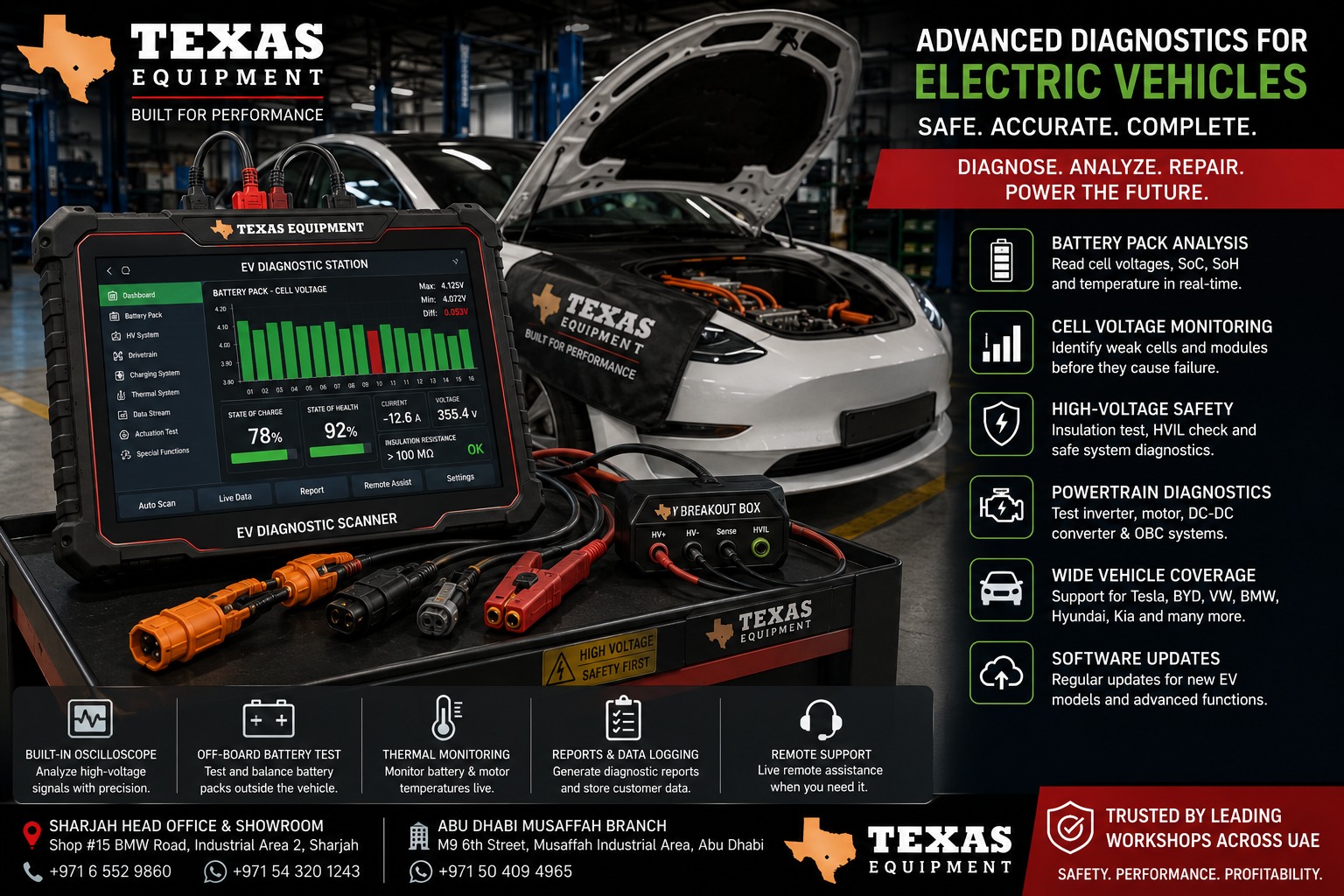
Investing in a specialized EV diagnostic scanner allows UAE workshops to analyze high-voltage battery pack health, pinpoint weak individual cells, and diagnose electric powertrain faults safely. Standard OBD2 scan tools only read basic 12-volt auxiliary codes and cannot communicate with isolated traction battery management systems (BMS), high-voltage junction boxes, or inverter drive circuits.
Written by: Rajesh Sharma, Technical Service Lead (Automotive Diagnostics)
Over 14 years supporting commercial diagnostic scanners, ECU coding interfaces, and workshop electrical systems across Sharjah Industrial Areas, Al Quoz, and Musaffah
Why High-Voltage EV Diagnostics Demand Dedicated Equipment
Electric vehicles from Tesla, BYD, Volkswagen, BMW, and commercial electric delivery fleets operate on high-voltage DC systems ranging from 400V to 800V. Under severe UAE summer conditions where road temperatures frequently cross 60°C, high-voltage battery packs experience thermal stress that accelerates cell degradation and cooling system faults.
Diagnosing an electric vehicle requires much more than clearing a simple check engine light. Technicians must be able to:
- Measure individual battery cell voltage variations down to the millivolt.
- Perform off-board battery pack health testing when a pack is removed from the chassis.
- Test High-Voltage Interlock Loops (HVIL) to ensure safety disconnects function properly.
- Measure insulation resistance between the high-voltage bus and vehicle ground.
Safety standards established by the International Electrotechnical Commission (IEC) mandate that diagnostic tools interfacing with live high-voltage traction circuits must feature certified insulation protection and dedicated high-voltage break-out leads to prevent technician shock and arc-flash hazards.
Comparing Generic OBD2 Scanners with Dedicated EV Diagnostic Scanners
Selecting the right EV diagnostic hardware determines whether your technicians can perform in-depth battery pack repairs or only read superficial trouble codes. Explore our active range of diagnostic equipment on the Texas Equipment machinery store.
| Diagnostic Capability | Standard Multi-Brand Scanner | Generic Code Reader | Texas Equipment Dedicated EV Diagnostic Station | Workshop Advantage |
| High-Voltage Battery BMS Access | Read-only general codes | Not supported | Full deep BMS parameter & cell access | Reads state-of-charge (SoC) and state-of-health (SoH) |
| Off-Board Battery Pack Testing | Not supported | Not supported | Direct off-board jumper cables & protocols | Tests battery packs on lift tables outside the car |
| Cell Voltage Deviation Analysis | Basic live data list | None | Dynamic graphical cell bar chart display | Identifies weak modules causing rapid range drops |
| High-Voltage Component Testing | Limited | None | Inverter, DC-DC converter, and OBC testing | Diagnoses onboard charger and motor phase faults |
| Safety Measurement Hardware | Standard probes | None | Integrated digital oscilloscope & multimeter | Measures isolation resistance and high-voltage signals |
| Average Investment | 9,500 to 16,000 AED | 1,200 to 3,000 AED | 19,000 to 34,000 AED | Opens high-ticket commercial EV fleet maintenance revenue |
5 Practical Steps to Run Safe EV Diagnostics in Your Bay
Step 1: Check Insulation Resistance Before Disassembly
Before opening any high-voltage control enclosure or unplugging orange cables, use the high-voltage insulation tester on your diagnostic station. Testing between the positive bus, negative bus, and the vehicle chassis confirms that no live current is leaking into the bodywork.
Step 2: Analyze Cell Voltage Uniformity and State of Health
Connect to the Battery Management System (BMS) and view the cell balancing graph. In a healthy traction pack, voltage differences across all cell blocks should remain within 10 to 20 millivolts. A cell showing a 50+ millivolt drop under load indicates internal resistance breakdown, requiring module replacement.
Step 3: Verify High-Voltage Interlock Loop (HVIL) Continuity
The HVIL is a low-voltage safety circuit running through every high-voltage connector. If a connector is loose or a manual service plug is removed, the HVIL opens and the vehicle disables main battery contactors. Use your scanner to monitor real-time HVIL circuit continuity when troubleshooting no-start conditions.
Step 4: Perform Off-Board Battery Diagnostic Routines
When rebuilding or replacing modules in a dropped battery pack, utilize off-board diagnostic connection cables. These specialized wiring adapters connect directly from your diagnostic station to the battery pack connector, allowing you to test module health on the bench before reinstalling the heavy pack into the car.
Step 5: Keep Vehicle Model Software Updated for Local GCC Imports
The UAE market contains a wide mix of GCC-spec electric cars, Chinese-market EVs (BYD, Zeekr), and North American imports. Maintain an active software update plan to access factory diagnostic algorithms, high-voltage wiring schematics, and service reset procedures for new electric vehicle models.
Frequently Asked Questions
Can I diagnose an electric vehicle using my existing petrol car scanner?
Standard OBD2 scanners only access low-voltage 12V modules such as body control and infotainment. They cannot access high-voltage battery management systems, test individual cell voltages, or perform high-voltage safety discharge procedures.
What is the difference between State of Charge (SoC) and State of Health (SoH)?
State of Charge (SoC) represents the current battery percentage remaining, similar to a fuel gauge. State of Health (SoH) measures the maximum usable capacity of the battery compared to when it was brand new.
How does an EV diagnostic scanner assist during battery replacement?
When replacing a high-voltage module or complete pack, an EV diagnostic scanner performs battery registration, cell balancing routines, and cooling circuit bleed cycles so the car’s BMS recognizes the replacement hardware.
Where can I get training and accessories for EV diagnostic scanners in Sharjah?
Texas Equipment provides full setup assistance, high-voltage safety training, and replacement breakout leads at our main showroom in Sharjah Industrial Area 2 and our Musaffah branch in Abu Dhabi.
Equip Your Workshop with Texas Equipment UAE
Position your repair shop as a leader in electric vehicle maintenance with certified EV diagnostic stations, high-voltage safety toolkits, battery lift tables, and insulation meters backed by local technical support across the UAE.
- Sharjah Head Office & Showroom: Shop #15 BMW Road, Industrial Area 2, Sharjah.
Landline: +971 6 552 9860 | WhatsApp / Mobile: +971 54 320 1243 - Abu Dhabi Musaffah Branch: M9 6th Street, Musaffah Industrial Area, Abu Dhabi.
WhatsApp / Mobile: +971 50 409 4965
Visit the Texas Equipment Contact Page to speak directly with an EV diagnostic specialist and book an on-site equipment demonstration.