
How to Change Stiff Run-Flat and 24-Inch SUV Tyres Without Scratching Alloy Rims
Written by Rajesh Sharma, Workshop Systems Lead | Reviewed by Technical Services Division, Texas Equipment UAE
Investing in a dedicated run-flat tyre changer is essential for UAE workshops handling modern SUV wheels. It means looking past basic turntable sizes and focusing on the mechanical tools that guarantee damage-free mounting.
Tyre service shops across Dubai, Sharjah, and Abu Dhabi deal with some of the most challenging wheel assemblies in the global automotive market. Between factory 22-inch wheels on Nissan Patrols and Land Cruisers, 23-inch low-profile setups on Range Rovers, and stiff run-flat rubber on German luxury sedans, mounting tyres is no longer a simple mechanical task.
If your technicians still wrestle with stiff sidewalls using basic swing-arm tyre changers and manual steel crowbars, your workshop is losing money. A single slip of a steel tyre lever against a diamond-cut, gloss-black, or forged alloy rim can cost between 600 and 1,500 AED in rim repair bills. If an internal tyre bead tears during mounting, your shop is forced to replace a 2,000 AED tyre out of pocket.
Most machinery listings from distributors in industrial areas offer little practical guidance. They print short catalogue blurbs stating that a machine clamps up to 24 inches, show a generic stock photo, and expect workshop owners to figure out the rest.
Finding the best tyre changer for run-flat tyres UAE workshops require means looking past basic turntable sizes and focusing on the mechanical tools that guarantee damage-free mounting: multi-point pneumatic assist arms, rigid tilt-back towers, and leverless tool heads.
Why Run-Flat and Low-Profile SUV Tyres Destroy Alloy Rims
A standard passenger car tyre has flexible, thin sidewalls that easily collapse into the center of the wheel during dismounting. Run-flat tyres (RFT) and ultra-low-profile performance tyres are engineered with entirely different physical characteristics:
- Reinforced Self-Supporting Sidewalls: Run-flat tyres use dense rubber inserts and extra fabric layers designed to hold up a 2.5-ton vehicle even when air pressure drops to zero. This makes the sidewall extraordinarily stiff. Flexing that rubber over a wheel rim requires hundreds of kilograms of continuous hydraulic or pneumatic force.
- The Danger of Steel Tyre Levers: On an entry-level machine, the technician must force a heavy steel pry bar between the tyre bead and the rim flange. Using the alloy rim edge as a leverage fulcrum applies massive point pressure. On modern painted or diamond-cut wheels, this metal-on-metal contact instantly cracks the protective clear coat, gouges the aluminium lip, or bends the outer bead seat.
- Bead Stress and Hidden Core Tears: If the tyre bead is forced over the mounting head while the opposite side sits outside the wheel drop-center channel, the internal steel bead wire stretches beyond its yield point. This causes hidden internal bead fractures. The tyre will either leak air along the rim lip immediately or experience a high-speed blowout on the highway.
The 3 Features That Guarantee Scratch-Free Tyre Mounting
To handle wide SUV tyres and stiff run-flat assemblies safely, a commercial tyre changer must incorporate three structural upgrades:
1. Multi-Point Pneumatic Helper Arms
To mount or dismount a stiff tyre without damage, the bead directly opposite the mounting tool must remain pushed down into the deepest groove of the wheel, known as the drop-center. If that opposite bead pops up, the tyre has zero slack and physically cannot clear the rim edge.
A basic machine requires two technicians using manual hand clamps and wooden blocks to hold the tyre down while a third operates the foot pedals.
A professional run-flat tyre machine features twin pneumatic assist arms with independent controls:
- Rotating Bead Pressing Roller: Follows the tyre as the turntable spins, keeping the bead pinned inside the drop-center.
- Traveling Bead-Depressor Block: Pushes down on the upper sidewall to relieve tension directly at the mounting point.
- Lower Bead Lifting Disc: Slides under the bottom of the tyre to push the lower bead upward without requiring technicians to lift heavy SUV assemblies manually.
2. Leverless and Touchless Demount Heads
Traditional demount heads require inserting a steel tyre bar. Modern commercial tyre changers utilize automated finger hooks or integrated claw tools that slide smoothly between the rubber bead and the wheel lip:
- The claw hooks the tyre bead from the inside and lifts it over the rim flange with the touch of a pneumatic switch.
- The tool never uses the rim face as a leverage point.
- High-density polymer sleeves protect all contact surfaces, preventing metal-to-metal contact with painted or diamond-cut alloy wheels.
3. Rigid Pneumatic Tilt-Back Columns
When breaking the bead or mounting a stiff 35 kg tyre assembly, small swing-arm machines flex. That structural flex causes the steel mounting head to shift downward and dig into the face of the customer’s wheel.
A commercial tyre changer uses a heavy, reinforced box-section tower that tilts back pneumatically at the press of a foot pedal. When locked in the forward working position, high-pressure pneumatic clamps hold the column rigid, maintaining a precise 2 mm safety gap between the tool head and the rim edge throughout the entire rotation.
Choosing the Right Run-Flat Tyre Changer for Gulf Garages
| Feature & Capability | Entry-Level Swing-Arm Changer | Heavy-Duty Run-Flat Changer (Texas Equipment) |
| External Rim Clamping Range | 10 to 20 inches | 10 to 24 inches (expandable to 26 inches) |
| Assist Arm Configuration | None (Manual operation) | Dual multi-function pneumatic helper arms |
| Demounting Mechanism | Manual steel crowbar required | Leverless automatic finger tool with polymer guards |
| Column Construction | Manual swing-arm (Prone to flexing) | Pneumatic tilt-back box tower (Zero deflection) |
| Bead Breaker Cylinder Force | 1,800 to 2,200 kg | 2,800 to 3,200 kg with double-acting cylinder |
| Turntable Rotation Speed | Single speed (6.5 to 7 RPM) | Dual speed (7 to 14 RPM) for faster bay turnover |
| Alloy Wheel Protection | High risk of lever scratches | 100% scratch-free with full polymer contact kits |
| Target Wheel Compatibility | Standard steel and passenger tyres | Run-flat, low-profile, forged alloy, and off-road 4×4 |
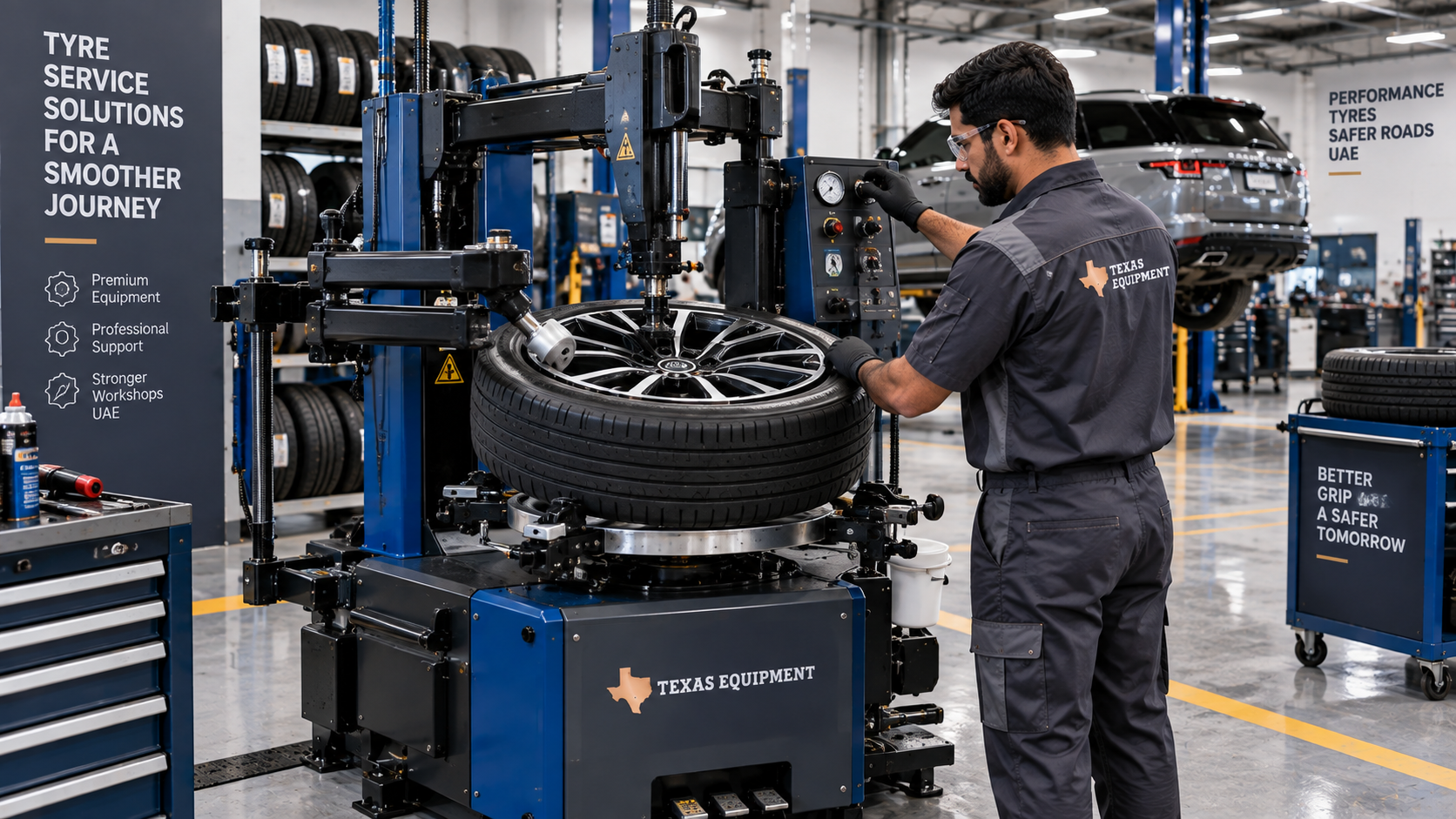
4-Step Standard Operating Procedure for Stiff Tyre Mounting
Train your workshop technicians to follow these four steps to eliminate rim damage and customer claims:
Step 1: Lubricate Both Beads and the Wheel Drop-Center
Never mount a dry run-flat tyre. Apply water-based tyre mounting paste generously to the upper bead, the lower bead, and the interior drop-center of the alloy wheel. Proper lubrication allows the stiff rubber to slip smoothly into the center groove without binding or tearing.
Step 2: Break Beads at Multiple Clock Positions
Position the bead-breaker blade against the tyre sidewall, keeping the blade edge approximately 10 mm away from the aluminium rim lip. For large SUV wheels, do not attempt to pop the bead in a single stroke. Break the bead gently, rotate the wheel 90 degrees, and press again. This gradual approach prevents bending the wheel barrel or damaging tyre pressure monitoring system (TPMS) sensors mounted inside.
Step 3: Use the Pneumatic Roller to Lock the Drop-Center
When mounting the upper bead, lock your pneumatic helper arm roller directly behind the mounting tool. As the turntable rotates, the roller follows the tyre, holding the stiff sidewall deep inside the wheel drop-center. This releases tension on the opposite bead, allowing the tyre to slide over the rim lip without heavy force.
Step 4: Seat Beads Using High-Volume Blast Jets
Stiff run-flat tyres often sit loose on wide alloy wheels, allowing compressor air to escape around the rim edges during inflation. Use the built-in blast jets on the turntable clamping jaws. Depressing the inflation pedal sends a high-pressure burst of air directly between the tyre and rim, snapping the beads into position instantly.
Frequently Asked Questions
What turntable clamping size is needed for UAE workshops?
Workshops in the UAE should invest in a machine with at least 24-inch external clamping capability. Popular local vehicles like the Nissan Patrol, Toyota Land Cruiser, Cadillac Escalade, and high-trim German SUVs come standard with 20-inch to 24-inch wheel options.
Can I install helper arms onto my existing basic tyre changer?
While some manufacturers offer bolt-on aftermarket helper arms, adding them to an entry-level machine often causes issues. If the main tower and turntable chassis are lightweight, the added mechanical force can twist the frame, causing the mounting head to scrape against the wheel.
How do touchless tyre changers protect internal TPMS sensors?
Modern tyre machines position the demount tool and bead-breaking rollers away from the valve stem location. By locking the wheel with the TPMS sensor at the recommended clock position (usually 10 to 15 cm after the mounting head), technicians dismount the tyre without the bead pressing against the fragile sensor body.
What compressed air supply is required for a commercial tyre changer?
Commercial tyre machines with dual pneumatic helper arms require clean, dry compressed air regulated between 8 and 10 Bar (115 to 145 PSI), with an air delivery volume of at least 6 to 8 CFM to operate cylinders at full clamping strength.
Equip Your Workshop with Texas Equipment UAE
Protect high-value customer wheels, reduce technician fatigue, and increase your tyre bay turnover with commercial tyre shop machinery engineered for Gulf vehicle fitments. Texas Equipment supplies heavy-duty tilt-back tyre changers, leverless mounting stations, 3D computerized wheel balancers, and wheel alignment systems across Dubai, Sharjah, and Abu Dhabi.
Visit our regional showrooms to test live tyre-changing demonstration stations:
- Sharjah Showroom & Technical Centre: Shop #15, BMW Road, Industrial Area 2, Sharjah.
Landline: +971 6 552 9860 | WhatsApp: +971 54 320 1243 - Abu Dhabi Musaffah Branch: M9, 6th Street, Musaffah Industrial Area, Abu Dhabi.
Mobile: +971 50 409 4965
Contact our workshop engineering team today to review your tyre bay machinery requirements or request an on-site equipment demonstration.