
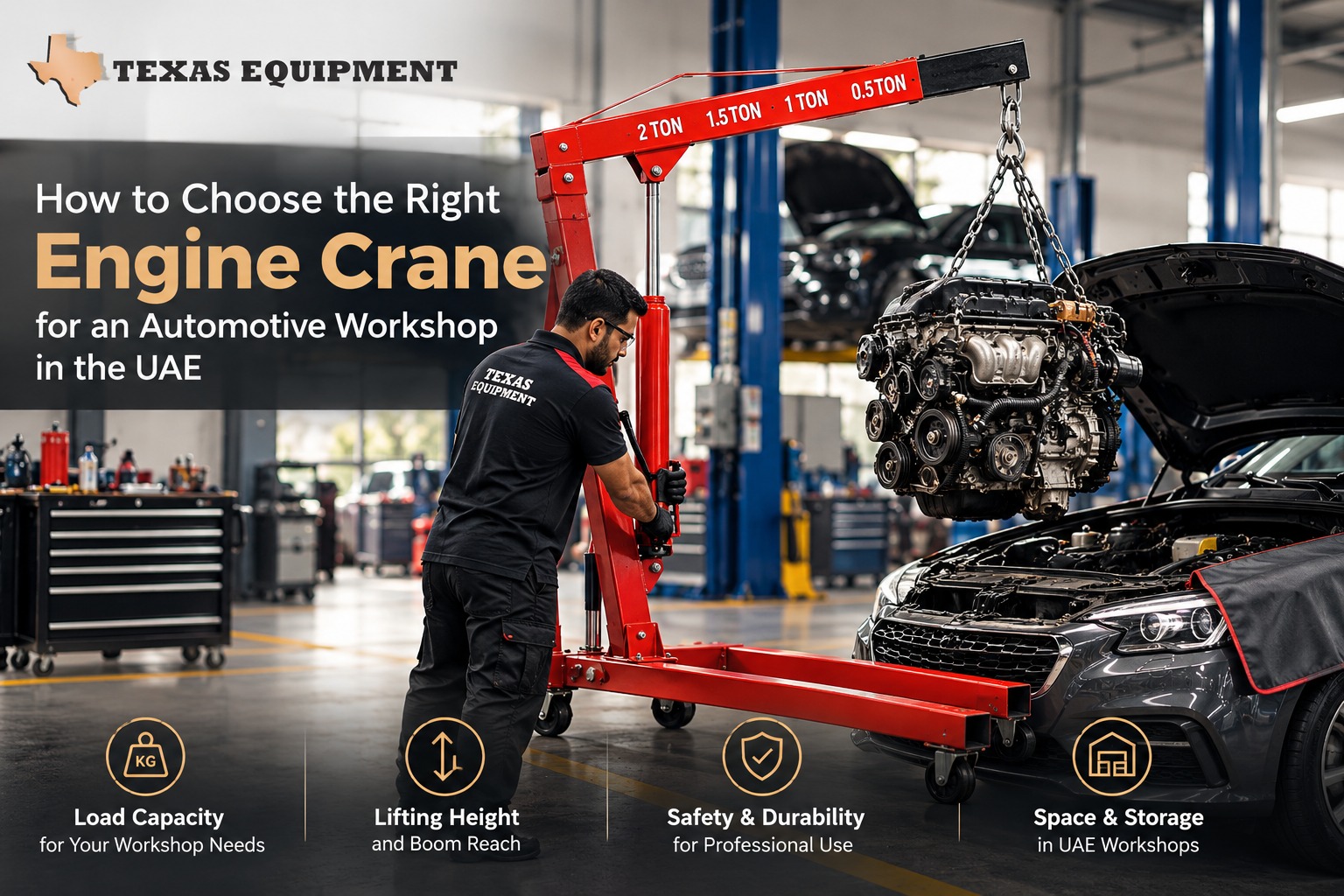
Engine Crane Selection: A Practical Guide for UAE Workshops
An engine crane is an essential lifting solution for automotive workshops that regularly remove, install or position engines and other heavy components. Choosing the right model, however, requires more than checking the maximum capacity printed on the product.
The crane must suit the loads being handled, required lifting height, boom reach, available floor space and the workshop’s daily workflow. This guide explains what automotive workshops in Dubai, Sharjah, Abu Dhabi and across the UAE should evaluate before purchasing an engine crane.
What Is an Engine Crane?
An engine crane, also known as an engine hoist, is a mobile lifting device used to raise and position engines and other suitable heavy automotive components. Unlike a vehicle lift, which raises a vehicle, an engine crane is designed to handle a component during removal, installation or repair.
Common applications include engine removal, engine replacement and positioning heavy components during mechanical repair. The equipment must always be used within its manufacturer’s rated capacity and operating instructions.
1. Choose the Correct Lifting Capacity
Capacity is one of the first specifications to evaluate. Start by identifying the vehicles and components your workshop typically handles, including passenger cars, SUVs and light commercial vehicles.
Do not assume that an engine crane can lift its maximum advertised load in every boom position. On many models, the permitted capacity changes as the boom extends. Always consult the manufacturer’s load chart for the intended configuration.
The right approach is to identify the heaviest intended application and select a crane with an appropriate rated capacity. Choosing equipment solely because it has a higher headline capacity may increase cost and take up more space without improving suitability for your workshop.
2. Check Boom Reach and Lifting Height
A crane can have sufficient capacity but still be unsuitable if it cannot reach the required position. Check the minimum and maximum lifting height, horizontal reach and available boom positions before making a decision.
Consider the complete engine-removal process. The crane must be positioned correctly over the engine bay, lift the component to the necessary height and allow it to be moved clear of the vehicle.
Workshop columns, walls, doors and neighbouring equipment can restrict movement. Measure the service bay and access routes before purchasing so that the crane can be positioned and operated comfortably.
3. Evaluate Mobility and Workshop Space
Engine cranes are often moved between service bays and vehicles. Their footprint, caster arrangement, turning space and compatibility with the workshop floor therefore matter.
Before choosing a model, check:
- The available space around the vehicle being serviced.
- The route between the storage area and the service bay.
- The clearance required to position the crane over the engine bay.
- The turning space needed to move the crane safely.
- The storage space available when the equipment is not in use.
A crane that fits beside a vehicle but cannot be manoeuvred into the correct lifting position may interrupt the workshop’s workflow.
4. Assess Construction, Stability and Maintenance
Review the crane’s frame, base configuration, boom construction, hydraulic system and adjustment mechanisms. The complete specification and serviceability are more important than the finish or appearance alone.
Inspect the equipment according to the manufacturer’s instructions. Hydraulic leaks, structural damage, damaged wheels or malfunctioning mechanisms should be addressed before the crane is returned to service.
Also consider the availability of technical support, replacement parts and maintenance assistance. These factors can affect the equipment’s long-term usefulness in a professional workshop.
Engine Crane vs Engine Stand: What Is the Difference?
An engine crane and an engine stand serve different purposes. A crane lifts and positions an engine, while a stand supports a removed engine during suitable inspection, repair or rebuilding work.
Workshops that regularly perform engine replacement or rebuilding may benefit from having both types of equipment. Explore the engine crane, stand and holder range from Texas Equipment to review relevant workshop equipment options.
Common Engine Crane Buying Mistakes
Choosing by capacity alone
A higher capacity does not automatically make a crane the best choice. Reach, lifting height, footprint and the intended application also matter.
Ignoring the boom-position load rating
Check the manufacturer’s load chart for the exact boom configuration you expect to use.
Forgetting storage and access
Measure the working bay, doorways, turning areas and storage location before selecting the equipment.
Overlooking inspection and maintenance
Hydraulic and mechanical lifting equipment requires inspection and maintenance in line with the manufacturer’s instructions.
Engine Crane Selection Checklist
| Requirement | What to Check |
|---|---|
| Lifting capacity | Heaviest intended load and rated capacity for the required boom position. |
| Boom reach | Permitted boom configurations and horizontal reach. |
| Lifting height | Required height for engine removal and installation. |
| Mobility | Caster arrangement, floor condition and turning space. |
| Footprint | Available service-bay and storage space. |
| Construction | Frame, boom, hydraulic system and adjustment mechanisms. |
| Maintenance | Inspection requirements, serviceability and parts support. |
| Application | Types of engines and other components the crane is intended to handle. |
UAE Workshop Considerations: Equipment and Maintenance
UAE legislation includes a framework for conformity requirements applicable to vehicle repair workshops and service centres. The framework addresses the suitability of equipment for the services provided and includes provisions concerning preventive maintenance and the calibration of relevant measuring instruments.
This should not be interpreted as prescribing one specific engine crane capacity or model for every workshop. Instead, workshops should select equipment appropriate to their services and follow the manufacturer’s operating, inspection and maintenance instructions.
Read the official UAE legislation on vehicle repair workshop and service-centre requirements for the applicable regulatory context.
Frequently Asked Questions
What capacity engine crane should a workshop buy?
Choose capacity according to the heaviest intended load and the manufacturer’s rated capacity for the required boom position. Do not select equipment based only on its maximum advertised rating.
Can an engine crane lift components other than engines?
Some cranes can handle other suitable components, but only when the load, lifting method and attachments are permitted by the manufacturer’s instructions and capacity ratings.
Is an engine crane the same as an engine stand?
No. An engine crane lifts and positions the engine. An engine stand supports a removed engine for suitable workshop tasks.
What should I measure before buying an engine crane?
Measure the service bay, doorways, storage area and turning space. Also establish the required boom reach, lifting height and typical loads.
Does a higher-capacity engine crane always make a better purchase?
No. The best fit depends on the intended load, permitted boom positions, working dimensions, mobility and available storage space.
Final Considerations
The right engine crane is determined by your workshop’s workload, not capacity alone. Before purchasing, evaluate the intended loads, boom reach, lifting height, workshop clearance, mobility, construction and maintenance requirements.
Texas Equipment offers workshop equipment options for automotive service businesses across the UAE. Explore the engine crane and engine stand category to review relevant products and compare them with your workshop’s requirements.