
Transmission Jack or Floor Jack? Compare Their Workshop Applications
A floor jack and a transmission jack both use hydraulic lifting mechanisms, but they are designed for different workshop tasks. A floor jack is primarily used to raise a vehicle, while a transmission jack is designed to support, lower and position a transmission during removal or installation.
For automotive workshops in Dubai, Sharjah, Abu Dhabi and across the UAE, the right choice depends on the services performed, the loads being handled and the level of positioning control required. Understanding these differences helps workshops select equipment that matches their actual workload.
At a Glance: Transmission Jack vs Floor Jack
| Comparison | Floor Jack | Transmission Jack |
|---|---|---|
| Primary purpose | General vehicle lifting | Transmission support and positioning |
| Typical applications | Tyre, brake and suspension service | Transmission removal and installation |
| Contact surface | General lifting saddle | Dedicated tray or support platform, depending on model |
| Positioning requirements | Vehicle lifting from an approved lifting point | Controlled positioning of a drivetrain component |
| Important specifications | Capacity, minimum height, maximum height and saddle design | Capacity, lifting range, tray adjustment and base dimensions |
| Best suited to | Routine vehicle service | Workshops performing transmission-related repairs |
Which Jack Does Your Workshop Need?
Start with the work your technicians perform most frequently. The following decision guide can help identify which equipment is relevant to your workshop.
Choose a floor jack for general vehicle service
A floor jack is a practical option when technicians need to raise an appropriate portion of a vehicle for routine service work. Common applications include tyre changes, brake repairs, suspension work and under-vehicle inspections.
Before selecting one, check the vehicle’s approved lifting points, the jack’s rated capacity, minimum height, maximum height and clearance beneath the vehicle. Low-profile models may be useful where ground clearance is limited, provided the equipment is suitable for the application.
Explore the Texas Equipment trolley jack and stand category to review available vehicle-lifting options.
Choose a transmission jack for drivetrain work
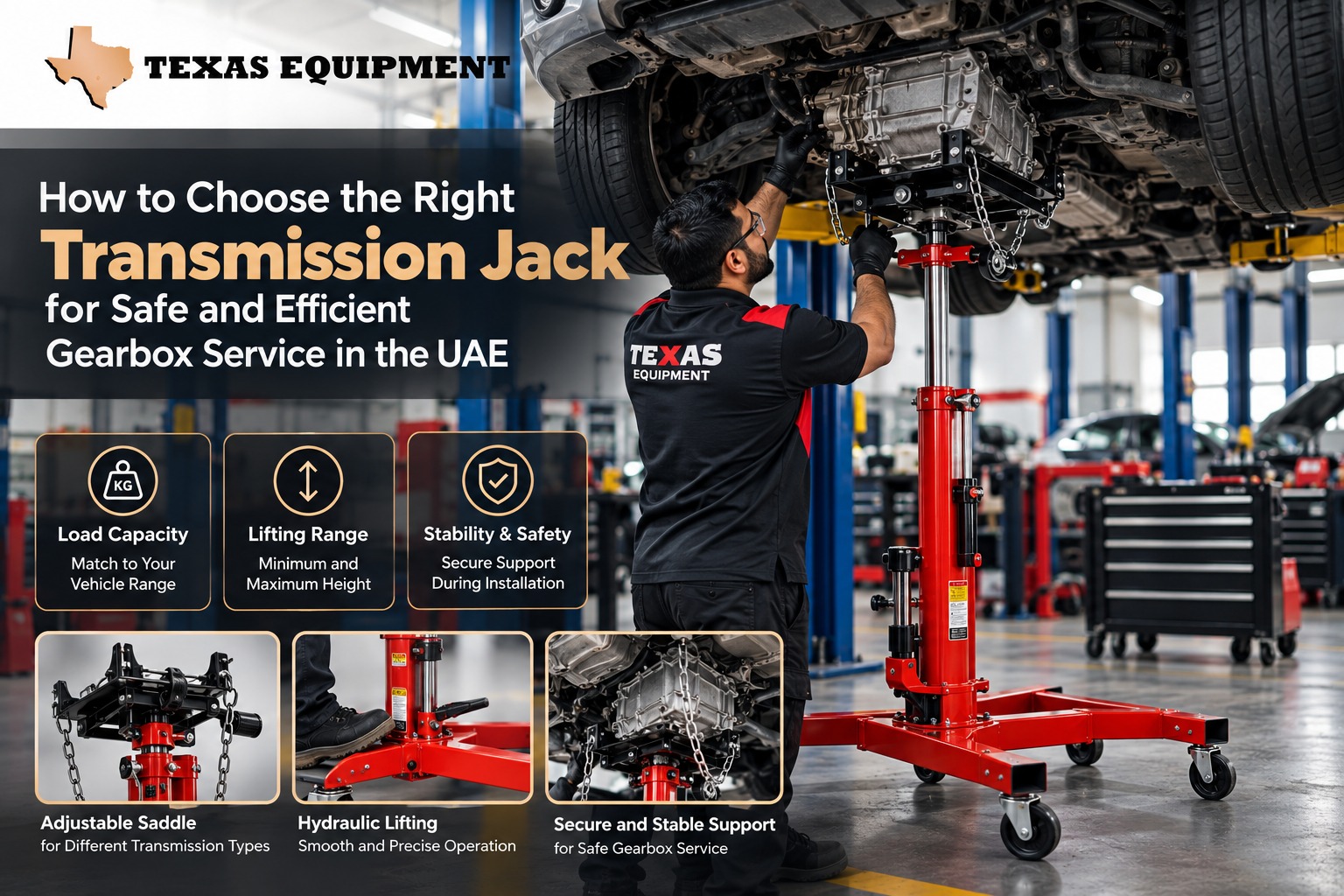
A dedicated transmission jack is designed to support and position a transmission during removal and installation. Its support tray or platform is intended for component handling rather than general vehicle lifting.
When selecting one, consider the transmission’s weight and shape, the required working height, tray dimensions, adjustment range, base footprint and the manufacturer’s rated capacity. The jack must also fit the available space beneath the raised vehicle.
Review the Texas Equipment transmission jack range to compare dedicated options for transmission-service work.
Why a Floor Jack Is Not a Direct Substitute for a Transmission Jack
A transmission is not simply a load that needs to be lifted vertically. Its shape, mounting points and centre of gravity can make controlled support and alignment important during removal and installation.
A general floor jack normally has a lifting saddle intended for vehicle lifting points. A transmission jack typically uses a platform or tray designed to support the component and, on suitable models, allow adjustment for positioning.
Using a tool outside its intended application can introduce avoidable handling risks. Follow the vehicle manufacturer’s service procedure and the lifting equipment manufacturer’s instructions. Select equipment specifically suited to the load and task.
Specifications to Compare Before Buying
Capacity is important, but it should not be the only deciding factor. The required lifting range, working clearance and support configuration can determine whether a jack is practical for a particular job.
For a floor jack
- Rated capacity: Confirm that the jack is suitable for the intended lifting task.
- Minimum height: Check whether it can fit beneath the vehicle at the designated lifting point.
- Maximum height: Confirm that it can reach the required working height.
- Saddle design: Ensure the contact surface is appropriate for the vehicle’s approved lifting point.
- Mobility: Consider the floor surface, caster arrangement and access around the vehicle.
For a transmission jack
- Rated capacity: Check the intended transmission load against the manufacturer’s rating.
- Lifting range: Confirm that the minimum and maximum heights suit the service procedure.
- Tray dimensions: Evaluate whether the support platform suits the component being handled.
- Adjustment: Check the available tray-tilt and positioning adjustments, if provided.
- Base footprint: Ensure the jack can fit and manoeuvre beneath the vehicle lift.
- Component restraint: Check the manufacturer’s instructions for any required securing mechanism.
Example: Matching Equipment to the Workshop Task
Consider a workshop that handles routine tyre changes and brake servicing alongside occasional transmission replacement. Its equipment requirements are different for each activity.
- Tyre and brake service: A suitable floor jack may be required to raise the vehicle at an approved lifting point.
- Transmission removal: A dedicated transmission jack is designed for supporting and positioning the transmission during the relevant procedure.
- Frequent work in both areas: The workshop may need both tools because they perform different functions.
The final selection should be based on the workshop’s actual workload, vehicle types, service procedures and equipment specifications. Not every workshop needs both types of jack.
Lifting Equipment Safety: Important Distinctions
A jack’s rated capacity must not be exceeded, and the equipment must be used according to its operating instructions. Inspect the jack before use and remove defective equipment from service until it has been assessed and repaired appropriately.
Raising a vehicle is not the same as securely supporting it for work underneath. Use suitable vehicle support equipment and follow the vehicle manufacturer’s approved lifting and support procedure. For transmission work, make sure the component is appropriately supported and secured throughout the operation.
The US Occupational Safety and Health Administration’s guidance on jacks covers rated capacity, operation, inspection and maintenance. This is a US safety reference, not UAE legislation; workshops should also follow applicable local requirements and manufacturer instructions.
Common Equipment Selection Mistakes
Comparing only the capacity rating
Two jacks with similar capacity ratings may differ in minimum height, maximum height, support surface and suitability for the intended task.
Ignoring clearance
A floor jack must fit beneath the intended vehicle, while a transmission jack must fit into the working area beneath the raised vehicle and reach the required component position.
Using general lifting equipment for specialised work
Do not assume that a floor jack is an appropriate substitute for a transmission jack. Match the support design and operating method to the task.
Overlooking inspection and serviceability
Hydraulic leaks, damaged wheels, worn components or other defects should be addressed before the equipment is used again. Follow the manufacturer’s maintenance schedule.
Frequently Asked Questions
Can I use a floor jack to remove a transmission?
A floor jack is not a direct substitute for a dedicated transmission jack. Use equipment and a procedure appropriate for supporting and positioning the transmission safely.
What is the main purpose of a transmission jack?
It is designed to support, raise, lower and position a transmission during removal and installation, subject to the model’s rated capacity and instructions.
What should I check when buying a transmission jack?
Check rated capacity, minimum and maximum lifting height, tray dimensions, adjustment range, base footprint, mobility and the manufacturer’s operating instructions.
Is a low-profile floor jack always the better option?
No. A low-profile jack can help where vehicle clearance is limited, but capacity, lifting range and suitability for the vehicle remain essential considerations.
Does every automotive workshop need both types of jack?
No. A workshop that performs general vehicle servicing may primarily need a suitable floor jack. One that regularly removes and installs transmissions may also need a dedicated transmission jack.
Conclusion: Select the Jack for the Job
A floor jack and a transmission jack are designed for different workshop requirements. A floor jack supports general vehicle-lifting tasks, while a transmission jack is intended for handling and positioning transmissions during drivetrain repairs.
Before purchasing, compare the intended application, rated capacity, lifting range, support configuration, available clearance and maintenance requirements. Texas Equipment supplies workshop lifting equipment for automotive businesses in the UAE. Explore the transmission jack range and trolley jack and stand category to review options for your workshop.