
How to Choose a Grease Pump for a Professional Workshop
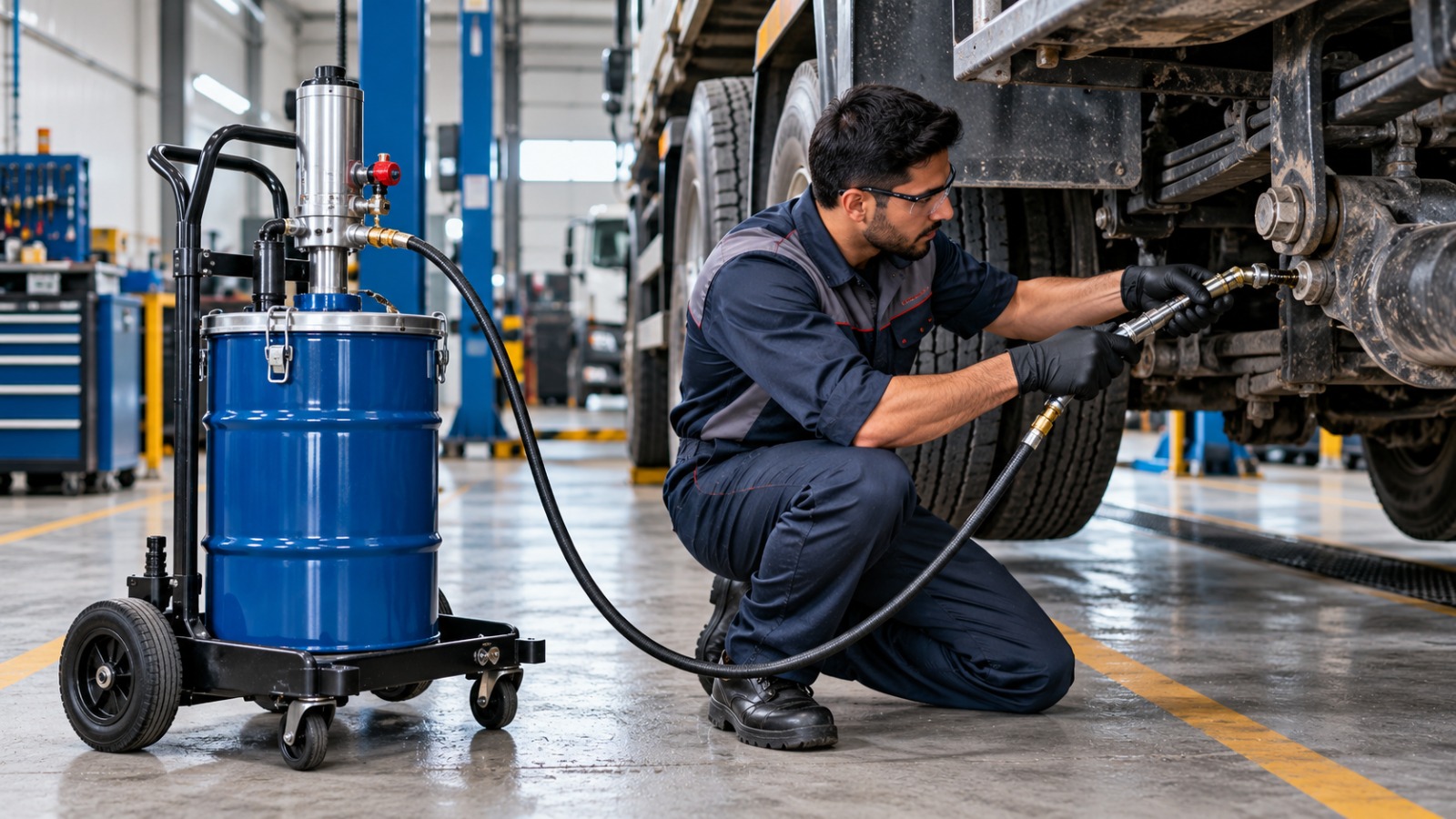
Workshop Lubrication Equipment
How to Choose a Grease Pump for a Professional Workshop
Match your grease pump to the lubricant, container size, delivery requirements and daily workload to support consistent lubrication without unnecessary handling or downtime.
A grease pump may look like a small purchase, but the wrong setup can turn a routine lubrication job into a messy, slow task. A technician may have to keep refilling a small container, struggle with incompatible fittings or discover that the pump does not handle the grease being used. The right choice starts with the lubrication work your team performs every week, not just the pump’s advertised pressure.
Count the lubrication points you service, identify the grease grade and container size, and estimate how often the team needs to dispense it. For occasional jobs, a manual grease gun may be enough. For frequent servicing across several bays or vehicles, a pump with a suitable hose and dispensing arrangement may reduce handling time. Confirm compatibility with the lubricant and fittings before choosing a model.
Quick Selection Guide
Occasional lubrication: compare a manual grease gun or compact dispenser.
Frequent workshop use: assess grease demand, hose reach, container capacity and refill frequency.
Multiple service bays or large drums: evaluate a suitable mobile grease pump system and verify the required air supply where applicable.
1. Start With the Lubrication Job
List the equipment that will be lubricated, the type of grease specified by its manufacturer, the number of lubrication points and how frequently each point is serviced. Heavy vehicle workshops, fleet maintenance bays and industrial service teams may have very different needs from a small garage.
The workload helps determine whether a hand-operated tool is practical or whether a pump system can reduce repetitive handling. Before comparing models, document:
- The vehicles, machines or components that require lubrication.
- The grease grade and quantity specified by the component manufacturer.
- The number of lubrication points and service frequency.
- The number of technicians and service bays sharing the equipment.
- Whether lubrication happens at one fixed position or across multiple bays.
2. Match the Pump to the Grease and Container
Grease Type and Consistency
Grease consistency matters. Match the pump to the lubricant grade, container and dispensing method used in your workshop. Storage conditions and operating temperature can also affect how easily grease flows. If the lubricant is unusually viscous or the working conditions fall outside the model’s documented range, request written confirmation of compatibility.
Container Size and Replenishment
A small container can be convenient for occasional jobs, while a large drum may suit a workshop that uses grease frequently. A mobile system can reduce repeated manual transfers, but it also needs suitable storage, movement space, drum compatibility and a safe container-changing procedure.
Texas Equipment’s grease pump category includes manual grease guns, dispensers, mobile grease pumps and equipment intended for larger drums. Check the specific model’s container compatibility rather than assuming every pump supports every container format.
View Texas Equipment Grease Pump Range
3. Understand the Main Grease Pump Formats
Different pump formats suit different workloads. Use the following comparison as a starting point, then verify the specifications and intended applications of the exact model.
| Pump Format | Potential Fit | What to Check |
|---|---|---|
| Manual grease gun | Low-volume or occasional lubrication at accessible points | Required pressure, cartridge or container type, fitting compatibility and operator effort |
| Small grease pump or dispenser | Regular workshop use with moderate lubricant demand | Grease compatibility, output, refill method, hose length and service parts |
| Pneumatic grease pump | Repeated use where a suitable compressed-air supply is available | Required air pressure and consumption, pump ratio, delivery characteristics and duty limits |
| Mobile drum system | Higher-volume lubrication across several service positions | Drum size, trolley stability, movement route, hose reel, connections and storage |
4. Understand Pressure Ratio and Actual Delivery
A pump’s pressure ratio is one element of its design. It should not be interpreted as the exact pressure or volume that will be delivered in every installation. Actual performance depends on supply pressure, lubricant characteristics, line losses, hose length, fittings, nozzle and the pump’s rated operating range.
Before choosing a pneumatic model, confirm that the workshop compressor and distribution system can supply the required air without undermining other tools. This matters when several pneumatic tools operate at the same time. A pump may appear suitable on paper but perform poorly if its air supply is inadequate or inconsistent.
Use These If-Then Selection Rules
- If lubrication is occasional and points are easy to reach, compare a manual grease gun with a small dispenser before investing in a mobile pump.
- If technicians service many vehicles per shift, estimate total grease demand, refill frequency and the time spent moving between points.
- If the workshop uses large drums, verify drum capacity, follower plate or suction arrangement where applicable, and the method of changing drums.
- If the pump is pneumatic, compare its required air pressure and consumption with the compressor’s usable delivery at operating pressure, not only its motor horsepower.
- If the lubricant is unusually viscous or the line is long, obtain written confirmation that the selected pump, hose and fittings suit that combination.
- If the unit will move between bays, check wheel stability, handle ergonomics, hose storage and the floor route.
5. Check Hose Length, Fittings and Access
The delivery hose must reach lubrication points without creating trip hazards or forcing the technician to stretch around equipment. Consider the number of bays, vehicle size, wall-mounted service points and the route the hose will take.
A hose reel may improve organisation, but it must be matched to the hose and pump arrangement. Confirm the fittings used on the vehicles or machinery being serviced.
Where access is restricted, the coupler and nozzle can matter as much as the pump. A technically powerful system is not useful if the technician cannot connect it securely or control grease delivery at the fitting. Use compatible accessories and follow the equipment manufacturer’s procedures.
6. Keep Contamination Out of the Lubrication System
Grease contamination can damage the component being lubricated. Keep containers closed, clean the drum or cartridge opening before fitting the pump, protect couplers from dirt and do not leave the hose end resting on the floor.
- Label different grease grades clearly when the workshop uses more than one formulation.
- Avoid transferring grease between containers unless the procedure and container cleanliness are suitable.
- Keep couplers clean and protect hose ends when the equipment is not in use.
- Follow the product safety information for handling and clean-up.
- Dispose of contaminated materials according to the applicable site procedure.
Use only the cleaning agents and maintenance methods recommended by the pump manufacturer. Do not dismantle a pressurised unit. Isolate the air or power supply and release stored pressure according to the manual before servicing. If the pump behaves irregularly, leaks or fails to prime, stop and diagnose the cause rather than increasing supply pressure without guidance.
7. Calculate Practical Consumption and Refill Frequency
Estimate the grease used in a normal day or week from the service schedule and the equipment manufacturer’s lubrication instructions. Do not estimate usage from the number of fittings alone; the correct quantity depends on the component and its service procedure.
Where possible, record actual container use over a representative period and separate routine work from unusual repairs. Refill frequency influences productivity, but a larger container is not automatically better.
Consider whether the drum can reach the service area, whether the trolley can move through the bay and whether the hose can be stored without dragging across dirty surfaces. The container should suit both the grease demand and the practical layout of the workshop.
8. Check Air Supply and Line Losses for Pneumatic Pumps
For a pneumatic pump, confirm the required inlet air pressure and consumption in the model documentation. Compare these requirements with usable compressor delivery at operating pressure and account for other tools running at the same time.
A pressure ratio does not, by itself, tell the buyer the complete delivered output under every condition. Ask the supplier for the model’s rated operating range and any restrictions on hose length or lubricant viscosity.
Inspect the air connection, regulator, hose and couplers as part of installation. If the pump cycles irregularly or output falls, investigate the air supply and lubricant path rather than increasing pressure beyond the specified range. Establish a written isolation and depressurisation procedure before cleaning or servicing the pump.
9. Control Dispensing and Protect the Work Area
Grease should be applied according to the component manufacturer’s procedure. Too little can leave a component inadequately lubricated; excess grease can create mess or interfere with some assemblies. The correct amount is application-specific.
- Use a compatible coupler and verify that the fitting is engaged correctly.
- Do not use a pump to force grease into a blocked component without diagnosis.
- Store couplers cleanly and keep drum openings covered.
- Identify containers and tools when different grease types are used.
- Follow the product safety information for handling and clean-up.
10. Compare Ownership Cost, Not Just Purchase Price
The purchase price is only one part of the cost of a grease pump system. Include the pump, trolley, hose reel, couplers, air treatment where needed, replacement seals, maintenance labour and potential downtime.
Ask whether consumables and service parts are available and which maintenance tasks the operator can perform. If the system is used frequently, ease of cleaning and service access may matter more than a small difference in initial price.
Before approving the purchase, ask the supplier to confirm the exact model, compatible container, supported grease, included accessories, operating limits and warranty terms. Record any exclusions in the quotation. This helps prevent a situation where the pump arrives but the required hose, reel or fitting must be sourced separately.
11. Prevent Downtime With an Operating Checklist
Before Use
- Inspect the hose, coupler, connections and container condition.
- Confirm the correct grease is installed.
- Check the setup against the equipment instructions.
- Verify that the operator understands the start, stop and depressurisation procedures.
During and After Use
- Watch for abnormal noise, leaks, loss of prime or inconsistent delivery.
- Stop the system if an unsafe condition occurs rather than increasing supply pressure.
- Store the hose and coupler so they remain clean.
- Close containers and note any abnormal behaviour.
- Follow the manufacturer’s service schedule for seals, filters and wear parts.
A simple maintenance record can help identify recurring issues, plan spare parts and reduce avoidable interruptions.
12. Plan a Trial With the Actual Lubricant
When a pump is intended for a specific fleet or production line, test the proposed arrangement with the actual lubricant and container format before standardising it. Confirm priming, delivery consistency, coupler access and hose reach under normal working conditions.
Record any limitations and obtain supplier confirmation if the grease grade or operating temperature falls outside the published examples. A short, controlled trial can reveal practical issues that a headline pressure ratio or catalogue photograph will not show.
13. Questions to Send With a Quotation Request
Use this checklist when requesting a grease pump quotation from an equipment supplier:
- Which grease grades and container formats are supported?
- What air supply, pressure and consumption are required for pneumatic models?
- What output or delivery data is documented for the selected pump?
- Which hose, reel, coupler and trolley accessories are included?
- Which seals and service parts are replaceable, and are they available locally?
- What operating limits, maintenance steps and safety instructions apply?
Ask the supplier to identify the exact model and provide the manual and written operating limits. If the pump is intended for a particular grease or vehicle fleet, state that use in the enquiry and request written confirmation of compatibility.
14. Keep Lubrication Traceable
For fleet or industrial maintenance, connect the dispensing process to the equipment’s lubrication schedule. Record the grease grade, service date and any abnormal condition. A simple job card can help identify missed service points, incorrect grease selection and recurring fitting problems.
Before the first use, verify that the pump is assembled correctly, the lubricant is the specified grade, the delivery path is clean and the operator understands how to start, stop and depressurise the unit. Check for leaks under the prescribed safe procedure before beginning routine work. If any connection, pressure rating or lubricant compatibility is uncertain, consult the manual and obtain confirmation from the supplier before operating.
Frequently Asked Questions
Is a higher pressure ratio grease pump always better?
No. The pump must suit the grease, application, air supply, line layout and required delivery. An unnecessarily high ratio does not automatically improve the result.
Can one grease pump handle every grease type?
Not always. The right choice depends on the grease grade, delivery rate and the pump’s stated compatibility. Match these before selecting the unit.
Should I buy a mobile grease pump for a small workshop?
Only if the workload justifies the container size and movement requirements. For occasional lubrication, a simpler tool may be more practical.
What causes poor grease delivery?
Possible causes include an unsuitable lubricant, blocked or incompatible fittings, air supply problems, leaks, contamination or maintenance issues. Follow the model-specific troubleshooting guide.
What should workshops in Dubai, Sharjah or Abu Dhabi consider when choosing a grease pump?
Consider where the pump will be stored and used during the working day. A mobile unit may suit work spread across several bays, while a fixed setup can be more convenient when lubrication tasks happen in one service area. Also verify lubricant compatibility, container size, hose reach and the required utilities.
Choose a Grease Pump for Your Workshop’s Actual Needs
Choose a grease pump around the lubricant, required delivery, container format and reach needed across your workshop. Confirm the air supply for pneumatic models, compatible hoses and couplers, and a practical way to keep grease clean. Comparing these details together helps you select a setup that supports repeatable lubrication without adding unnecessary complexity.
Browse Grease Pumps View Mobile Grease Pump
Get Equipment Guidance from Texas Equipment UAE
Sharjah Showroom: Shop #15 BMW Road, Industrial Area 2, Sharjah
Phone: +971 6 552 9860 | WhatsApp: +971 54 320 1243
Abu Dhabi Musaffah Branch: M9, 6th Street, Musaffah Industrial Area, Abu Dhabi | WhatsApp: +971 50 409 4965