
Brake Lathe vs Brake Disc Replacement: What Should a Workshop Check First?
When a customer reports brake vibration, noise or uneven braking, a workshop must determine whether the brake disc can be safely resurfaced or needs replacement. A brake lathe in the UAE can help workshops machine eligible brake discs, but the decision must always begin with inspection and vehicle manufacturer specifications.
Before investing in a Pro-Cut brake lathe, workshops should understand which discs can be machined, when replacement is necessary and whether the equipment matches their vehicle workload.
1. Inspect the Brake Disc Before Choosing a Solution
Start with a visual inspection and accurate measurements. Do not assume every scored or uneven disc can be resurfaced.
- Cracks: Replace a cracked disc. Do not attempt to machine away structural damage.
- Severe corrosion: Assess whether corrosion affects the braking surface or compromises safe operation.
- Deep scoring or heat damage: Check the severity and whether machining is permitted under the applicable service procedure.
- Disc thickness: Measure at the specified locations and compare the result with the vehicle manufacturer’s minimum thickness and machining allowance.
- Disc runout: Measure using the correct procedure and equipment to identify excessive variation.
The objective is to establish whether resurfacing is permitted and whether sufficient material will remain after machining.
2. When Should a Workshop Replace the Brake Disc?
Replacement is generally the appropriate choice when the disc is cracked, below its specified minimum thickness, or cannot be restored within the manufacturer’s permitted limits.
A workshop should also consider replacement when corrosion or damage cannot be corrected safely, or when the required tooling, adapters or approved machining procedure is unavailable.
Important: A brake lathe’s maximum cutting capacity does not determine whether a particular vehicle’s disc is safe to machine. Vehicle-specific service information takes priority.
3. When Does Brake Disc Resurfacing Make Sense?
Brake disc resurfacing may be suitable when the disc is structurally sound, has sufficient thickness and meets the manufacturer’s requirements for machining. The process can restore the braking surface on eligible discs, provided the correct procedure and tooling are used.
Before machining, confirm:
- The disc is approved for resurfacing under the applicable service information.
- Its measured thickness leaves enough material for the permitted cut.
- The correct adapters and fixtures are available.
- The machine setup and cutting procedure are suitable for the job.
- Final measurements meet the relevant specifications.
If these conditions cannot be met, replacing the disc may be the appropriate decision.
4. Pro-Cut B17 Brake Lathe: Key Specifications
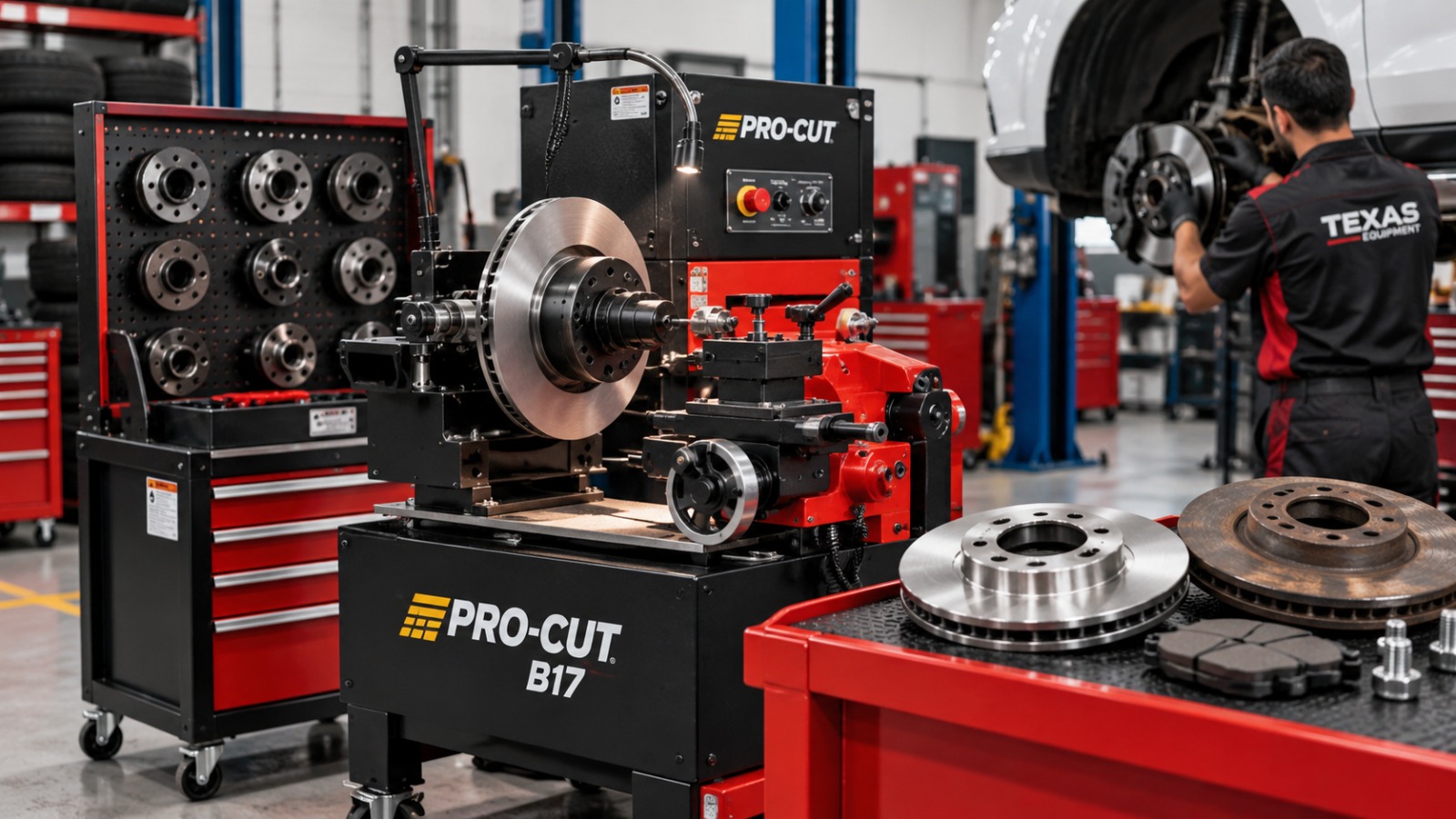
For workshops evaluating professional brake machining equipment, the Pro-Cut B17 brake lathe is one option listed by Texas Equipment.
Pro-Cut B17 at a glance
- Listed price: AED 39,000 + VAT
- Maximum rotor thickness: 57 mm
- Maximum rotor diameter: 495 mm
- Maximum drum diameter: 670 mm
- Maximum drum depth: 150 mm
- Rotor feed rate: 0.17 mm/revolution
- Spindle speeds: 100, 140 and 180 RPM
- Motor power: 750 W
- Brake types: Rotor and drum
According to the product listing, the B17 includes a quick-change cutting head. Confirm the current package contents, compatibility, availability and price with Texas Equipment before purchasing.
5. What Should You Check Before Buying a Brake Lathe?
Machine specifications alone are not enough to determine whether a brake lathe is a suitable investment. Evaluate your workshop’s actual requirements first.
- Vehicle mix: Identify the cars, light commercial vehicles and other vehicles you regularly service.
- Disc and drum sizes: Compare the dimensions of your typical jobs with the machine’s rated capacity.
- Adapters and tooling: Confirm that the required vehicle-specific fixtures and accessories are available.
- Workshop space: Check the machine footprint, working clearance and storage requirements.
- Operator capability: Account for training, setup, measurement and safe operating procedures.
- Running costs: Consider cutting tools, maintenance and ongoing support.
- Eligible job volume: Estimate how many jobs genuinely qualify for resurfacing rather than assuming every brake job will use the machine.
Estimate the likely workload and time required for setup and machining before calculating the potential return on investment.
6. Brake Lathe or Replacement: A Practical Decision Guide
- Cracked disc: Replace the disc.
- Disc below minimum thickness: Replace the disc.
- Disc can be machined within manufacturer limits: Resurfacing may be suitable.
- Damage cannot be corrected within permitted limits: Replace the disc.
- Compatibility or service procedure is uncertain: Verify the specifications before proceeding.
Always follow the applicable vehicle manufacturer’s service information and the brake lathe manufacturer’s operating instructions.
Frequently Asked Questions
Can every brake disc be resurfaced?
No. Resurfacing depends on the disc’s condition, measured thickness, vehicle manufacturer requirements and the availability of suitable tooling. Cracked or otherwise unsafe discs should not be machined for reuse.
Does a brake lathe’s maximum capacity confirm vehicle compatibility?
No. Maximum rotor thickness and diameter describe machine capacity, not approval to machine every disc within those dimensions. Check the vehicle-specific procedure, adapters and permitted machining limits.
Should a workshop machine a disc that is close to minimum thickness?
Only if the applicable manufacturer procedure permits it and the disc will remain within all required limits after machining. If this cannot be confirmed, do not proceed with resurfacing.
How much does the Pro-Cut B17 brake lathe cost in the UAE?
Texas Equipment’s product listing shows AED 39,000 plus VAT. Contact the supplier to confirm the current price, availability, included accessories and compatibility requirements.
Looking for a Brake Lathe for Your Workshop?
Texas Equipment supplies automotive workshop equipment in the UAE. If you are considering a brake lathe, discuss your vehicle mix, machining requirements, available tooling and expected job volume before selecting a machine.
Explore the Pro-Cut B17
Browse Brake Lathe & Service Equipment
View Tyre Shop Equipment
Contact Texas Equipment for product guidance
Sharjah showroom: Shop #15 BMW, Al Batha Warehouses & Shops, Industrial Area 2, Sharjah.
Phone: +971 6 552 9860
WhatsApp: +971 54 320 1243
Abu Dhabi branch: M9, 6th Street, Musaffah Industrial Area.
Abu Dhabi WhatsApp: +971 50 409 4965
Product specifications and prices may change. Confirm the current listing before purchase.