
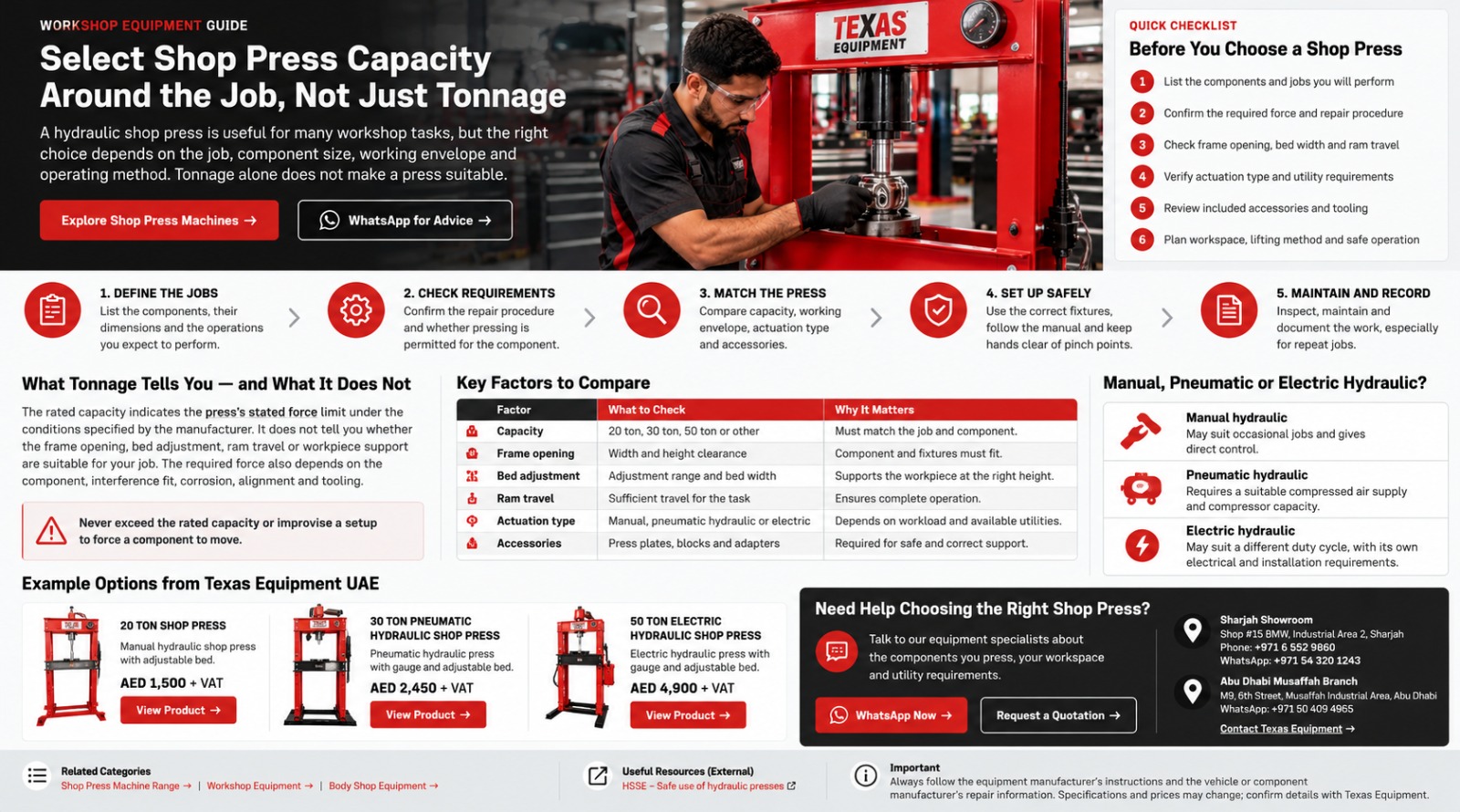
Select Shop Press Capacity Around the Job, Not Just Tonnage
A hydraulic shop press should be selected around the components you handle, the working space you have and the procedure the job requires. The biggest capacity is not automatically the best fit.
Use this practical guide to assess force requirements, frame clearance, bed adjustment, ram travel, actuation type, tooling and safe operation before requesting a quotation.
A hydraulic shop press is used in workshops for controlled pressing operations on suitable components, such as certain bushes, bearings and metal assemblies. Whether a particular component can be pressed, and how it must be supported, depends on its design and service instructions.
This matters when comparing a 20 ton shop press, a 30 ton pneumatic-hydraulic model and a 50 ton hydraulic press. Their ratings may look like a simple ranking, but capacity alone does not establish which model suits your jobs. Working range, bed width, ram stroke, fixtures, utilities and handling requirements all affect the decision.
01 / Build a job profile before choosing a machine
Do not start by selecting a tonnage number from a catalogue. Start by documenting the work the workshop expects to perform. The purpose is to define the operating envelope the machine must accommodate.
What will be pressed?
Record component type, dimensions, material where known and the relevant vehicle or equipment application. Confirm the manufacturer’s procedure before deciding that pressing is appropriate.
What needs to happen?
Define whether the job involves installing, removing or positioning a component. Note the approved direction of force and whether a dedicated adapter or support is required.
How often will it run?
Occasional repair work and repeated daily jobs can have different workflow, access, handling and maintenance requirements. Include expected duty cycle in the specification.
Where will it operate?
Measure the installation area, access route, floor conditions and space needed to load and remove the workpiece. Include any lifting equipment used by the workshop.
For broader workshop planning, compare the press with other equipment in the Texas Equipment workshop equipment range. Select tools around actual service requirements rather than buying equipment based on a capacity label alone.
02 / Understand what tonnage does and does not tell you
The rated capacity is the manufacturer’s stated force limit under the specified conditions. It does not tell you whether a particular job requires that force, whether the component will fit inside the frame or whether the available tooling can support it safely.
| Specification | What to verify | Why it matters |
|---|---|---|
| Rated capacity | Documented force rating and operating limits | The press must be suitable for the approved job without exceeding its rating. |
| Frame opening | Usable width and height | The workpiece and fixtures need to fit without interference. |
| Bed adjustment | Adjustment range, support width and locking arrangement | The workpiece must be positioned and supported at a suitable height. |
| Ram stroke | Total travel and usable movement | The ram must reach the working position without an improvised extension. |
| Working range | Minimum and maximum clearance specified by the manufacturer | The part must fit within the machine’s actual operating envelope. |
| Tooling | Press plates, blocks, adapters and their compatibility | Incorrect or unstable supports can shift, break or damage the component. |
| Utilities | Air supply or electrical supply, depending on the model | The workshop must meet the machine’s stated installation requirements. |
Required force can vary with the component, interference fit, corrosion, alignment and tooling. Do not estimate a force requirement from tonnage alone. If the approved procedure or required force is unknown, consult the component documentation or a suitably qualified technician before proceeding.
03 / Match the press to the physical workpiece
A machine can have ample rated capacity and still be unsuitable if its working envelope is too small. Before buying, compare the largest representative workpiece with the press dimensions and the fixtures needed for the operation.
- Frame clearance: confirm the component can enter the frame in the required orientation.
- Bed width: verify that the intended supports fit securely on the bed.
- Bed height: check that the adjustment range accommodates the workpiece and fixture stack.
- Ram travel: verify that the stroke is sufficient for the specified procedure.
- Ram alignment: ensure the load can be applied along the intended axis.
- Part handling: plan how heavy or awkward components will be lifted and removed.
- Accessories: confirm whether the required adapters are included or must be purchased separately.
04 / Manual, pneumatic-hydraulic or electric-hydraulic?
The actuation system affects the workshop’s utilities, controls and working routine. The correct choice depends on the selected model’s specifications and the tasks it is intended to perform.
Manual hydraulic
May suit some occasional workshop tasks where the operator can use the specified manual control. Verify the machine’s capacity, travel and operating method rather than assuming all manual presses are alike.
Pneumatic-hydraulic
Uses compressed air to operate the hydraulic system, sometimes alongside manual operation. Confirm the required air pressure and consumption, and check the compressor’s usable delivery under the workshop’s actual demand.
Electric-hydraulic
Uses an electric-powered hydraulic system. Check voltage, phase, motor power, installation conditions and the manufacturer’s operating requirements before confirming compatibility with the workshop.
Controls and workflow
Review how force is applied, monitored and released. Consider the frequency of work, operator training, maintenance access and the controls fitted to the exact machine.
For a pneumatic-hydraulic press, do not check only the compressor’s advertised maximum pressure. Compare the press requirement with the compressor’s delivered air capacity at the required pressure, including other tools running at the same time. Follow the equipment manufacturer’s installation guidance.
05 / Compare real product configurations
Texas Equipment’s online catalogue includes multiple shop press configurations. The examples below illustrate why buyers should compare specifications and utilities alongside capacity. Prices and stock can change, so confirm the current quotation, exact model and availability with Texas Equipment before purchasing.
30 Ton Pneumatic-Hydraulic Press TE-TE0310
Listed price: AED 3,500 + VAT, subject to confirmation.
Published specifications include a 162 mm stroke, 605 mm bed width, 30 mm–1045 mm working range and stated air pressure of 0.75–0.85 MPa. The listing describes air and manual operation.
Check before selecting: working clearance, air supply capability, required fixtures, operator access and compatibility with the component procedure.
50 Ton Pneumatic-Hydraulic Press TE-TE0311
Listed price: AED 4,500 + VAT, subject to confirmation.
Published specifications include a 180 mm piston stroke, 280 mm–1100 mm operating distance and a maximum stated pressure of 8 bar. The listing describes an air-hydraulic pump that can also be operated manually.
Check before selecting: the job’s approved force requirement, load alignment, workpiece support, air supply and actual usable frame clearance.
50 Ton Electric Hydraulic Press Machine
Listed price: AED 17,000 + VAT, subject to confirmation.
The online listing states a 300 mm stroke, 3 HP motor, 380 V supply and three-phase power. Verify these specifications against the exact machine and your site’s electrical installation before ordering.
Check before selecting: electrical compatibility, installation space, handling arrangements, controls, maintenance requirements and suitability for the intended duty cycle.
These examples are not a recommendation to choose the highest-capacity machine. They are starting points for comparing working range, stroke, utilities and operating method against the job profile developed earlier.
Browse the complete Shop Press Machine category to review other listed configurations. Confirm the exact product specifications and availability directly before finalising a purchase.
06 / Use a safe setup and controlled procedure
A hydraulic shop press can expose operators to crushing and pinch-point hazards. A component or fixture may also shift or break under load. The correct safeguards depend on the machine design, risk assessment, workpiece and operating procedure.
- Read the specific machine’s operating manual and follow its installation, inspection and maintenance instructions.
- Inspect the frame, ram, hydraulic components, controls, gauge and return mechanism as directed by the manufacturer.
- Use suitable press plates, blocks and adapters; do not use damaged, unstable or improvised supports.
- Position the workpiece correctly and apply force in the approved direction.
- Keep hands and other body parts clear of the ram, workpiece, bed and other pinch points.
- Use the machine’s specified controls and safeguards. Never bypass protective devices.
- Increase force only in accordance with the approved procedure. Stop if the part moves, deforms unexpectedly or behaves differently than expected.
- Release pressure according to the manual before adjusting the workpiece or removing fixtures.
- Remove damaged equipment from service until it has been assessed by a competent person.
For additional technical context, consult the US Occupational Safety and Health Administration’s Hydraulic Presses safety guidance. It discusses operator involvement, point-of-operation hazards and protective measures. OSHA is a US authority; this resource is technical guidance, not a statement of UAE law.
The international standard ISO 16092-3:2017 — Safety requirements for hydraulic presses provides further technical context for hydraulic press safety. Whether a particular standard or requirement applies to a machine or workplace must be assessed for the specific circumstances.
For UAE workplace requirements, consult the applicable official authority and rules for your emirate and activity. The UAE Government’s workplace health and safety information is a starting point for general official guidance. Do not treat an overseas reference or a product listing as proof of UAE regulatory compliance.
07 / Maintenance, inspection and job records
Safe operation depends on the condition of the press as well as the operator’s technique. Follow the machine manufacturer’s specified inspection intervals and maintenance procedures. The schedule should reflect the exact model and its use; do not invent a universal service interval.
Before use
Complete the checks required by the manual. Look for visible damage, leakage, abnormal movement or faults in the gauge and controls. Do not operate equipment with an unresolved safety defect.
During maintenance
Use the specified hydraulic fluid and procedure. Never search for a hydraulic leak with your hand or loosen a connection while the system is pressurised. Have defects assessed by a competent person.
For repeat jobs
Record the component, approved procedure, fixture arrangement and relevant manufacturer-defined limits. Recheck suitability when the part or operation changes.
For shared equipment
Keep the manual accessible and ensure operators receive appropriate instruction. Document inspections and maintenance as required by the manufacturer’s guidance and applicable workplace procedures.
For workshops reviewing their wider equipment requirements, the workshop equipment category provides a starting point for exploring other equipment types. Each machine should be assessed separately for its intended use, installation and operating requirements.
08 / The buyer’s pre-quotation checklist
Complete this checklist before asking for a hydraulic shop press quotation. It helps the supplier compare suitable configurations instead of recommending a machine on tonnage alone.
- List the components and operations the press must handle.
- Confirm the approved repair or component procedure.
- Record the dimensions and approximate weight of representative workpieces.
- Identify the required force from the approved procedure or a competent technical assessment.
- Measure frame clearance, bed width and working-height requirements.
- Check ram travel and the usable working range.
- List required press plates, blocks, adapters and other fixtures.
- Confirm the availability of suitable compressed air or electrical supply, where applicable.
- Plan safe loading, lifting, unloading and operator access.
- Ask for the exact model’s specifications, included accessories, price, VAT treatment, warranty terms and current availability.
Frequently asked questions
1. Is a 50 ton hydraulic shop press always better than a 20 ton press?
No. Capacity is only one selection factor. The correct press must suit the job’s documented force requirements, workpiece dimensions, tooling, working range, utilities and safety requirements. A higher rating does not make an unsuitable setup safe.
2. How do I choose the right shop press machine for an automotive workshop?
List the intended jobs, verify the relevant component procedures, measure the workpieces and compare capacity, frame opening, bed adjustment, ram travel, actuation method and compatible tooling. Confirm the exact model’s specifications before purchasing.
3. What is the difference between a pneumatic-hydraulic and an electric-hydraulic press?
A pneumatic-hydraulic model uses compressed air to operate its hydraulic system, while an electric-hydraulic model uses an electric-powered hydraulic system. Their utilities, controls and installation requirements differ. Check the exact model’s documentation rather than assuming all machines in either category have identical features.
4. Does a pneumatic-hydraulic press need a particular compressor?
Yes, the compressor must meet the specific press’s stated air pressure and air-consumption requirements. Check usable delivered air capacity at the required pressure, including simultaneous demand from other workshop tools.
5. Why do frame opening and ram stroke matter?
Frame opening determines whether the workpiece and fixtures can fit. Ram stroke describes the ram’s travel. Both must suit the intended operation; neither can be inferred from the press’s tonnage rating alone.
6. Can a shop press be used on any bearing, bush or automotive component?
No. Confirm that pressing is permitted for the specific component and follow the manufacturer’s procedure. Some parts require dedicated tools, a defined pressing direction or replacement rather than pressing.
7. What should I check before installing a hydraulic shop press in a UAE workshop?
Check the manufacturer’s installation requirements, floor and anchoring conditions where specified, working and access space, safe handling arrangements, operator training and required utilities. Also confirm the applicable workplace health and safety obligations for your location and activity.
8. What should be inspected during shop press maintenance?
Follow the exact machine’s maintenance manual. Relevant checks may include the frame, ram, hydraulic hoses and connections, visible leaks, gauge, controls and return mechanism. Do not operate a press with unresolved defects.
Make the selection specific to your workshop
Before selecting a hydraulic shop press, bring together the job profile, approved procedure, required force, component dimensions, working envelope, utilities and tooling. Compare the actual model specifications and confirm current product details with the supplier.
Texas Equipment UAE lists multiple configurations in its Shop Press Machine range. Share your intended applications and workshop requirements to help narrow down the options that merit a closer technical review.
Need Help Comparing Shop Press Options?
Share the components you press, approximate dimensions, intended operations and available air or electrical supply. Ask for the exact model specifications, included accessories, current price and availability before making a purchase decision.
Sharjah Showroom
Shop #15, BMW Road, Al Batha Warehouses & Shops, Industrial Area 2, Sharjah, UAE
Phone: +971 6 552 9860
WhatsApp: +971 54 320 4123
Abu Dhabi Musaffah Branch
M9, 6th Street, Musaffah Industrial Area, Abu Dhabi, UAE
WhatsApp: +971 50 409 4965
Request Product Details or a Quotation → Browse Shop Press Range →
Editorial and safety note: This article is general equipment-selection information, not a substitute for the specific machine manual, component service instructions, a competent risk assessment or applicable UAE requirements. Verify specifications, pricing, VAT treatment, accessories and availability with Texas Equipment before ordering.