
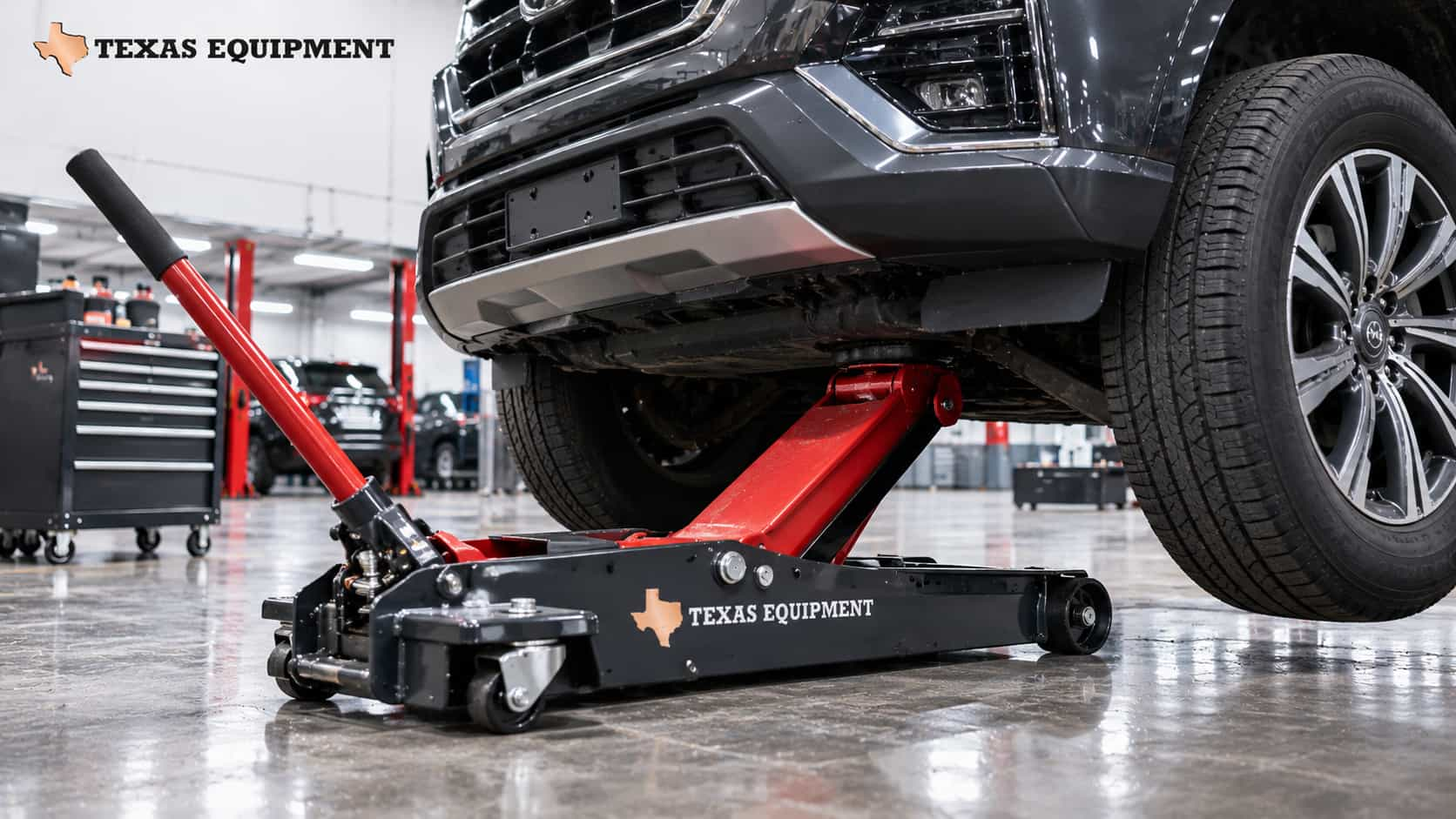
A 5 ton floor jack can be useful in a professional garage, but the capacity label alone does not determine whether it is the right tool. The jack must reach the vehicle’s approved lifting point, fit beneath it, raise it to the required height and operate within its rated limits. Workshop buyers should also consider manoeuvrability, maintenance, safe support equipment and the types of vehicles they service.
This guide explains how to evaluate a heavy-duty hydraulic floor jack, including lifting capacity, minimum and maximum height, reach, construction and safe operating requirements. It also uses Texas Equipment product listings as examples for buyers comparing workshop equipment in the UAE.
1. What Does a 5 Ton Floor Jack Rating Actually Mean?
The rating of a 5 ton floor jack indicates the manufacturer’s stated lifting capacity under defined operating conditions. It does not mean the jack is suitable for every vehicle weighing less than five tonnes in every lifting position.
Vehicle weight distribution, approved lifting points, jack geometry and the manufacturer’s instructions all matter. A vehicle’s total weight alone does not establish whether a particular jack can safely lift it from a specific point.
Before selecting a hydraulic floor jack, check:
- Vehicle weight: Confirm the actual vehicle weight and relevant axle loads where available.
- Approved lifting points: Follow the vehicle manufacturer’s instructions for positioning the jack.
- Jack capacity: Check the manufacturer’s rated capacity and operating limitations.
- Vehicle clearance: Establish whether the jack can fit beneath the vehicle and reach the approved lifting point.
- Working height: Confirm that the jack can raise the vehicle sufficiently for the intended task.
Never select a jack only by the vehicle’s badge or broad category. If the vehicle has unusual ground clearance, modified suspension or non-standard bodywork, confirm the lifting arrangement before proceeding.
2. Minimum Height, Maximum Height and Reach
When comparing a 5 ton hydraulic floor jack, lifting range and reach are just as important as rated capacity. These dimensions determine whether the jack can access the vehicle’s approved lifting point and raise it to the required height.
Minimum Saddle Height
Minimum saddle height determines whether the jack can be positioned beneath the approved lifting point. This is particularly important when servicing low-clearance cars or vehicles with modified suspension.
Check the actual clearance at the approved lifting point. Advertised ground clearance is not always the same as clearance beneath the point where the jack must be positioned.
Maximum Lifting Height
Maximum lifting height determines how far the jack can raise the vehicle. Compare this measurement with the clearance required for the intended service task and the manufacturer’s vehicle lifting instructions.
Reach and Frame Dimensions
Reach and frame length affect whether the saddle can reach the correct lifting point without placing the jack at an awkward angle. The jack must be positioned correctly on a suitable surface, following the manufacturer’s instructions.
Texas Equipment’s 5-ton ultra-low-profile hydraulic floor jack product page lists a lifting range of 6–22 inches (152–559 mm), an overall length of 1,424 mm and an overall reach of 1,194 mm.
Use these published dimensions to screen suitability, then verify the current product specification and physical clearances at the vehicle before purchase.
3. How to Assess Floor Jack Construction and Safety Features
A heavy-duty hydraulic floor jack must be suitable for repeated workshop use. Buyers should examine its frame, lifting arm, hydraulic system, wheels and lowering controls rather than relying only on its capacity rating.
The Texas Equipment product listing describes the 5-ton model as having thick frame side plates, a reinforced lift arm and overload/bypass safety valves. These are the features stated in the product listing; confirm the current specification with the supplier before ordering.
Frame and Lifting Arm
Inspect the frame and lifting arm for visible damage, deformation or signs of poor alignment. Structural components must be used within the manufacturer’s rated limits and maintained according to the operating instructions.
Hydraulic System
Check the hydraulic system for leaks, inconsistent lifting or uncontrolled lowering. A jack showing hydraulic faults should be removed from service and inspected by a competent person.
Wheels and Handle
Check that the wheels move as intended and that the handle and controls operate correctly. Damaged or obstructed wheels can make positioning difficult and may affect the correct operation of the equipment.
Overload and Bypass Protection
Some hydraulic jacks include overload or bypass valves intended to help prevent operation beyond specified limits. These features do not remove the need for correct positioning, inspection, maintenance and compliance with the operating manual.
4. Floor Jack vs Trolley Jack: What Is the Difference?
In everyday workshop language, the terms “floor jack” and “trolley jack” are often used for wheeled hydraulic jacks that roll beneath a vehicle. Product naming varies, so compare the actual design and specifications instead of relying only on the product label.
A bottle jack has a different form factor. Its vertical hydraulic design may suit particular access conditions, but its positioning, lifting range and intended application differ from those of a wheeled floor jack.
Texas Equipment lists multiple trolley and floor jack options, including low-profile models with different capacities and lifting ranges.
For example, the 4-ton low-profile OTEM592B floor jack listing states a 90–550 mm lifting range. This does not mean it is interchangeable with a 5-ton model. Capacity, dimensions, lifting range and intended use must all be compared.
You can also explore the wider trolley jack and stand range to compare available workshop equipment.
5. Safe Floor Jack Operation and UAE Workplace Safety Requirements
Correct operating procedures are essential whenever a hydraulic floor jack is used. A jack is a lifting device, not a substitute for properly rated vehicle support equipment.
Prepare the Vehicle and Work Area
Park on a firm, level surface, apply the vehicle’s parking brake where appropriate and prevent rolling according to the vehicle manufacturer’s procedure. Use wheel chocks when required. Identify the approved lifting point before positioning the jack.
Position the Jack Correctly
Centre the saddle at the vehicle manufacturer’s designated lifting point. Check that the jack is correctly positioned and stable before raising the vehicle. Raise it smoothly, following the jack’s operating instructions.
Use Approved Support Stands
Never put any part of your body beneath a vehicle supported only by a hydraulic floor jack. Use correctly rated jack stands or another approved support system, placed at the vehicle manufacturer’s designated support points, before working underneath.
Do not exceed the jack’s rated capacity or use improvised extensions. Lower the vehicle in a controlled manner, following the operating manual. Inspect the jack and accessories regularly and keep the working area clear.
UAE Workplace Health and Safety References
Workshops in the UAE should consider applicable occupational health and safety requirements when selecting and operating lifting equipment. The UAE Government’s workplace health and safety guidance provides information about workplace safety responsibilities and occupational hazards.
Federal Decree-Law No. 33 of 2021, Regarding the Regulation of Employment Relationships, sets out employer obligations relating to worker protection and workplace safety. Refer to the official UAE legislation record for the applicable legal provisions.
For workshops operating in Sharjah, consult the Sharjah Occupational Safety and Health System Codes of Practice for relevant local guidance. Check which requirements apply to your establishment and the equipment being used.
These regulatory references do not certify a particular floor jack. Buyers must separately verify the manufacturer’s specifications, operating instructions and suitability for the intended application.
6. How to Choose a 5 Ton Floor Jack for Your Workshop
Selecting a 5 ton floor jack for a workshop requires an assessment of the vehicles serviced, the work performed and the physical layout of the workshop.
Start by listing the vehicle types and tasks handled most often. Then compare the following specifications:
- Rated capacity: Confirm that the manufacturer’s rating is appropriate for the intended lifting application.
- Minimum height: Check whether the jack fits beneath the vehicle at its approved lifting point.
- Maximum height: Confirm that it provides the required lifting range.
- Reach: Compare frame length and saddle reach with the vehicle’s lifting-point position.
- Saddle design: Check compatibility with the intended lifting points and manufacturer’s instructions.
- Wheel movement: Consider manoeuvrability and positioning within the workshop bay.
- Dimensions and storage: Check the jack’s overall length, width and storage requirements.
- Support equipment: Ensure that correctly rated jack stands or another approved support system are available.
- Maintenance and service: Ask about inspection, maintenance and after-sales support.
If technicians regularly work on low-clearance cars, minimum height may be decisive. If the workshop services larger vehicles, capacity and approved lifting geometry may be more important.
Consider storage and handling too. A larger jack may have a higher rating but occupy more floor space and be harder to manoeuvre in tight bays. Ask the supplier for the exact dimensions and maintenance requirements before ordering.
7. 5-Ton Floor Jack Buying Checklist
Use this comparison table when evaluating different hydraulic floor jacks for your workshop.
| Selection Factor | What to Verify | Why It Matters |
|---|---|---|
| Rated capacity | Manufacturer rating and vehicle lifting requirements. | Avoids choosing by vehicle category alone. |
| Minimum height | Clearance at the approved lifting point. | Determines whether the jack can be positioned. |
| Maximum height | Required service clearance. | Determines whether the jack reaches the needed height. |
| Reach and dimensions | Frame length, saddle reach and workshop bay access. | Affects positioning and correct operation. |
| Construction | Frame, lifting arm, hydraulic system and wheels. | Helps assess suitability for workshop use. |
| Safety and support | Overload protection, controlled lowering and compatible stands. | Supports safe operation when used correctly. |
| Maintenance | Inspection requirements and service support. | Helps plan ongoing equipment care. |
Conclusion: Choose the Complete Floor Jack Specification
Choosing the right 5 ton floor jack requires more than selecting the highest capacity available. Lifting range, minimum clearance, reach, frame dimensions, approved lifting points and safe operating procedures must all be considered together.
View the 5-ton ultra-low-profile hydraulic floor jack and compare it with the wider trolley jack and stand range.
Contact Texas Equipment to confirm current stock, pricing and suitability for your workshop requirements.
Frequently Asked Questions About 5-Ton Floor Jacks
Is a 5 ton floor jack suitable for all SUVs?
No. Verify the vehicle’s actual weight, approved lifting points, jack geometry and the manufacturer’s operating limits. A five-ton capacity rating alone does not establish compatibility with every SUV.
What lifting range does the Texas Equipment 5-ton floor jack list?
The supplied Texas Equipment product information lists a lifting range of 152–559 mm (6–22 inches). Verify the live product specification before purchase.
Can I work beneath a vehicle supported only by a floor jack?
No. Never work beneath a vehicle supported only by a hydraulic jack. Use correctly rated jack stands or another approved support system at the designated support points.
Is a low-profile floor jack always better?
Not necessarily. A low-profile jack is useful when access beneath a vehicle is limited, but its capacity, reach and lifting range must still suit the vehicle and intended task.
Should I choose the highest capacity floor jack available?
No. Choose equipment based on the actual lifting requirements and compare capacity, minimum height, maximum height, reach, dimensions, operating instructions and compatible support equipment.
What should I check before buying a hydraulic floor jack?
Check the manufacturer’s rated capacity, lifting range, reach, frame dimensions, saddle design, hydraulic system, safety features, maintenance requirements and compatibility with the vehicles serviced in your workshop.
Request a Workshop Equipment Quotation from Texas Equipment
Need help selecting the right hydraulic floor jack or other workshop equipment? Share your vehicle requirements, intended application and workshop setup with Texas Equipment to confirm model suitability, current availability and a quotation.
Texas Equipment
Website: texasequipment.ae
Contact: Request a quotation
Sharjah showroom: Shop #15 BMW Road, Industrial Area 2, Sharjah
Phone: +971 6 552 9860
WhatsApp: +971 54 320 1243
Abu Dhabi branch: M9, 6th Street, Musaffah Industrial Area, Abu Dhabi
WhatsApp: +971 50 409 4965