
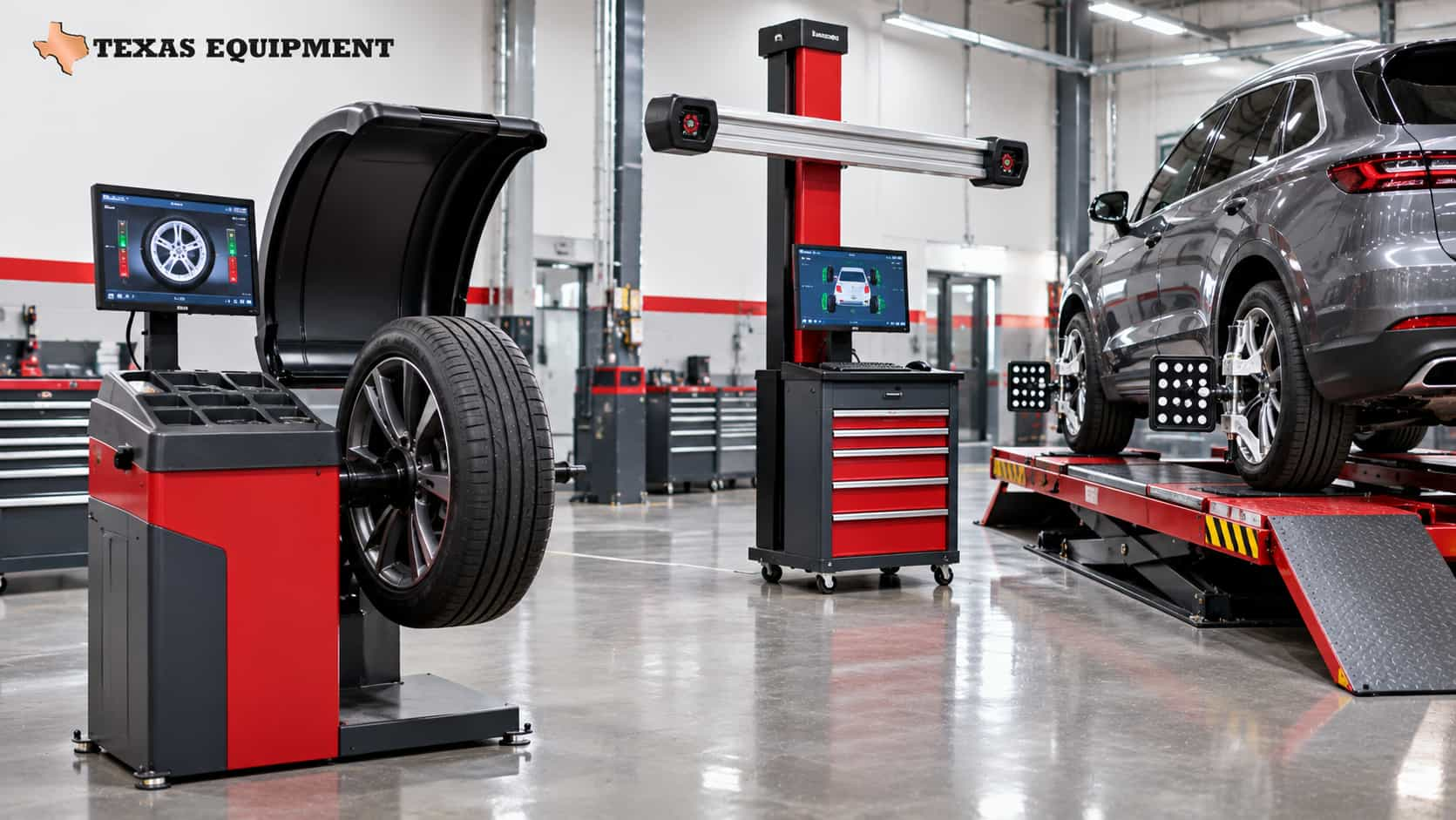
Wheel Balancer vs Wheel Alignment Machine: Which Does Your Workshop Need?
Wheel balancing and wheel alignment are two different workshop services. However, customers sometimes confuse them because both can relate to vibration, steering and tyre wear. A wheel balancer checks the weight balance of a wheel-and-tyre assembly. In contrast, an alignment machine measures vehicle wheel geometry against the manufacturer’s specifications.
This guide explains how both machines work, when workshops use them and what to check before investing in either system.
1. What Does a Wheel Balancer Do?
A wheel balancer measures mass imbalance in a wheel-and-tyre assembly. The machine spins the assembly and detects areas where the weight is not evenly distributed.
Next, the technician uses the machine’s readings to decide where to place corrective weights. These weights help balance the rotating assembly according to the machine’s instructions.
Correct mounting is important. Therefore, technicians must use suitable cones, adapters and mounting methods. Incorrect centring can lead to misleading readings.
When Is Wheel Balancing Needed?
Balancing is commonly checked when a customer reports vibration linked to wheel rotation. For example, a driver may notice vibration at certain road speeds.
It is also commonly performed after tyre replacement or wheel repair. However, not every vibration problem comes from wheel imbalance.
Other possible causes include:
- Tyre damage or uneven tyre wear.
- A bent or damaged wheel rim.
- Incorrect tyre mounting or centring.
- Worn suspension or steering components.
- Driveline problems.
Therefore, a technician should inspect the vehicle before promising that balancing will solve every vibration complaint.
Wheel Balancer Models Listed by Texas Equipment
Texas Equipment lists several wheel balancers for tyre workshop applications. The category-page prices supplied for this article are shown below.
Wheel Balancer Range
- TE-H598 Fully Automatic Wheel Balancer: AED 6,000 + VAT.
- DL-65L Premium Wheel Balancer: AED 7,500 + VAT.
- TE-698 LCD Display Wheel Balancer: AED 8,500 + VAT.
View the Texas Equipment wheel balancer range for current product details and availability.
Before choosing a model, check its supported wheel dimensions, wheel weight limits, adapters, operating modes and calibration requirements. Also confirm which accessories are included in the quotation.
2. What Does a Wheel Alignment Machine Do?
A wheel alignment machine measures vehicle wheel geometry. It checks angles such as toe, camber and caster, depending on the vehicle and the equipment.
The technician compares the readings with the vehicle manufacturer’s specifications. Then, where the vehicle design allows, the technician adjusts the relevant angles.
What Are Toe, Camber and Caster?
- Toe: This describes the direction the wheels point when viewed from above. They may point slightly inward or outward.
- Camber: This is the inward or outward tilt of a wheel when viewed from the front of the vehicle.
- Caster: This describes the forward or backward tilt of the steering axis when viewed from the side.
These measurements help technicians assess the vehicle’s wheel geometry. However, the correct values depend on the vehicle manufacturer’s specifications.
For a technical introduction to wheel geometry, see the Bharat Skills automotive training material.
When Is Wheel Alignment Inspection Needed?
An alignment inspection may be useful when a vehicle shows certain steering or tyre-wear symptoms.
For example, a vehicle may pull to one side, or the steering wheel may sit off-centre when driving straight. Some uneven tyre-wear patterns may also justify an alignment check.
However, these symptoms do not prove that alignment is the only problem. Incorrect tyre pressure, damaged tyres and worn suspension parts can also cause similar complaints.
Therefore, technicians should inspect the vehicle and identify the cause before recommending adjustments.
Wheel Alignment Machines Listed by Texas Equipment
Texas Equipment lists the following alignment machines and category-page prices in the supplied information.
Wheel Alignment Machine Range
- FOX 3D Auto Boom Wheel Alignment Machine: AED 44,000 + VAT.
- Wheel-Alignment-JUMBO-3D-Super-5A: AED 75,000 + VAT.
View the wheel alignment machine category or review the FOX 3D Auto Boom product listing.
Before buying, check vehicle-data coverage, installation requirements, included targets or clamps, software, calibration and technician training.
3. Wheel Balancer vs Wheel Alignment Machine: Key Differences
These machines measure different things. Therefore, they cannot replace one another.
A wheel balancer checks mass distribution in the rotating wheel-and-tyre assembly. On the other hand, an alignment system measures vehicle wheel geometry against the relevant specifications.
| Comparison | Wheel Balancer | Wheel Alignment Machine |
|---|---|---|
| Main purpose | Measures wheel-and-tyre mass imbalance. | Measures vehicle wheel geometry. |
| What is measured? | Imbalance in the rotating assembly. | Angles such as toe, camber and caster, where supported. |
| Corrective work | Uses weights in the positions indicated by the machine. | Adjusts wheel geometry where the vehicle design allows. |
| Common reason for inspection | Vibration linked to wheel rotation. | Vehicle pulling, off-centre steering or certain uneven-wear patterns. |
| Typical workshop service | Wheel and tyre balancing. | Wheel alignment inspection and adjustment. |
| Key buying checks | Wheel size, weight limits, adapters and calibration. | Vehicle coverage, bay setup, targets, software and calibration. |
For another explanation of these two services, read Michelin’s guide to wheel alignment and wheel balancing.
4. Which Machine Should Your Tyre Workshop Buy First?
The right purchase depends on the services your customers need today and the services you plan to offer next.
Choose a Wheel Balancer for a Tyre-Fitting Workflow
If tyre fitting is a core workshop service, balancing equipment may be needed to complete the job. It allows technicians to measure imbalance after mounting a tyre and apply corrective weights based on the readings.
However, the machine must support the wheel sizes and weights handled by the workshop. Also check the adapters, cones and other accessories required for your vehicle mix.
Choose an Alignment Machine to Add Alignment Services
If the workshop plans to offer alignment checks and adjustments, it needs a suitable alignment system. It also needs an appropriate bay, lifting arrangement and access to relevant vehicle specifications.
In addition, check the installation space and floor conditions. Confirm the equipment’s supported vehicle types and whether the package includes targets, clamps, software and training.
Compare the Total Setup Cost
The machine price is only one part of the investment. Depending on the system, the workshop may also need:
- Clamps, cones, adapters or targets.
- Monitor, computer or other display equipment.
- Software and vehicle data access.
- Floor preparation or bay changes.
- Installation and calibration.
- Technician training.
- Maintenance and replacement parts.
Therefore, ask the supplier for an itemised quotation. This makes it easier to compare the full installation cost rather than the machine price alone.
5. Can a Workshop Need Both Machines?
Yes. A workshop that offers tyre replacement, wheel balancing and alignment may need both machines because they perform different tasks.
For example, a technician may balance a wheel-and-tyre assembly after fitting a new tyre. The vehicle may also need an alignment inspection if its symptoms or service history justify one.
However, neither service replaces the other. Correct balancing does not correct toe or camber settings. Similarly, alignment adjustments do not correct mass imbalance.
Before investing in both systems, estimate the expected number of jobs each week. Also consider the vehicle types served, technician skills, available bay space and the expected return from adding each service.
6. Questions to Ask Before Purchasing
Ask the supplier clear questions before comparing models. This helps prevent missing costs and equipment limitations.
Wheel Balancer Buying Checklist
- What wheel sizes and weights does the machine support?
- Which cones, adapters and accessories are included?
- What measurement modes are available?
- What calibration procedure is required?
- What installation and maintenance support is available?
- Are spare parts available locally?
Wheel Alignment Machine Buying Checklist
- Which vehicle classes and models are supported?
- What targets, clamps and accessories are included?
- What bay, lift and floor conditions are required?
- Is installation included in the quotation?
- Is technician training included?
- How are calibration and vehicle-data updates handled?
- What warranty and service support are offered?
Finally, request an itemised quotation. It should separate the equipment price, accessories, installation, training, VAT and any exclusions.
7. Wheel Balancer and Alignment Machine Price Comparison
The following table summarises the models and prices supplied for this article. These figures are reference prices from the category information checked for the draft, not a guarantee of current pricing.
| Equipment | Model | Listed Price | Main Function |
|---|---|---|---|
| Wheel balancer | TE-H598 Fully Automatic | AED 6,000 + VAT | Measures wheel-and-tyre imbalance. |
| Wheel balancer | DL-65L Premium | AED 7,500 + VAT | Measures wheel-and-tyre imbalance. |
| Wheel balancer | TE-698 LCD Display | AED 8,500 + VAT | Measures wheel-and-tyre imbalance. |
| Wheel alignment machine | FOX 3D Auto Boom | AED 44,000 + VAT | Measures vehicle wheel geometry. |
| Wheel alignment machine | JUMBO 3D Super 5A | AED 75,000 + VAT | Measures vehicle wheel geometry. |
Prices alone do not show which machine is better for a particular workshop. Compare supported wheel dimensions, vehicle coverage, accessories, installation, training and service support before making a decision.
Conclusion: Buy Equipment for the Service You Want to Deliver
Wheel balancing and wheel alignment complement each other, but they solve different problems. A balancer checks mass imbalance in the wheel-and-tyre assembly. An alignment machine measures vehicle wheel geometry against the manufacturer’s specifications.
Therefore, start with your workshop’s service plan, customer demand and vehicle mix. Then compare machine capacity, accessories, bay requirements, installation and after-sales support.
Browse the Texas Equipment wheel balancer range and the wheel alignment machine range. You can also review the FOX 3D Auto Boom product before requesting a model-specific quotation.
Frequently Asked Questions
Is wheel balancing the same as wheel alignment?
No. Wheel balancing measures mass imbalance in the wheel-and-tyre assembly. In contrast, wheel alignment measures vehicle wheel geometry against the manufacturer’s specifications.
Which service fixes steering vibration?
Balancing may help when wheel imbalance causes the vibration. However, tyre damage, a bent rim, worn suspension parts and driveline faults can also cause vibration. Therefore, inspect the vehicle before choosing a repair.
Does wheel alignment always fix uneven tyre wear?
No. Incorrect alignment can contribute to uneven tyre wear, but tyre pressure, tyre condition and worn suspension parts can also be responsible. Check these areas before recommending adjustments.
Can a tyre shop offer alignment without an alignment machine?
A full alignment measurement requires suitable equipment, a suitable workshop setup and the relevant vehicle specifications. The workshop must also have the tools and trained staff needed for the service.
What should I check before buying a wheel balancer?
Check supported wheel size and weight, adapters, measurement modes, calibration, installation needs and service support. Also confirm that the machine suits the vehicles handled by your workshop.
What should I check before buying a wheel alignment machine?
Check vehicle-data coverage, supported vehicle classes, targets or clamps, bay and lift requirements, calibration, training and after-sales support.
Can a workshop use both machines?
Yes. A workshop offering tyre fitting, balancing and alignment may need both. Each machine performs a different measurement, so one cannot replace the other.
Planning to Upgrade Your Tyre Workshop?
Share your workshop setup, vehicle types and service requirements with Texas Equipment. The team can help you review suitable equipment, check current availability and request a quotation.
Explore Equipment
Request a QuotationSharjah Showroom
Shop #15 BMW Road, Industrial Area 2, Sharjah
Phone: +971 6 552 9860
WhatsApp: +971 54 320 1243
Abu Dhabi Branch
M9, 6th Street, Musaffah Industrial Area, Abu Dhabi
WhatsApp: +971 50 409 4965
Publication note: Recheck product prices, VAT, stock, model names, specifications, included accessories, product URLs, installation, warranty and service claims before publication. The listed prices in this article are based on the supplied category-page information and may change.