
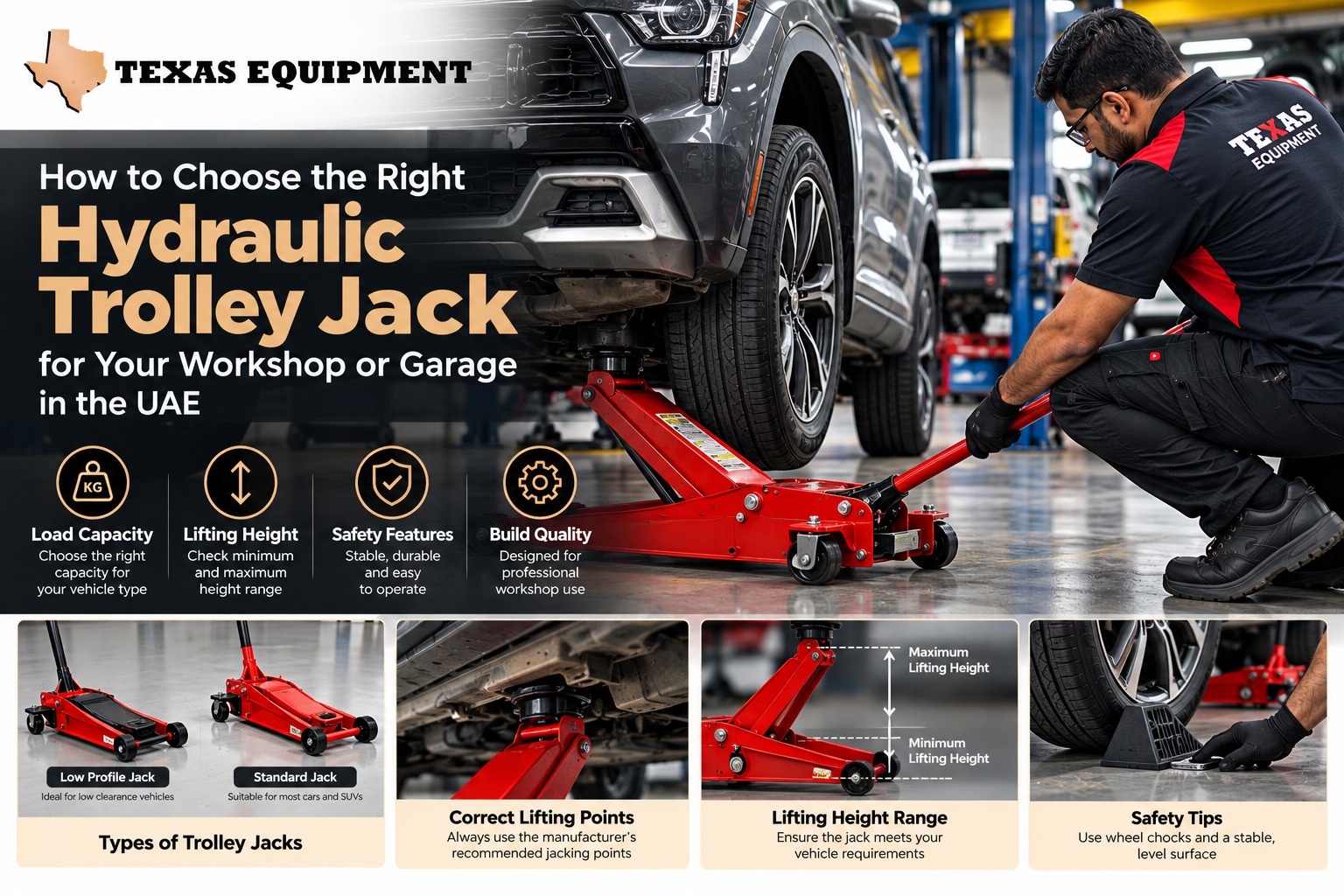
Hydraulic Trolley Jacks: Matching the Right Model to Your Garage
A hydraulic trolley jack helps automotive technicians raise a vehicle from an approved lifting point for service work. However, selecting the right model involves more than choosing a tonnage rating. The jack must fit beneath the vehicle, reach the required working height and suit the workshop’s floor, space and daily workload.
For garages and automotive workshops in Dubai, Sharjah, Abu Dhabi and across the UAE, the most useful starting point is the vehicle mix. A workshop servicing low-clearance passenger cars may need different equipment from one that mainly handles SUVs or other vehicles.
Start With the Vehicle, Not the Jack
Before comparing products, consider the vehicles that enter your workshop most often and the lifting tasks your technicians perform.
- Low-clearance cars: Check whether the jack can fit beneath the vehicle at the manufacturer’s approved lifting point.
- Passenger cars and SUVs: Match the rated capacity and lifting range to the intended application.
- Frequent service work: Consider mobility, ease of positioning and the available working space.
- Multiple service bays: Check whether the jack can move between bays and be stored without obstructing technicians.
Once the intended applications are clear, evaluate the jack’s capacity, minimum height, maximum height, saddle design and construction.
Will the Jack Fit Under the Vehicle?
Minimum height is a critical specification when working with vehicles that have limited ground clearance. If the jack cannot fit beneath the vehicle at the intended lifting point, its other features will not solve that problem.
Measure the clearance at the approved lifting point rather than relying only on the vehicle’s general ground clearance. Account for the shape and position of the lifting point and follow the vehicle manufacturer’s instructions.
When a low-profile design makes sense
A low-profile trolley jack can be useful for sports cars, low-clearance passenger vehicles and other applications where space beneath the vehicle is restricted. It is not automatically the best choice for every garage; capacity and the full lifting range must still meet the intended requirements.
Can It Reach the Required Lifting Height?
Minimum height tells you whether the jack can fit into position. Maximum height tells you how far it can raise the vehicle. Both specifications matter.
A model that fits beneath a vehicle may still be unsuitable if it cannot reach the required height for the intended task. Evaluate the complete lifting range and confirm that it matches the vehicle manufacturer’s approved lifting procedure.
Also consider saddle design and compatibility with the designated lifting point. The contact surface must be appropriate for the application and used according to the equipment manufacturer’s instructions.
Capacity: How Much Is Enough?
The jack’s rated capacity must be appropriate for the intended lifting application. Do not assume that the vehicle’s total weight is automatically the load applied at a single lifting point, and do not estimate capacity without considering the manufacturer’s specifications and approved lifting procedure.
A higher capacity rating alone does not make a jack more suitable. A larger model may have a different minimum height, footprint or lifting range. The goal is to find equipment that satisfies the load requirements and fits the physical conditions of the job.
Standard vs Low-Profile Trolley Jacks
| Consideration | Standard Trolley Jack | Low-Profile Trolley Jack |
|---|---|---|
| Vehicle clearance | Suitable when available clearance meets the model’s minimum height | Designed for applications with more restricted clearance |
| Selection priority | Capacity, lifting range and fit | Minimum height, capacity and lifting range |
| Workshop suitability | Depends on the vehicles and tasks handled | Useful where low-clearance vehicles are regularly serviced |
Neither design is universally better. Choose according to the vehicles your workshop services and the manufacturer’s published specifications.
Mobility and Workshop Layout
A trolley jack may be moved between service bays throughout the day. Its wheels, caster arrangement, handle, overall weight and footprint can affect how easily technicians position it.
Consider the following practical questions:
- Is the workshop floor suitable for moving the jack?
- Can technicians position it accurately at the intended lifting point?
- Is there enough room to manoeuvre the handle?
- Can the jack move around other equipment without obstructing work?
- Is there a designated storage space when the jack is not in use?
These details matter in busy workshops where equipment is shared across multiple bays.
Hydraulic System and Safety Features
Depending on the model, relevant features may include hydraulic bypass systems, overload protection and controlled lowering mechanisms. Check the product documentation to establish which features are actually provided.
Such features do not replace correct operation, suitable lifting points or appropriate vehicle support. Inspect the jack before use and follow the manufacturer’s maintenance instructions. Hydraulic leaks, structural damage, damaged wheels or malfunctioning controls should be addressed before the equipment is used again.
Important: Lifting a Vehicle Is Not the Same as Supporting It
A hydraulic trolley jack is designed to lift. It should not automatically be treated as the sole support for a vehicle while a technician works underneath it.
Use suitable support equipment and follow the vehicle manufacturer’s approved lifting and support procedure, together with the instructions supplied with the equipment. The US Occupational Safety and Health Administration provides additional guidance on jack capacity, operation, inspection and maintenance in its jack safety standard. This is a US reference, not UAE legislation.
Explore Trolley Jacks for Your Workshop
Texas Equipment offers trolley jack options in different capacities and configurations. Compare the product specifications with your vehicles’ clearance, lifting requirements and available workshop space before selecting a model.
Explore Texas Equipment’s trolley jack and stand range for relevant vehicle-lifting equipment.
You can also review the 3-ton capacity trolley jack product page to inspect the listed details for that specific model. Confirm its specifications against your intended application before purchasing.
Frequently Asked Questions
What capacity trolley jack does a professional garage need?
It depends on the vehicles and lifting applications. Select a jack whose rated capacity is appropriate for the intended load and approved lifting configuration.
Is a low-profile trolley jack better?
It is useful when a vehicle has limited clearance at the approved lifting point. It is not automatically the best option for every workshop.
What matters more: capacity or lifting height?
Both matter. Capacity must suit the intended application, while minimum and maximum heights must match the vehicle and service requirements.
Can a trolley jack support a vehicle while someone works underneath it?
Do not automatically treat the jack as the sole support. Follow the approved vehicle lifting procedure and use suitable support equipment.
What should I measure before buying a trolley jack?
Check clearance at the approved lifting point, required lifting height, available movement and storage space, and the floor conditions in your workshop.
Choose for Fit, Function and Safe Operation
The right hydraulic trolley jack is one that suits the workshop’s vehicles, rated-capacity requirements, lifting range and working environment. A high capacity rating alone is not enough if the jack cannot fit beneath the vehicle or reach the required position.
Compare the published specifications carefully and follow the relevant operating and maintenance instructions. To explore suitable options, visit the Texas Equipment trolley jack and stand category.