
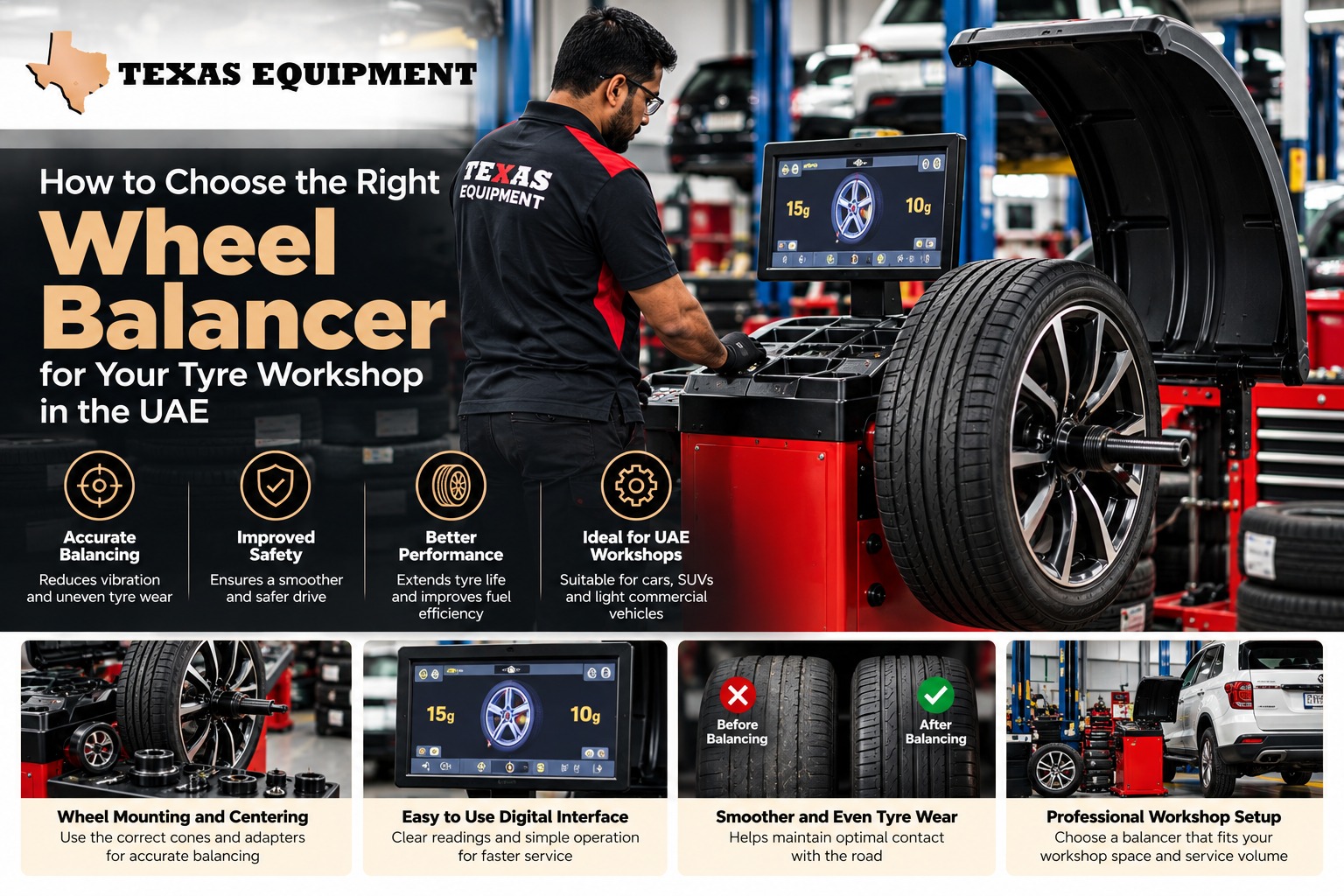
Wheel Balancer Selection: From Wheel Compatibility to Accurate Results
A wheel balancer is essential equipment for a professional tyre shop because it helps identify uneven mass distribution in a wheel and tyre assembly. Choosing the right machine involves more than comparing prices or digital displays. The machine must accommodate the wheels your business services, centre them correctly, measure imbalance reliably and support the balancing procedures your technicians use.
For tyre shops and automotive workshops in Dubai, Sharjah and Abu Dhabi, the right wheel balancer depends on the vehicle categories handled, wheel dimensions, assembly weight, centring accessories, measurement system and available balancing programmes. Understanding how these elements work together makes it easier to select equipment that suits your daily operations.
First, understand what the machine is measuring
A wheel and tyre assembly can have uneven mass distribution around its axis of rotation. When it spins, this imbalance can produce vibration that may be felt through the steering wheel, seat or vehicle body, depending on the conditions and location of the imbalance.
A wheel balancing machine measures the imbalance and indicates where corrective wheel weights should be placed. The technician follows the machine’s instructions to apply the appropriate correction, then checks the result according to the machine’s operating procedure.
Wheel balancing and wheel alignment are different services. Balancing addresses mass distribution in the rotating wheel and tyre assembly. Alignment concerns wheel angles and their relationship to the vehicle’s suspension and steering geometry. A workshop may offer both services, but each requires equipment designed for its specific task.
Follow the wheel through the balancing process
Stage 1: Identify the wheel before mounting it
The first selection question is whether the machine can physically accommodate the wheels that arrive at your shop. Consider the rim diameter, wheel width, overall assembly weight and the types of wheels you expect to service.
A shop focused on passenger cars may have different requirements from a commercial vehicle workshop that handles heavier wheel assemblies. If your business services both passenger vehicles and trucks, confirm whether the intended machine is suitable for each category. Do not assume that a standard passenger-car model can handle truck wheels.
Check the manufacturer’s stated operating range rather than relying on a product name or appearance. The maximum supported dimensions and weight should cover the wheels you actually intend to balance.
Stage 2: Centre the wheel accurately
Correct centring is fundamental to obtaining a useful measurement. The wheel must be mounted securely and positioned appropriately on the balancer’s shaft. If it is mounted off-centre or incorrectly, the measured result may not represent the wheel’s true imbalance.
Review the shaft arrangement, available cones, flanges, adapters and other centring accessories supplied or supported by the machine. The appropriate arrangement depends on the wheel’s centre bore and mounting design.
Before purchasing, consider the range of wheel designs handled by your technicians. Ask the supplier which accessories are included, which may need to be purchased separately and whether the proposed setup supports the wheel types common in your workshop.
Stage 3: Understand how imbalance is measured
Once the wheel is mounted, the machine rotates the assembly and measures imbalance. Depending on the model, the operator may enter wheel dimensions manually or use a supported measurement system to provide the required information.
Look at how the machine captures rim dimensions, how the readings are displayed and how clearly it communicates the correction required. An interface that technicians can understand and operate consistently is valuable during a busy workshop day.
Confirm the machine’s documented measurement capabilities and operating procedure with the supplier. Avoid choosing equipment based only on a large screen or claims about advanced technology without understanding the functions available on the specific model.
Stage 4: Select the correct balancing programme
Different wheel and rim designs can require different balancing approaches. Available programmes may support different correction methods, including configurations for alloy wheels and different wheel-weight placement requirements. The exact options vary by machine.
When reviewing a wheel balancer, establish which balancing modes it offers and whether those modes match the wheels serviced by your shop. If your technicians frequently work with alloy rims, confirm that the machine supports the correction methods required for those applications.
Also review how the machine guides the operator through weight placement. Clear instructions can help reduce confusion during setup and make the process more consistent across technicians.
Stage 5: Apply the correction and verify the result
After the machine identifies the required correction, the technician installs the appropriate wheel weights in the indicated positions. The assembly is then checked again using the machine’s prescribed procedure.
A final verification matters because the initial measurement alone does not confirm that the correction has been completed successfully. If the result remains outside the machine’s acceptable indication, the technician should review the mounting, entered dimensions, weight placement and wheel condition before repeating the measurement.
Consistent mounting and correct operation are therefore just as important as the balancer’s features. Staff should follow the manufacturer’s instructions for mounting, operation, calibration and maintenance.
Which machine features affect day-to-day workshop work?
Once wheel compatibility and the balancing process are understood, consider the features that affect how the machine fits into your service operation.
Measurement and display interface
The operator should be able to identify the readings, required corrections and selected programme without unnecessary confusion. Review the actual interface where possible and confirm that the instructions are clear enough for the technicians who will use the machine.
Balancing modes and wheel-weight options
Available modes should correspond to the wheel types and correction methods your workshop handles. Ask for a demonstration using a representative wheel, where practical, rather than relying solely on a list of features.
Operating cycle and workflow
Cycle time is only one part of productivity. Wheel loading, dimension entry, programme selection, weight application and rechecking also affect the total service process. Consider the complete workflow rather than assuming that a particular display or automatic function will, by itself, make the shop faster.
Guard, installation and available space
Review the machine’s physical dimensions, required working clearance, installation conditions and protective features. Confirm the electrical supply and any other installation requirements stated by the manufacturer before arranging the machine in the workshop.
Calibration, service and spare parts
Ask about the recommended calibration procedure, maintenance requirements, availability of relevant accessories and access to technical support. A machine’s long-term usefulness depends on proper setup and maintenance as well as its initial specifications.
Passenger-car balancer or heavy-duty truck balancer?
The correct category depends on the wheel assemblies your business intends to service. A passenger-car-focused tyre shop should verify the supported dimensions and weight of the selected machine against its regular workload. A commercial vehicle workshop must separately establish the requirements for its heavier and larger wheel assemblies.
Texas Equipment offers wheel balancing equipment for workshop applications, including general workshop models and a heavy-duty truck wheel balancer. Review the intended application and the manufacturer’s specifications before deciding which category is appropriate.
Explore the available wheel balancing machines at Texas Equipment to assess the options relevant to your workshop. For larger commercial vehicle wheels, confirm suitability with the supplier rather than assuming that every machine in the category supports truck applications.
Common selection mistakes that can affect results
- Choosing by price alone: A lower purchase price does not establish whether the machine supports the wheels and balancing procedures your shop needs.
- Ignoring centring accessories: Confirm the supplied cones, adapters and other mounting accessories against the wheel types you handle.
- Assuming all wheel balancers support trucks: Check the stated dimensions and weight limits for the specific model.
- Overlooking operator workflow: A feature-rich machine may still be unsuitable if its controls and operating process do not fit your technicians’ needs.
- Neglecting installation and maintenance: Confirm site requirements, operating instructions, calibration and service arrangements before purchase.
- Confusing balancing with alignment: A wheel balancer measures mass imbalance. It does not replace a wheel alignment machine.
Questions tyre shop owners should ask before ordering
Before finalising a purchase, ask the supplier to confirm the machine’s operating range, supported wheel categories, centring accessories, balancing programmes, measurement method, installation requirements and recommended maintenance procedure. Request the official specification sheet for the exact model under consideration.
It is also useful to describe the vehicles your shop services and the types of rims your technicians regularly encounter. This gives the supplier a clearer basis for recommending a suitable configuration without relying on assumptions about compatibility.
Frequently asked questions
What does a wheel balancer do?
A wheel balancer measures uneven mass distribution in a wheel and tyre assembly and indicates where corrective weights should be placed. The assembly is checked again after correction.
Is a wheel balancer the same as a wheel alignment machine?
No. A wheel balancer addresses mass imbalance in the rotating assembly. A wheel alignment machine measures wheel angles in relation to the vehicle’s alignment specifications.
Can one wheel balancer handle both passenger cars and trucks?
That depends on the specific model’s supported wheel dimensions, assembly weight and intended applications. Check the manufacturer’s specifications and confirm suitability with the supplier before purchase.
Why are centring accessories important?
Centring accessories help mount the wheel correctly on the balancer. Incorrect mounting can affect measurement results, so the accessories must suit the wheel’s mounting design.
Does a digital display guarantee accurate balancing?
No. The display is only one part of the system. Correct mounting, appropriate dimensions, the machine’s measurement capability, proper operation and maintenance all contribute to reliable results.
How often should a wheel balancer be calibrated?
Follow the maintenance and calibration instructions provided by the manufacturer for the specific machine. The required procedure and interval should be confirmed in its documentation rather than assumed to be identical for every model.
Choose equipment around the work your shop performs
The right wheel balancer should suit the wheel assemblies your technicians handle, support correct centring, provide the necessary balancing programmes and fit the workshop’s operating conditions. Evaluating the complete process, from mounting through final verification, gives you a more useful basis for choosing equipment than comparing price or display features alone.
To review suitable options, visit Texas Equipment’s tyre shop equipment range or explore its wheel balancer category. Confirm the relevant specifications and accessories for your intended application before placing an order.