Rotary Screw vs Piston Air Compressors: Why Gulf Workshops Outgrow Piston Units

Written by Rajesh Sharma, Technical Service Lead | Reviewed by Technical Services Division, Texas Equipment UAE

Operating a busy vehicle service workshop in the UAE puts massive stress on your air system. When two or three mechanics run air impact guns, tyre changers, and sanders at the same time, pressure drops can stop work completely. If your shop still runs an older piston compressor, you probably deal with machines shutting down on hot summer afternoons, wet air ruining paint jobs, and a loud clatter that gives everyone a headache.

Choosing between a standard piston unit and an industrial rotary screw air compressor comes down to work volume, heat handling, noise, and air cleanliness. A piston compressor works fine for a tiny garage with one bay and occasional use. But for a commercial workshop handling multiple cars daily, pushing a piston pump beyond its limits leads to burnt valves and constant downtime once summer temperatures cross 45°C.
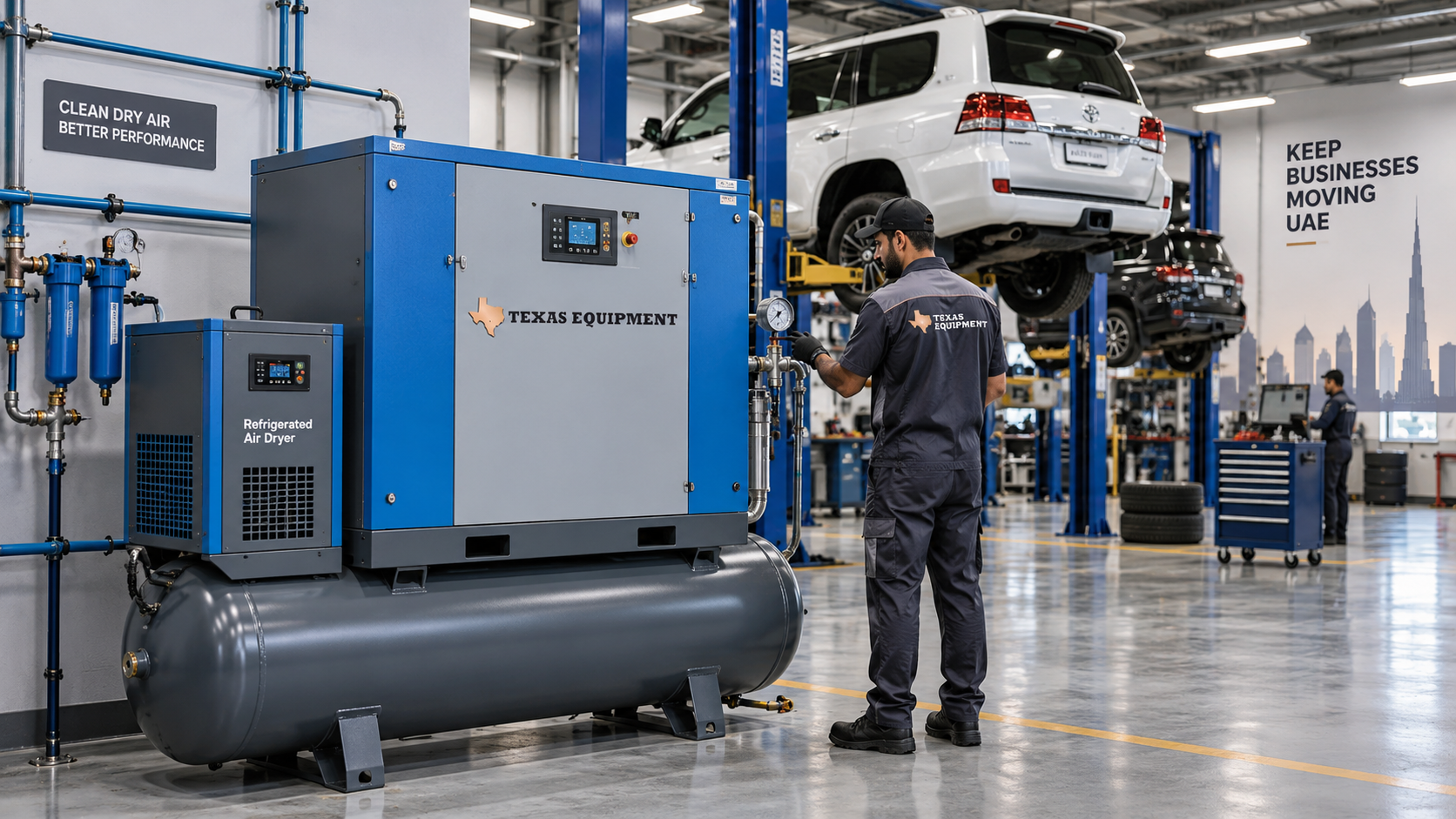
Industrial rotary screw air compressor and integrated refrigerated air dryer installed in a UAE automotive repair workshop.

The Core Mechanical Difference: Continuous Work vs Rest Breaks

The main difference between these two machines is how they compress air and handle friction:

  • Piston Compressors (Intermittent Duty): These work like a small car engine, using pistons moving up and down inside cylinders. Because metal parts create heavy friction and heat, standard piston compressors have a 50% to 60% duty cycle. That means for every 10 minutes of pumping, the machine needs 4 to 5 minutes of rest to cool down. If you force a piston unit to run non-stop all day, the valves burn out and the pump head can seize.
  • Rotary Screw Air Compressors (100% Continuous Duty): These use two spiral screws that spin smoothly together to push air through. Oil continuously cools and seals the screws, so metal parts do not grind against each other. Because of this design, a rotary screw compressor can run 100% non-stop through an entire 8 to 12 hour shift without overheating.

The 50°C Summer Heat Challenge in the Gulf

In industrial zones across Sharjah, Al Quoz in Dubai, and Musaffah in Abu Dhabi, workshop indoor heat easily tops 48°C during July and August. Hot air makes it much harder for any compressor to cool itself down.

Standard piston pumps lose about 8% of their pumping power for every 5°C jump above 40°C. Under non-stop demand, the cylinder head of a piston compressor gets hot enough to burn the oil inside into sticky carbon, causing valve leaks. A commercial rotary screw air compressor, on the other hand, comes with large oil radiators and cooling fans that keep internal temperatures stable between 75°C and 90°C, even during peak summer afternoons.

Noise Levels: Workshop Comfort and Safety

Sound level is a major factor that garage owners often forget until the machine is installed:

  • Piston Compressors (82 to 92 dBA): The rhythmic banging of pistons and slapping reed valves makes a huge racket. Working near an open piston compressor makes normal conversation impossible and causes ear strain. To work comfortably, you usually have to build a separate room outside the shop to hide the noise.
  • Rotary Screw Compressors (62 to 72 dBA): The smooth spinning of screws creates no banging or hammering sounds. Encased in a sound-dampened steel cabinet, a rotary screw unit is about as quiet as a household appliance. You can install it right next to your service bays and talk comfortably beside it.

Local Noise Regulations in Dubai and Sharjah

Local municipality safety rules in Dubai and across the UAE set daytime commercial noise limits between 60 and 70 dBA. Setting up an unshielded, 90-decibel piston compressor along an open wall can bring customer complaints or safety warnings. A cabinet screw compressor stays well within safe occupational limits without needing extra masonry walls.

Sizing Your Air System: Total Tool Demand (CFM)

Never buy a compressor based only on tank size in liters or basic horsepower (HP). What matters most is Cubic Feet per Minute (CFM), which measures how much air volume the machine delivers under pressure.

Workshop Tool Average CFM Needed (at 90 PSI / 6 Bar) Work Pattern Recommended Compressor
1/2″ Air Impact Wrench 4.5 to 6.0 CFM Short bursts (Tyre changes) Piston (1 bay) or Screw
3/4″ Heavy Duty Impact Gun 8.0 to 12.0 CFM Moderate (Trucks & SUV suspension) Rotary Screw Recommended
Automatic Tyre Changer 5.0 to 8.0 CFM Short bursts (Bead breaking) Piston or Rotary Screw
Orbital Body Sander 11.0 to 15.0 CFM Continuous non-stop sanding Rotary Screw Mandatory
Paint Spray Gun (HVLP) 12.0 to 18.0 CFM Continuous spraying Rotary Screw + Air Dryer
Pneumatic Lift / Jack 6.0 to 9.0 CFM Intermittent lifting Piston or Rotary Screw

To find the right size, add up the CFM of the tools your mechanics use at the same time and add 25% extra for line resistance. If your shop runs a 3/4″ gun (10 CFM), a tyre machine (6 CFM), and a sander (12 CFM) together, you need roughly 35 CFM. A 10 HP to 15 HP rotary screw compressor provides 38 to 55 CFM all day long without breaking a sweat, whereas a piston unit of the same size would overheat trying to keep up.

The Humidity Problem: Why an Air Dryer is Mandatory in the UAE

Compressing air squeezes out humidity like water from a sponge. In coastal cities like Dubai and Sharjah, summer air humidity often hits 75% to 85%.

A 10 HP compressor running for 8 hours in UAE summer weather pulls about 15 to 20 liters of water straight out of the atmosphere. If you do not dry this air, all that water goes right into your pipes and tools:

  • Rusted Air Tools: Water washes away tool oil, rusting inside bearings and ruining impact guns.
  • Paint Blisters: Water spraying out of a paint gun causes bubbles, peeling, and spots that ruin expensive paint jobs.
  • Corroded Rims: Wet air pumped into customer tyres oxidizes aluminum wheel rims from the inside.

This is why an inline refrigerated air dryer is essential. It cools incoming compressed air to 3°C, drops out the liquid moisture through automatic drain valves, and delivers dry, clean air to your work bays.

3-Year Cost Reality: Purchase Price vs Power Bills

A piston unit looks cheap on day one, but looking at a 3-year timeline shows why growing garages switch to screw units:

Feature Piston Compressor (10 HP) Rotary Screw Compressor (10 HP Complete Skid)
Upfront Machine Cost Lower (6,500 to 11,000 AED) Moderate (16,000 to 24,000 AED)
Daily Work Capacity 50% to 60% (Needs rest breaks) 100% continuous full output
Noise Level Loud (85+ dBA, needs separate room) Quiet (65 dBA, fits inside the bay)
Air Cleanliness High oil mist passing into lines Very clean air with built-in separators
Power Efficiency Loses efficiency as it gets hot High CFM output per kilowatt of electricity
Typical Lifespan in Gulf Heat 3 to 5 years under heavy garage work 8 to 12+ years with simple servicing

Because a screw compressor gives you more air for every unit of electricity and avoids heat breakdowns, it generally makes up the price difference within 14 to 20 months of busy workshop use.

Common Questions Workshop Owners Ask

Is a rotary screw compressor better for a car workshop than a piston compressor?

Yes, especially if you have more than two bays or use tools that run continuously like sanders and paint sprayers. A rotary screw compressor runs non-stop without overheating, keeps noise low, and delivers smooth, clean air.

How much quieter is a screw compressor compared to a piston model?

Rotary screw compressors operate around 62 to 72 dBA, meaning you can stand right next to the cabinet and speak in a normal voice. Piston compressors produce 82 to 92 dBA, creating a heavy hammering sound that usually requires a separate walled-off room.

Can a piston compressor run all day without stopping in UAE weather?

No. Piston compressors need regular rest periods. Running one non-stop in 45°C ambient heat will overheat the pump heads, burn the gaskets, and eventually seize the pistons.

Why do I need a refrigerated air dryer with my compressor?

Summer humidity in the UAE is very high. Compressing humid air produces up to 20 liters of water each day inside your air lines. A refrigerated air dryer removes this moisture before it can rust your air tools or ruin spray paint finishes.

Equip Your Workshop with Texas Equipment UAE

Avoid pressure drops, wet air lines, and summer shutdowns with an air system built specifically for high-temperature Gulf conditions. Texas Equipment supplies compact, tank-mounted rotary screw compressors, integrated refrigerated air dryers, line filters, and workshop piping across the UAE.

Visit our showrooms to see live working demonstration units:

  • Sharjah Showroom: Shop #15, BMW Road, Industrial Area 2, Sharjah.
    Landline: +971 6 552 9860 | WhatsApp: +971 54 320 1243
  • Abu Dhabi Branch: M9, 6th Street, Musaffah Industrial Area, Abu Dhabi.
    Mobile: +971 50 409 4965

Contact our technical team today to calculate your workshop air requirements or request an on-site consultation.


Screw vs. Piston Compressor: Stop Overheating & Noise in UAE Workshops

Screw vs. Piston Compressor: Stop Overheating & Noise in UAE Workshops

It is 2:00 PM in July. The temperature in your Sharjah Industrial Area workshop hits 45°C. Suddenly, your air tools stop working. Your piston compressor has overheated and shut down on thermal overload.

This is the most common summer complaint we hear from garages across the Emirates.

If you are facing downtime or noise complaints, the solution is not a “bigger fan.” The solution is upgrading to a screw air compressor in the UAE. This screw air compressor UAE guide explains why piston units fail in our climate and why a screw unit is the most profitable investment for busy workshops.

screw air compressor UAE

1. The Physics of Failure: Why Piston Compressors Overheat

The problem is the Duty Cycle. A traditional piston compressor creates massive friction and heat. It is designed to run only 50-60% of the time. It must stop to cool down.

In a hot UAE summer, the ambient air is already 40°C+. The machine cannot cool itself fast enough. If your team keeps working, the compressor never rests, the oil breaks down, and the thermal switch trips to save the motor.

The Fix:

A screw air compressor is designed for 100% Duty Cycle. It uses oil-injection cooling and can run 24/7 without stopping, even in high heat.

Stop losing labor hours to downtime.

[Browse our High-Cooling Screw Compressors]

2. Screw vs. Piston Compressor Noise Levels

If your workshop is near a residential area or inside a closed building, noise is a legal and health issue.

  • Piston Compressor: Sounds like a motorcycle revving (~90-95 dB). It causes worker fatigue and makes communication difficult.
  • Screw Compressor: Sounds like a running AC unit (~65-70 dB). You can have a normal conversation right next to it.

Commercial Insight:

A quieter workshop is a professional workshop. Customers trust a garage that doesn’t sound like a construction site.

[Check Prices for Silent Screw Compressors]

3. Energy Efficiency & UAE Government Standards

Running a compressor is expensive. A screw compressor produces more air (CFM) per kilowatt of electricity than a piston unit.

Upgrading supports the UAE Energy Strategy 2050, which aims to increase energy efficiency by 40% across industrial sectors. By switching to a high-efficiency screw unit, you reduce your carbon footprint and, more importantly, lower your monthly DEWA/SEWA bill.

Competitor Analysis: Texas Equipment vs. “Box Pushers”

Many traders in Dubai sell compressors, but few support them. Buying a sophisticated machine from a general hardware store is risky.

Feature Texas Equipment (Specialist) General Trading Companies
Air Demand Audit Yes (We calculate your CFM needs) No (They just sell you a box)
Cooling System Tropicalized (Built for 50°C+) Standard (Overheats in UAE)
Spare Parts In-Stock (Filters, Separators, Oil) “Order & Wait” (Downtime risk)
Maintenance AMC Available (Scheduled Service) No After-Sales Support

We ensure you don’t buy a machine that is too big (wasting energy) or too small (overworking).

[Request a Free Air Demand Audit]

FAQ: Screw Air Compressor UAE Buyers

Q1: What is the price difference between a piston and a screw air compressor in UAE?

A: A screw compressor has a higher initial cost (starting approx. AED 8,000 – 12,000 depending on HP) compared to a piston. However, the energy savings and lack of downtime usually pay back the difference within 12-18 months.

Q2: Do I need a massive tank with a screw compressor?

A: No. Because a screw unit produces air continuously (it doesn’t wait to pump up like a piston), you often need a smaller tank, saving valuable floor space in your garage.

Q3: Can I install a screw compressor myself?

A: It is not recommended. Screw compressors require proper electrical phase connection and rotation checks. Our team provides professional installation to ensure the warranty remains valid.

Q4: How often does a screw compressor need service?

A: Typically every 2,000 operating hours. This involves changing the oil, oil filter, and air/oil separator. We offer [Annual Maintenance Contracts (AMC)] to handle this for you.

Q5: Is a screw compressor better for paint booths?

A: Yes. Piston compressors push hot, oily air that can ruin paint jobs. Screw compressors run cooler and carry less oil carry-over, making them ideal for high-quality body shop work.

Q6: My piston compressor keeps tripping the breaker. Why?

A: This is likely due to “hard starts” or overheated motor windings. A screw compressor uses a “Soft Starter” or VFD (Variable Frequency Drive), which eliminates power spikes.

Stop Summer Downtime Today

Don’t wait for your compressor to die in the middle of a rush job. Upgrade to a machine that works as hard as your technicians.

  • Get Advice: Contact us at (+971) 6 552 9860 for a consultation.

About the Author

Ahmed Khan

Workshop Infrastructure Lead | Texas Equipment

Ahmed helps UAE garage owners transition from inefficient piston setups to high-reliability screw systems, ensuring compliance with local noise and energy standards.

The Workshop’s Powerhouse: Screw vs. Piston Air Compressor (A TCO & Noise Analysis for UAE Garages)

The Workshop’s Powerhouse: Screw vs. Piston Air Compressor (A TCO & Noise Analysis for UAE Garages).

Your air compressor is the powerhouse of your workshop. It runs your pneumatic tools, tyre changers, and is essential for your paint booth. But choosing the wrong one is a very expensive mistake that costs you money in energy bills and downtime.

This guide compares the two main types of professional garages: the traditional Piston compressor and the modern screw air compressor in the UAE.

screw air compressor UAE

Piston vs. Screw: Quick Comparison Table

This table breaks down the most important differences for a business owner.

Feature Piston Air Compressor Screw Air Compressor
Duty Cycle Intermittent (30-60%) 100% Continuous
Noise Level Very Loud (85-95 dB) Quiet (60-70 dB)
Upfront Cost Low High
Energy Cost (TCO) High (Inefficient) Low (Very Efficient)
Air Quality Hotter, Oily, Wette Cooler, Cleaner, Drier
Best For Small garages, intermittent use Body shops, high-volume garages

Our Lead Technician’s Tip:

“The biggest mistake we see is a new body shop trying to save money with a large piston compressor. It’s a disaster. The noise is so loud your staff can’t think. But the real problem is air quality. The piston compressor runs hot and can’t run 100% of the time. It sends hot, humid air to the paint gun, which overwhelms the dryer. This causes ‘fisheyes’ and moisture bubbles, ruining thousands of dirhams in paintwork. For a professional paint booth, you must have a screw air compressor.”

What is a Piston Compressor Good For?

A piston compressor is a great, low-cost choice for many smaller workshops. If your garage only needs air intermittently—for a tyre changer, a half-inch impact wrench, or an air-blow gun—a piston model works well.

Its main weakness is its “duty cycle.” This means it needs to rest and cool down. It is not designed to run all day, every day.

Why Do Body Shops & High-Volume Garages Need a Screw Compressor?

You must invest in a screw air compressor if your garage has a high air demand.

  1. 100% Duty Cycle: It is built to run 24/7 without stopping or overheating. This is a must for a paint booth or a large garage running multiple lifts and air tools at once.
  2. Energy Efficiency (The TCO): This is the main point. A screw compressor is 20-30% more energy efficient. While the upfront cost is higher, it saves you thousands of AED per year on your DEWA or SEWA bill. Over 3 years, the screw compressor is often the cheaper machine.
  3. Noise: A screw compressor is quiet, often around 60-70 dB (like a conversation). A piston compressor is 85-95 dB (like a lawnmower). A quieter shop is a safer and more productive shop.
  4. Air Quality: Because it runs cooler, the compressed air is easier to dry. This is critical for painting and protecting your expensive pneumatic tools from rust.

This focus on efficiency aligns with the UAE’s industrial development goals, which support modern, sustainable technology in workshops.

Regular service is key to this efficiency. An Annual Maintenance Contract (AMC) for your compressor is the best way to protect your investment and ensure it continues to run at peak performance.

Screw Air Compressor UAE FAQ

Q1: What size compressor do I need for a small garage (2-3 bays)?

A: For 2-3 bays doing mechanical work, a 200-300L piston compressor is often a good start. If one of those bays is for painting, you must get a screw compressor (at least 5-7.5 HP) to keep up with the demand.

Q2: How much more expensive is a screw air compressor?

A: Upfront, a screw compressor can cost 2-3 times more than a piston compressor of the same horsepower. However, it pays back this cost in 2-4 years through energy savings alone, making it a better long-term investment.

Q3: Do I still need an air dryer with a screw air compressor?

A: Yes. You always need a dryer in the humid UAE climate, especially for painting. However, because the screw compressor produces cooler air, the dryer’s job is much easier, resulting in far better final air quality.

Q4: How often does a screw air compressor need maintenance?

A: It requires regular service, just like a car. It needs its oil, oil filter, and air filter changed on a set schedule (usually every 2,000 hours or as recommended). An AMC plan is the easiest way to manage this.

Ready to Power Your Workshop?

Don’t let the wrong compressor drain your profits. Whether you need a simple, reliable piston model or a high-efficiency screw air compressor, our team can help you calculate your exact needs.

About the Author

Ahmed Khan is a Workshop Infrastructure Specialist at Texas Equipment. With a background in industrial engineering, Ahmed has designed the compressed air systems for over 100 workshops. He is an expert in TCO analysis, helping garage owners save money by matching their air demand to the most efficient equipment.