Written by Rajesh Sharma, Workshop Systems Lead | Reviewed by Technical Services Division, Texas Equipment UAE
Choosing the right spot welding machine is now a make-or-break decision for automotive body shops across the UAE. If your garage still attempts structural chassis repairs using standard MIG torches or outdated transformer equipment, your business faces rejected insurance claims and serious liability. Modern collision repair across Dubai, Sharjah, and Abu Dhabi demands verified factory-level resistance joining.
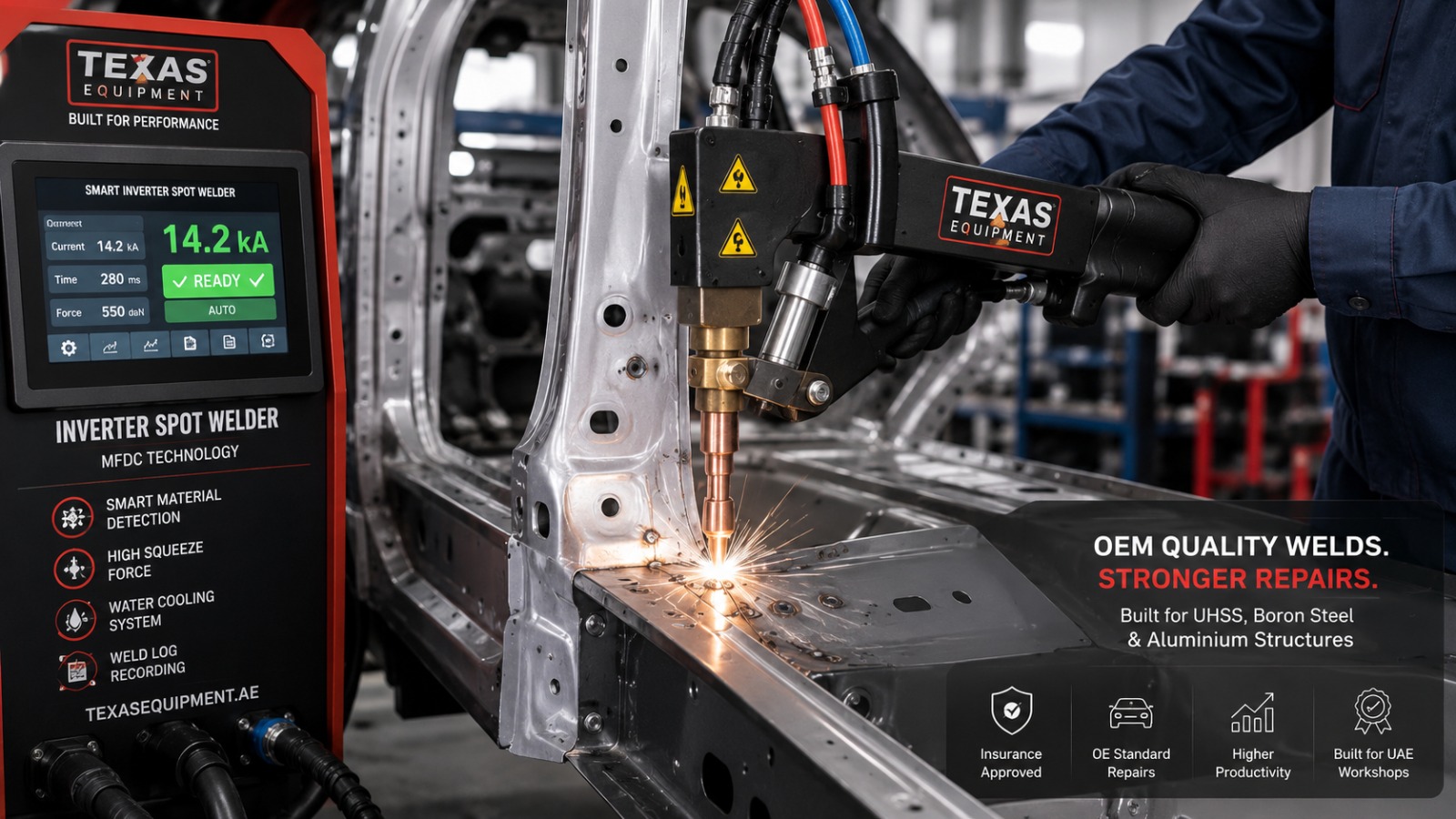
Modern vehicles no longer use soft, forgiving sheet metal for their internal frames. Today’s passenger sedans, commercial delivery vans, and full-size SUVs rely heavily on Ultra-High-Strength Steel (UHSS) and hot-stamped Boron steel rated up to 1,500 Megapascals (MPa). Repairing these crash-safety cells requires a dedicated inverter spot welding machine capable of delivering high clamping force, stabilized direct current, and printable quality logs.
While local machine sellers in industrial areas often hand you a basic catalog sheet listing prices between 14,000 and 22,000 AED, they rarely explain the real challenge: buying a welder that merely melts metal will not protect your shop if the insurance engineer rejects the finished repair.
Why Modern Car Steels Cause Insurance Claim Rejections
The high-strength alloys used in modern vehicle chassis protect passengers by redirecting crash energy around the cabin. However, their unique metallurgy makes workshop repairs unforgiving:
- The Heat Affected Zone (HAZ) Problem: Traditional mild steel absorbs prolonged heat without catastrophic failure. Boron steel and UHSS, by contrast, gain their strength from specialized factory heating and rapid quenching. Applying a continuous MIG torch or an uncalibrated welder introduces excessive heat into the surrounding area. This anneals the steel, leaving the metal brittle or dangerously soft. In a subsequent collision, that repaired pillar will tear open rather than protect the cabin.
- Structural Adhesives in Factory Seams: Modern car manufacturers bond frame panels with high-strength structural epoxies alongside spot welds. If a welding gun cannot generate enough clamping pressure to squeeze the adhesive out of the direct weld zone before the current fires, the glue burns. This creates internal porosity, severe arcing, and weak joints that fail non-destructive chisel tests.
- Insurance Liability and Roadworthiness Audits: Under roadworthiness safety standards enforced in the UAE, collision repair facilities must match factory structural integrity. If an insurance surveyor identifies scorched panels, uneven puddle welds, or heat-warped pillars, the claim will be rejected immediately, leaving your workshop to cover the repair costs.
Transformer vs Inverter: Choosing the Right Spot Welding Machine
Most local distributor listings focus entirely on machine amperage while ignoring the technology behind power delivery and clamp mechanics.
1. Electrical Current: 50 Hz AC vs 1,000 Hz to 2,000 Hz MFDC
Traditional transformer spot welders run on standard 50 Hz alternating current. Because AC current constantly shifts polarity, power drops to zero 100 times every second. These electrical ripples cause metal spatter, inconsistent nugget fusion, and surface burning on sensitive high-strength steels.
Commercial inverter spot welders utilize Medium Frequency Direct Current (MFDC) operating between 1,000 Hz and 2,000 Hz. The inverter converts 3-phase workshop power into smooth, continuous direct current. This delivers uniform electrical energy through high-tensile panels, creating a clean weld nugget in milliseconds without burning through delicate outer panels.
2. Clamping Force: The Difference Between a Solid Nugget and a Burn-Through
Clamping force is just as critical as electrical amperage. Manual spot guns squeeze with only 150 to 250 decanewtons (daN) of pressure. When high current hits a loosely clamped panel, the electrical resistance causes an explosive spark that blows a hole straight through the sheet.
High-strength steel requires pneumatic or liquid-cooled C-tongs that deliver 450 to 600+ daN of clamping force. This mechanical squeeze forces the panel layers flat, drives out structural adhesives, and creates the tight metal-to-metal contact required for a uniform weld nugget.
Inverter Spot Welder Comparison: Commercial Workshop Guide
| Equipment Specification | Basic AC Transformer Welder | Mid-Tier Inverter Welder (10,000A) | Texas Equipment Smart MFDC Inverter (13,000A to 14,500A) |
| Welding Current Type | 50 Hz Alternating Current (AC) | Inverter DC (Basic control) | Medium Frequency Direct Current (MFDC) |
| Max Output Current | 6,000 to 8,000 Amps | 9,000 to 10,500 Amps | 13,000 to 14,500 Amps genuine output |
| Pneumatic Clamping Force | 180 to 250 daN (Manual/Weak) | 350 to 450 daN | 500 to 600+ daN (Liquid-cooled pneumatic C-tong) |
| Material Capability | Mild steel only | High-Strength Steel (HSS) | Boron Steel, UHSS, USIBOR, Galvanized, and Aluminium |
| Cooling Mechanism | Fan/Air cooled (Overheats quickly) | Basic internal water tank | High-capacity radiator with liquid-cooled arms and tips |
| Material Sensing | Manual dial adjustments | Basic preset menus | Smart automatic thickness and resistance detection |
| Digital Audit Logging | None | Basic screen display | USB data export (Time, date, force, current, pass/fail) |
| UAE Insurance Compliance | High rejection rate on structural jobs | Acceptable for cosmetic repairs | 100% compliant for structural chassis certification |
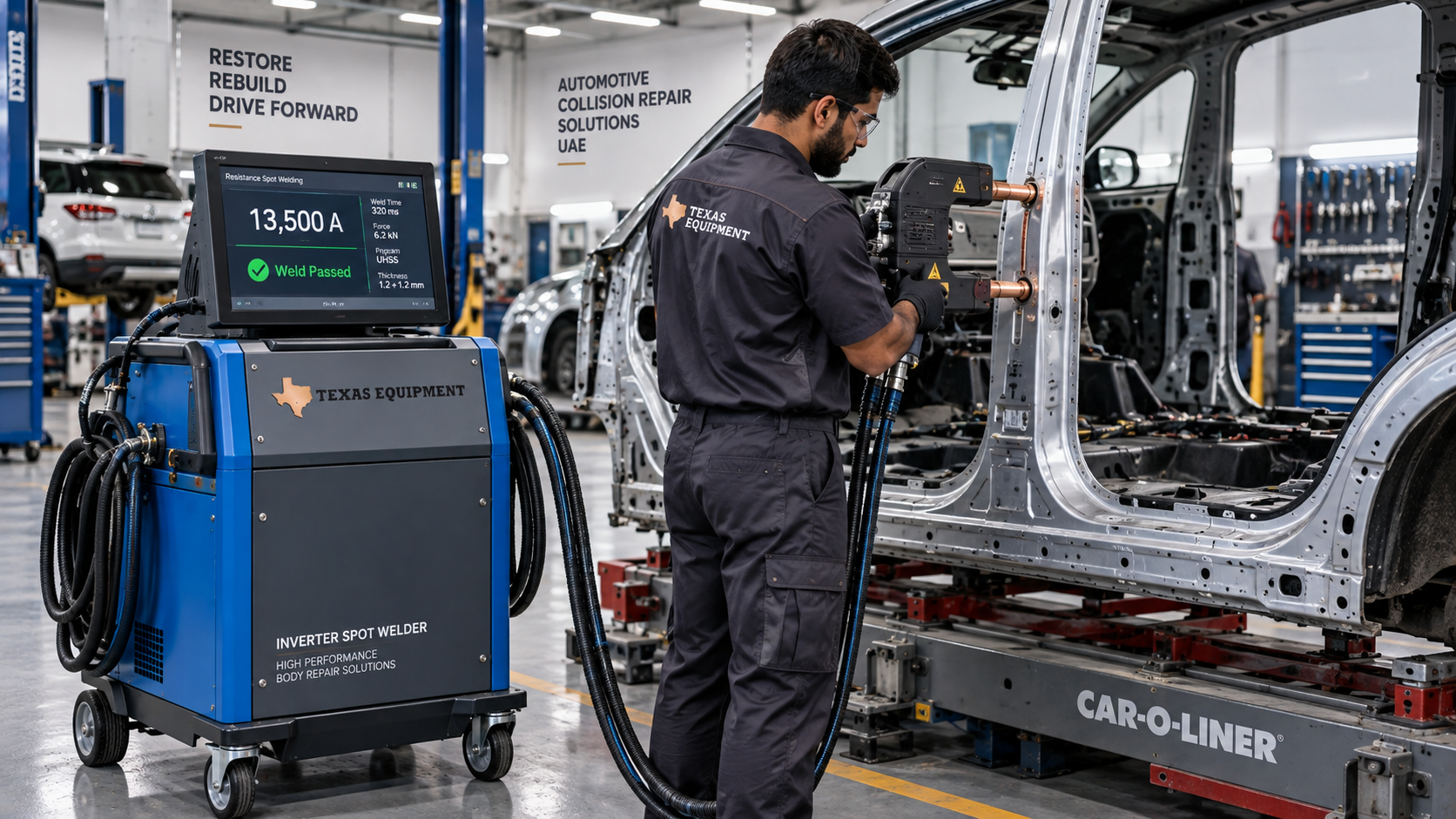
The Audit Factor: USB Quality Logging That Protects Your Invoices
In previous years, an insurance estimator checked body repairs with a visual inspection or a quick tap of a hammer. Today, certified fleet operators and major insurance underwriters expect verifiable technical proof that repairs match factory crash standards.
Smart inverter spot welders remove human guesswork by integrating automated quality control sensors:
- Real-Time Parameter Monitoring: As the trigger is pulled, onboard sensors measure actual secondary current, clamp pressure, and electrical resistance thousands of times per second.
- Automated Pass/Fail Warnings: If a technician attempts to weld through thick e-coat primer, releases the trigger too early, or works with worn electrode tips, the unit sounds an audible alert and logs a failed weld.
- Exportable USB Job Files: Every completed weld is stored in memory. Technicians can export a complete digital log to a USB flash drive, listing the exact date, time, amperage, and clamping force for every spot weld on that job card. Attaching this report to your insurance invoice provides undeniable proof of structural compliance, speeding up payment releases.
4 Practical Bay Steps to Pass Structural Inspections Every Time
1. Remove Coatings from Direct Contact Points
Even high-end smart welders cannot overcome heavy paint or rust on outer electrode contact points. Grind the metal down to clean, bare steel where the copper tips make contact, ensuring zero electrical resistance before clamping.
2. Dress Copper Electrode Tips Daily
Mushroomed or pitted electrode tips spread electrical current over an excessively large surface area. This drops current density and creates undersized, weak weld nuggets. Use a calibrated pneumatic or manual tip dresser every morning to maintain the factory 5 mm to 6 mm tip profile.
3. Conduct a Morning Destructive Peel Test
Before welding a customer vehicle, take two scrap off-cuts of matching panel thickness. Run a test spot weld, clamp one piece in a bench vise, and peel the other strip back using locking pliers. The weld nugget must tear a solid round plug out of the parent sheet metal rather than unzipping cleanly at the seam.
4. Provide Dedicated 3-Phase Industrial Power
A commercial spot welder delivering 14,000 Amps at the electrode tips demands clean, stable electricity. Running the machine through long, undersized extension cords causes voltage drops that trip workshop breakers mid-weld. Connect your unit directly to a dedicated 32A or 63A 3-phase industrial supply.
Frequently Asked Questions
Why do UAE insurance adjusters reject MIG plug welds on structural pillars?
MIG plug welding generates intense, continuous heat that ruins the delicate heat treatment of high-strength boron steel, leaving structural joints brittle. Insurance engineers require factory-style resistance spot welding to preserve original crash-test ratings.
How much welding current is actually needed for modern high-strength steels?
To overcome internal adhesive layers and properly fuse multi-layer UHSS structural posts, a body shop spot welder must deliver a genuine minimum of 12,000 to 13,000 Amps of inverter direct current (MFDC).
Can a smart inverter spot welder weld automotive aluminium?
Yes. When equipped with specialized aluminium welding programs and dedicated electrode arms, advanced inverter welders deliver the rapid, high-energy current bursts needed to weld aluminium chassis panels found on modern Land Rover, Audi, and Ford vehicles.
Why is liquid cooling mandatory for spot welders in the UAE?
High workshop ambient temperatures during summer cause air-cooled welding arms to overheat after just a few welds. Liquid-cooling systems circulate chilled fluid directly through the transformer, C-tong arms, and copper caps, allowing non-stop production without thermal shutdowns.
Equip Your Body Shop with Texas Equipment UAE
Upgrade your collision repair capability with certified inverter spot welding systems, computerized chassis alignment benches, digital dent pullers, and downdraft spray booths. Texas Equipment provides on-site machine commissioning, operator training, and local spare parts support across the UAE.
Visit our regional showrooms to test live demonstration welding stations:
- Sharjah Showroom & Technical Centre: Shop #15, BMW Road, Industrial Area 2, Sharjah.
Landline: +971 6 552 9860 | WhatsApp: +971 54 320 1243 - Abu Dhabi Musaffah Branch: M9, 6th Street, Musaffah Industrial Area, Abu Dhabi.
Mobile: +971 50 409 4965
Contact our workshop engineering team today to review your body shop machinery requirements or request an on-site equipment demonstration.