
Written by Rajesh Sharma, Technical Service Lead | Reviewed by Technical Services Division, Texas Equipment UAE
Operating a busy vehicle service workshop in the UAE puts massive stress on your air system. When two or three mechanics run air impact guns, tyre changers, and sanders at the same time, pressure drops can stop work completely. If your shop still runs an older piston compressor, you probably deal with machines shutting down on hot summer afternoons, wet air ruining paint jobs, and a loud clatter that gives everyone a headache.
Choosing between a standard piston unit and an industrial rotary screw air compressor comes down to work volume, heat handling, noise, and air cleanliness. A piston compressor works fine for a tiny garage with one bay and occasional use. But for a commercial workshop handling multiple cars daily, pushing a piston pump beyond its limits leads to burnt valves and constant downtime once summer temperatures cross 45°C.
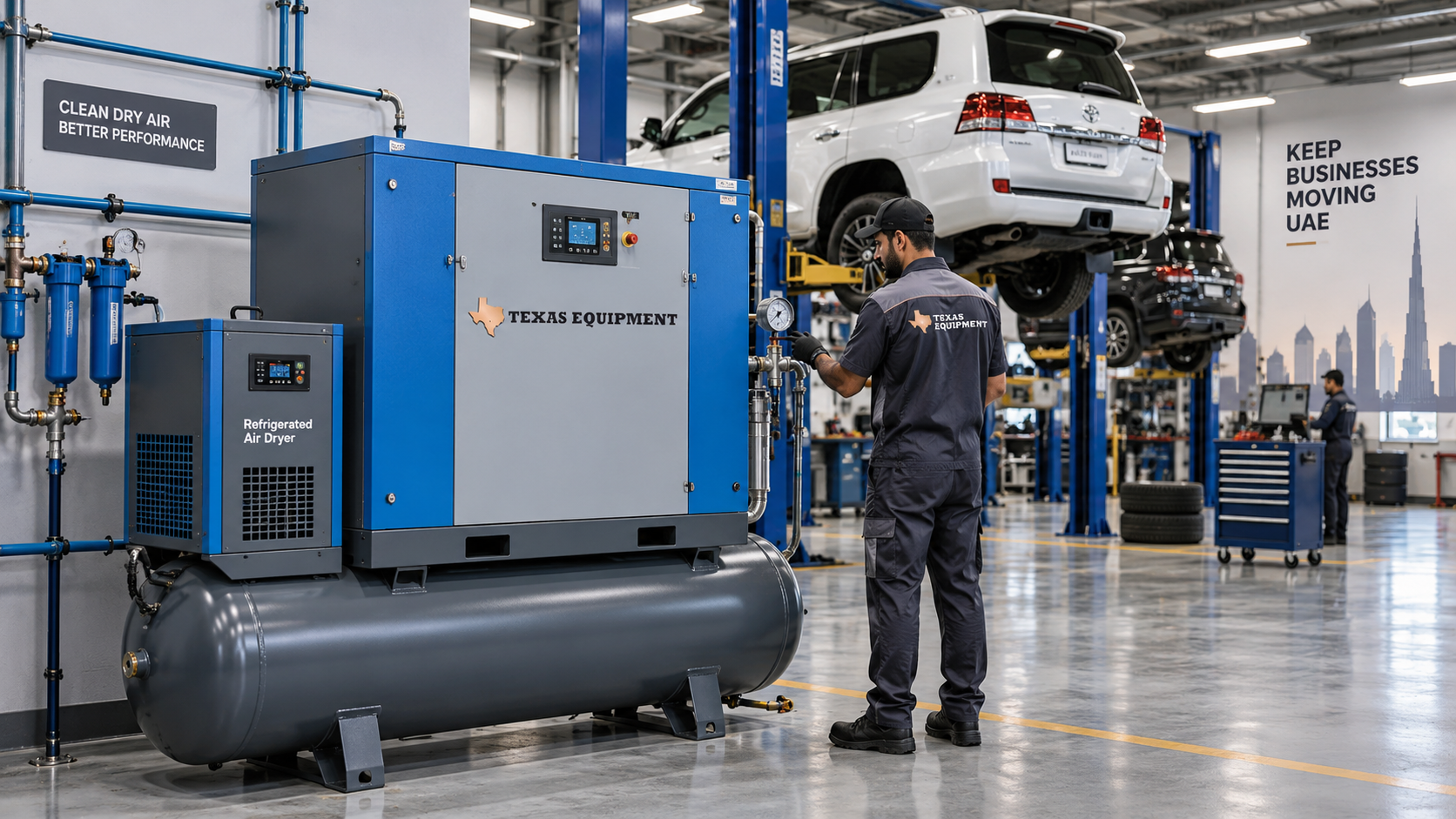
The Core Mechanical Difference: Continuous Work vs Rest Breaks
The main difference between these two machines is how they compress air and handle friction:
- Piston Compressors (Intermittent Duty): These work like a small car engine, using pistons moving up and down inside cylinders. Because metal parts create heavy friction and heat, standard piston compressors have a 50% to 60% duty cycle. That means for every 10 minutes of pumping, the machine needs 4 to 5 minutes of rest to cool down. If you force a piston unit to run non-stop all day, the valves burn out and the pump head can seize.
- Rotary Screw Air Compressors (100% Continuous Duty): These use two spiral screws that spin smoothly together to push air through. Oil continuously cools and seals the screws, so metal parts do not grind against each other. Because of this design, a rotary screw compressor can run 100% non-stop through an entire 8 to 12 hour shift without overheating.
The 50°C Summer Heat Challenge in the Gulf
In industrial zones across Sharjah, Al Quoz in Dubai, and Musaffah in Abu Dhabi, workshop indoor heat easily tops 48°C during July and August. Hot air makes it much harder for any compressor to cool itself down.
Standard piston pumps lose about 8% of their pumping power for every 5°C jump above 40°C. Under non-stop demand, the cylinder head of a piston compressor gets hot enough to burn the oil inside into sticky carbon, causing valve leaks. A commercial rotary screw air compressor, on the other hand, comes with large oil radiators and cooling fans that keep internal temperatures stable between 75°C and 90°C, even during peak summer afternoons.
Noise Levels: Workshop Comfort and Safety
Sound level is a major factor that garage owners often forget until the machine is installed:
- Piston Compressors (82 to 92 dBA): The rhythmic banging of pistons and slapping reed valves makes a huge racket. Working near an open piston compressor makes normal conversation impossible and causes ear strain. To work comfortably, you usually have to build a separate room outside the shop to hide the noise.
- Rotary Screw Compressors (62 to 72 dBA): The smooth spinning of screws creates no banging or hammering sounds. Encased in a sound-dampened steel cabinet, a rotary screw unit is about as quiet as a household appliance. You can install it right next to your service bays and talk comfortably beside it.
Local Noise Regulations in Dubai and Sharjah
Local municipality safety rules in Dubai and across the UAE set daytime commercial noise limits between 60 and 70 dBA. Setting up an unshielded, 90-decibel piston compressor along an open wall can bring customer complaints or safety warnings. A cabinet screw compressor stays well within safe occupational limits without needing extra masonry walls.
Sizing Your Air System: Total Tool Demand (CFM)
Never buy a compressor based only on tank size in liters or basic horsepower (HP). What matters most is Cubic Feet per Minute (CFM), which measures how much air volume the machine delivers under pressure.
| Workshop Tool | Average CFM Needed (at 90 PSI / 6 Bar) | Work Pattern | Recommended Compressor |
| 1/2″ Air Impact Wrench | 4.5 to 6.0 CFM | Short bursts (Tyre changes) | Piston (1 bay) or Screw |
| 3/4″ Heavy Duty Impact Gun | 8.0 to 12.0 CFM | Moderate (Trucks & SUV suspension) | Rotary Screw Recommended |
| Automatic Tyre Changer | 5.0 to 8.0 CFM | Short bursts (Bead breaking) | Piston or Rotary Screw |
| Orbital Body Sander | 11.0 to 15.0 CFM | Continuous non-stop sanding | Rotary Screw Mandatory |
| Paint Spray Gun (HVLP) | 12.0 to 18.0 CFM | Continuous spraying | Rotary Screw + Air Dryer |
| Pneumatic Lift / Jack | 6.0 to 9.0 CFM | Intermittent lifting | Piston or Rotary Screw |
To find the right size, add up the CFM of the tools your mechanics use at the same time and add 25% extra for line resistance. If your shop runs a 3/4″ gun (10 CFM), a tyre machine (6 CFM), and a sander (12 CFM) together, you need roughly 35 CFM. A 10 HP to 15 HP rotary screw compressor provides 38 to 55 CFM all day long without breaking a sweat, whereas a piston unit of the same size would overheat trying to keep up.
The Humidity Problem: Why an Air Dryer is Mandatory in the UAE
Compressing air squeezes out humidity like water from a sponge. In coastal cities like Dubai and Sharjah, summer air humidity often hits 75% to 85%.
A 10 HP compressor running for 8 hours in UAE summer weather pulls about 15 to 20 liters of water straight out of the atmosphere. If you do not dry this air, all that water goes right into your pipes and tools:
- Rusted Air Tools: Water washes away tool oil, rusting inside bearings and ruining impact guns.
- Paint Blisters: Water spraying out of a paint gun causes bubbles, peeling, and spots that ruin expensive paint jobs.
- Corroded Rims: Wet air pumped into customer tyres oxidizes aluminum wheel rims from the inside.
This is why an inline refrigerated air dryer is essential. It cools incoming compressed air to 3°C, drops out the liquid moisture through automatic drain valves, and delivers dry, clean air to your work bays.
3-Year Cost Reality: Purchase Price vs Power Bills
A piston unit looks cheap on day one, but looking at a 3-year timeline shows why growing garages switch to screw units:
| Feature | Piston Compressor (10 HP) | Rotary Screw Compressor (10 HP Complete Skid) |
| Upfront Machine Cost | Lower (6,500 to 11,000 AED) | Moderate (16,000 to 24,000 AED) |
| Daily Work Capacity | 50% to 60% (Needs rest breaks) | 100% continuous full output |
| Noise Level | Loud (85+ dBA, needs separate room) | Quiet (65 dBA, fits inside the bay) |
| Air Cleanliness | High oil mist passing into lines | Very clean air with built-in separators |
| Power Efficiency | Loses efficiency as it gets hot | High CFM output per kilowatt of electricity |
| Typical Lifespan in Gulf Heat | 3 to 5 years under heavy garage work | 8 to 12+ years with simple servicing |
Because a screw compressor gives you more air for every unit of electricity and avoids heat breakdowns, it generally makes up the price difference within 14 to 20 months of busy workshop use.
Common Questions Workshop Owners Ask
Is a rotary screw compressor better for a car workshop than a piston compressor?
Yes, especially if you have more than two bays or use tools that run continuously like sanders and paint sprayers. A rotary screw compressor runs non-stop without overheating, keeps noise low, and delivers smooth, clean air.
How much quieter is a screw compressor compared to a piston model?
Rotary screw compressors operate around 62 to 72 dBA, meaning you can stand right next to the cabinet and speak in a normal voice. Piston compressors produce 82 to 92 dBA, creating a heavy hammering sound that usually requires a separate walled-off room.
Can a piston compressor run all day without stopping in UAE weather?
No. Piston compressors need regular rest periods. Running one non-stop in 45°C ambient heat will overheat the pump heads, burn the gaskets, and eventually seize the pistons.
Why do I need a refrigerated air dryer with my compressor?
Summer humidity in the UAE is very high. Compressing humid air produces up to 20 liters of water each day inside your air lines. A refrigerated air dryer removes this moisture before it can rust your air tools or ruin spray paint finishes.
Equip Your Workshop with Texas Equipment UAE
Avoid pressure drops, wet air lines, and summer shutdowns with an air system built specifically for high-temperature Gulf conditions. Texas Equipment supplies compact, tank-mounted rotary screw compressors, integrated refrigerated air dryers, line filters, and workshop piping across the UAE.
Visit our showrooms to see live working demonstration units:
- Sharjah Showroom: Shop #15, BMW Road, Industrial Area 2, Sharjah.
Landline: +971 6 552 9860 | WhatsApp: +971 54 320 1243 - Abu Dhabi Branch: M9, 6th Street, Musaffah Industrial Area, Abu Dhabi.
Mobile: +971 50 409 4965
Contact our technical team today to calculate your workshop air requirements or request an on-site consultation.
