Heavy-Duty Tyre Changers and 3D Wheel Balancers: Complete UAE Workshop Buying Guide

Equipping your garage with an automatic tyre changer with a helper arm and a digital 3D wheel balancer ensures you can service modern low-profile run-flat tyres and heavy SUV wheels without scratching alloy rims. Basic manual tyre changers damage expensive customer wheels, struggle with stiff beads in summer, and slow down your bay during peak seasonal replacement months.

Written by: Tariq Mansoor, Senior Workshop Installation Specialist

Over 12 years outfitting commercial automotive workshops across Sharjah Industrial Area 2, Al Quoz, and Musaffah.
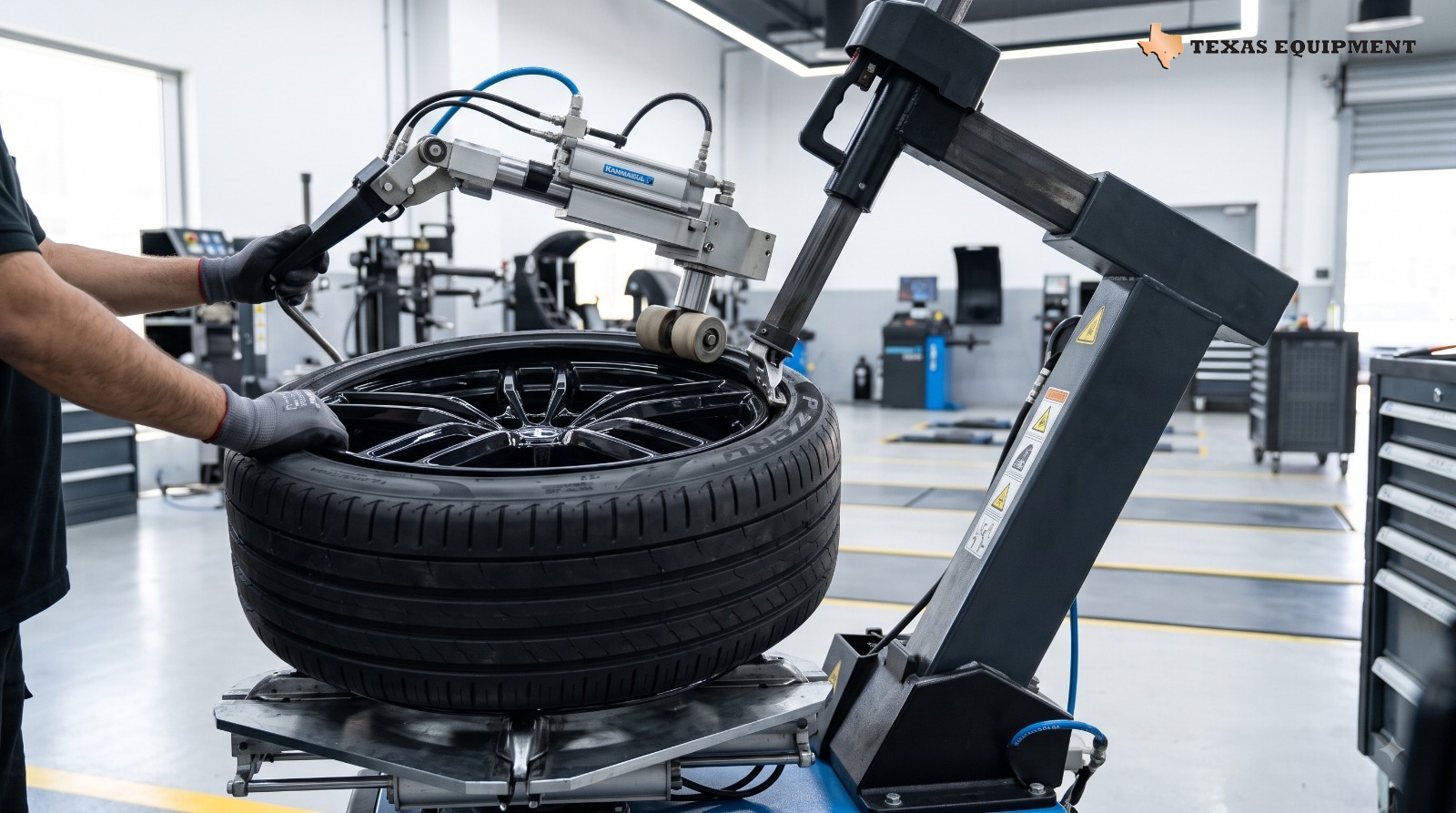
Tyre Changer Machine

The Post-Summer Tyre Replacement Demand in the UAE

August and September see a massive surge in tyre replacement across Dubai, Sharjah, and Abu Dhabi. Extreme summer road surface temperatures (often exceeding 60°C) accelerate rubber degradation, causing cracking, tread separation, and sidewall bulges on passenger and commercial vehicles.

During this period, vehicle owners rush to replace tyres before annual registration renewals. Under federal traffic safety rules enforced by the Roads and Transport Authority (RTA) and technical standards monitored by the Ministry of Industry and Advanced Technology (MoIAT), any vehicle with tyre tread depth below 1.6mm, visible sidewall cracks, or tyres older than 5 years will fail technical passing immediately.

For tyre shops and independent garages, handling this volume requires machinery that mounts and balances wheels quickly without damaging sensitive pressure sensors (TPMS) or custom alloy rims.

Comparing Semi-Automatic vs. Fully Automatic Tyre Service Equipment

Choosing the right machinery combination determines how fast your mechanics work and what wheel sizes you can accept. Explore our current stock on the Texas Equipment machinery store.

Machinery Feature Semi-Automatic Swing-Arm Unit Fully Automatic Tilt-Back Unit Heavy-Duty Automatic with Helper Arm Tyre Shop Advantage
Max Rim Diameter Up to 20 inches Up to 24 inches Up to 26 inches Handles heavy Nissan Patrol, Land Cruiser, and truck rims
Run-Flat Capability Difficult (High bead risk) Moderate (Requires 2 techs) Effortless (Single tech with pneumatic assist arm) Eliminates tyre bead tears and rim scratching
Balancing Technology Manual 2D data entry Digital 2D entry High-precision 3D sonar/laser measurement Eliminates high-speed steering vibration complaints
Clamping Protection Standard metal jaws Plastic jaw protectors Integrated non-marking nylon covers Protects expensive painted and diamond-cut wheels
Service Speed Per Wheel 12 to 15 minutes 8 to 10 minutes Under 5 minutes Triples daily bay turnover during busy seasons
Average Investment 7,500 to 11,000 AED 13,500 to 19,000 AED 21,000 to 32,000 AED Recovers cost rapidly through high-volume wheel sales

5 Practical Steps to Set Up a High-Volume Tyre Service Bay

Step 1: Add a Pneumatic Helper Assist Arm

Modern luxury cars and SUVs use stiff run-flat tyres with low aspect ratios (such as 35, 40, and 45 series). Manually prying these tyres over the mounting head with a crowbar will scratch the rim and tear the inner bead. A multi-function pneumatic assist arm holds the bead down into the drop center automatically, allowing one technician to mount tough tyres easily.

Step 2: Choose 3D Automatic Data Entry Wheel Balancers

Older wheel balancers require the operator to manually measure rim distance, diameter, and width with a ruler. 3D wheel balancers use automatic measuring arms and sonar sensors to capture all dimensions instantly, calculating exact hidden tape weight positions in seconds.

Step 3: Protect TPMS Sensors During Demounting

Tyre Pressure Monitoring System (TPMS) sensors are easily broken if the bead breaker shovel strikes the valve stem area. Train your technicians to position the valve stem at the 12 o’clock position before breaking the bead and use non-magnetic mounting tools.

Step 4: Ensure Stable Compressed Air Supply

Heavy-duty bead seating and pneumatic assist arms require strong, dry air volume. Connect your tyre changer to a dedicated air line providing a steady 8 to 10 bar pressure with an inline air lubricator and moisture filter.

Step 5: Calibrate Balancer Shafts Periodically

Continuous daily balancing shifts can throw off shaft accuracy. Run a self-calibration routine using a certified 100-gram calibration weight every week to keep balancer readings accurate down to 1 gram.

Frequently Asked Questions

What is the advantage of a tilt-back tyre changer over a swing-arm model?

On a tilt-back machine, the vertical column tilts backward pneumatically with a foot pedal, locking into the exact rim setting automatically. This saves setup time when servicing four identical wheels and provides greater rigidity for heavy SUV tyres.

Can automatic tyre changers handle diamond-cut alloy wheels without damage?

Yes, provided the machine is equipped with heavy-duty plastic clamping jaw covers, a plastic mounting head insert, and a pneumatic bead press roller that keeps metal tools away from the rim surface.

Why do customer cars experience steering vibration even after wheel balancing?

If the wheel balancer calibration is off by even 5 grams, or if dirt on the wheel mounting hub prevents flush centering on the balancer cone, high-speed vibration will occur on highways like Sheikh Zayed Road.

Where can I get replacement tyre changer seals, valves, and mounting heads in Sharjah?

Texas Equipment maintains a fully stocked inventory of replacement mounting heads, plastic protectors, pneumatic cylinder seal kits, and balancer cones at our Sharjah and Abu Dhabi warehouses for immediate delivery.

Equip Your Workshop with Texas Equipment UAE

Upgrade your tyre bay with commercial tyre changers, digital 3D wheel balancers, and pneumatic bead seating tools built for heavy daily use.

  • Sharjah Head Office & Showroom: Shop #15 BMW Road, Industrial Area 2, Sharjah.
    Landline: +971 6 552 9860 | WhatsApp / Mobile: +971 54 320 1243
  • Abu Dhabi Musaffah Branch: M9 6th Street, Musaffah Industrial Area, Abu Dhabi.
    WhatsApp / Mobile: +971 50 409 4965

Visit the Texas Equipment Contact Page to speak with our technical team and request an equipment package quote for your shop.

Commercial Vehicle Maintenance Market Continues to Expand Across Dubai and Abu Dhabi

Published: July 22, 2026
Category: Commercial Transport & Fleet Industry News | UAE
Author: Editorial Team, Texas Equipment Trading

Commercial Fleet Growth Fuels Demand for Professional Maintenance Equipment Across the UAE

The commercial vehicle maintenance sector in the United Arab Emirates is experiencing steady growth as logistics companies, construction firms, passenger transport operators, and delivery businesses continue to expand their fleets. Industry experts say this growth is creating increased demand for professional workshop equipment capable of supporting faster servicing, preventive maintenance, and higher workshop productivity.

With commercial vehicles operating for longer hours and covering greater distances each day, fleet operators are placing greater emphasis on minimizing downtime through efficient maintenance programs. This has encouraged workshops across Dubai, Abu Dhabi, Sharjah, and the Northern Emirates to invest in modern lifting equipment, diagnostic systems, tyre service machinery, hydraulic tools, and workshop automation technologies.

Logistics and Transport Industries Continue to Drive Market Expansion

The UAE remains one of the Middle East’s leading logistics hubs, supported by world-class ports, airports, free zones, and transportation infrastructure. Growth in e-commerce, regional trade, and industrial activity has increased the number of commercial vehicles operating across the country.

From delivery vans and refrigerated trucks to heavy construction vehicles and passenger buses, fleet operators are managing larger vehicle inventories than ever before. As a result, demand for efficient maintenance services has risen significantly.

Industry analysts note that proactive maintenance has become a strategic priority for businesses seeking to improve fleet reliability while reducing unexpected repair costs.

Fleet Operators Focus on Preventive Maintenance

Rather than waiting for mechanical failures, many fleet operators are adopting preventive maintenance strategies to keep vehicles operating efficiently.

Routine inspections and scheduled servicing help identify potential issues before they develop into major mechanical problems.

Preventive maintenance programs commonly include:

  • Engine diagnostics
  • Brake inspections
  • Suspension checks
  • Battery testing
  • Tyre inspections
  • Wheel alignment
  • Fluid monitoring
  • Hydraulic system inspections

Fleet managers say regular maintenance not only improves vehicle reliability but also contributes to better fuel efficiency and lower long-term operating costs.

Workshops Upgrade Equipment to Meet Fleet Requirements

As commercial vehicle maintenance becomes increasingly specialized, workshops are investing in equipment designed to handle larger and heavier vehicles.

Professional maintenance facilities are expanding their capabilities with:

  • Heavy-duty two-post vehicle lifts
  • Hydraulic bottle jacks
  • Engine cranes
  • Hydraulic shop presses
  • Commercial diagnostic scanners
  • Wheel alignment systems
  • Wheel balancing equipment
  • Air compressors
  • Tool trolleys and workshop storage systems

These investments allow workshops to complete repairs more efficiently while improving technician safety.

Reducing Vehicle Downtime Remains a Top Priority

Every hour a commercial vehicle remains off the road can affect delivery schedules, customer commitments, and operational profitability.

For logistics companies and fleet operators, reducing downtime has become one of the most important maintenance objectives.

Modern workshop equipment enables technicians to:

  • Identify faults more quickly.
  • Complete repairs efficiently.
  • Improve workshop workflow.
  • Reduce service turnaround times.
  • Increase daily repair capacity.

Industry professionals believe that equipment investments play an essential role in supporting business continuity across transport-dependent industries.

Technology is Transforming Fleet Maintenance

Commercial vehicle maintenance is becoming increasingly data-driven.

Advanced diagnostic systems now provide technicians with real-time information on engine performance, emissions systems, braking components, transmission operation, and electronic control modules.

Digital inspection tools allow maintenance teams to identify issues before warning lights appear, helping businesses schedule repairs at convenient times rather than responding to unexpected breakdowns.

Industry observers expect diagnostic technology to play an increasingly important role as connected commercial vehicles become more common throughout the UAE.

Safety Standards Continue to Influence Investment Decisions

Vehicle safety remains a critical consideration for fleet operators.

Regular servicing supported by professional workshop equipment helps ensure that braking systems, steering components, suspension assemblies, tyres, and lighting systems operate correctly.

Workshops are also investing in equipment that improves technician safety, including:

  • Hydraulic lifting systems
  • Stable vehicle support equipment
  • Ergonomic lifting solutions
  • Professional tool organization systems
  • Precision diagnostic equipment

These improvements help create safer working environments while supporting consistent maintenance quality.

Construction and Infrastructure Projects Increase Equipment Demand

Ongoing construction and infrastructure development across the UAE continues to generate demand for commercial vehicle servicing.

Construction companies operating cranes, trucks, loaders, and heavy equipment require reliable maintenance support to maximize equipment availability.

Specialized workshops servicing heavy vehicles are investing in durable lifting and hydraulic equipment capable of supporting demanding maintenance requirements.

This trend is expected to continue as infrastructure development remains an important component of the UAE’s economic growth.

Industry Perspective

“The commercial vehicle sector depends on reliable maintenance to keep businesses moving,” said a spokesperson from Texas Equipment Trading.

“As fleets expand and vehicle technology becomes more advanced, workshops require professional equipment that improves efficiency, enhances safety, and supports accurate diagnostics. Investment in modern workshop solutions is helping maintenance providers meet these changing industry requirements.”

Texas Equipment Supports Fleet Maintenance Professionals

Texas Equipment Trading supplies professional workshop equipment designed to support commercial vehicle maintenance facilities, fleet operators, transport companies, engineering workshops, and industrial businesses across the UAE.

Its product portfolio includes:

  • Heavy-duty vehicle lifts
  • Hydraulic shop presses
  • Engine cranes
  • Hydraulic bottle jacks
  • Wheel alignment machines
  • Wheel balancers
  • Tire changers
  • Diagnostic equipment
  • Air compressors
  • Tool boxes and tool trolleys
  • Hydraulic lift tables
  • Industrial workshop tools

These solutions are designed to improve operational efficiency while helping workshops maintain high standards of service quality.

About Texas Equipment Trading

Texas Equipment Trading is a trusted supplier of automotive workshop equipment, industrial machinery, hydraulic lifting solutions, and professional garage tools in the United Arab Emirates. Serving customers across Dubai, Abu Dhabi, Sharjah, and the wider UAE, the company provides equipment for automotive workshops, logistics companies, engineering firms, industrial facilities, and commercial fleet maintenance operations.

For more information, visit https://texasequipment.ae

Media Contact

Texas Equipment Trading
Website: https://texasequipment.ae
Category: Commercial Vehicle Maintenance & Workshop Equipment
Location: United Arab Emirates

Editor’s Note

This article highlights current developments within the UAE commercial vehicle maintenance industry based on market observations and industry trends. Maintenance requirements, equipment investments, and operational priorities may vary depending on fleet size, vehicle categories, and business operations.