
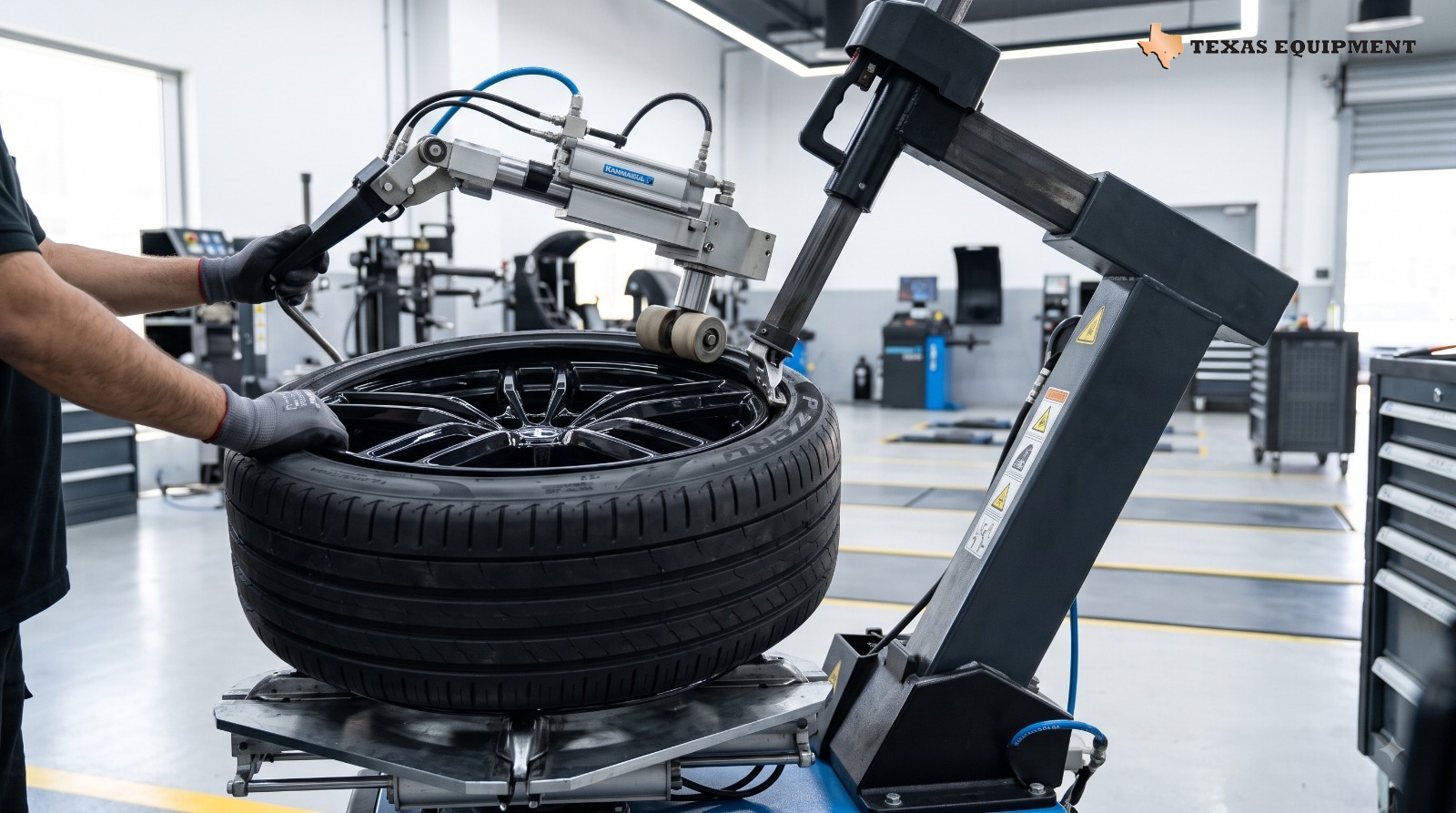
Equipping your garage with an automatic tyre changer with a helper arm and a digital 3D wheel balancer ensures you can service modern low-profile run-flat tyres and heavy SUV wheels without scratching alloy rims. Basic manual tyre changers damage expensive customer wheels, struggle with stiff beads in summer, and slow down your bay during peak seasonal replacement months.
Written by: Tariq Mansoor, Senior Workshop Installation Specialist
Over 12 years outfitting commercial automotive workshops across Sharjah Industrial Area 2, Al Quoz, and Musaffah.
The Post-Summer Tyre Replacement Demand in the UAE
August and September see a massive surge in tyre replacement across Dubai, Sharjah, and Abu Dhabi. Extreme summer road surface temperatures (often exceeding 60°C) accelerate rubber degradation, causing cracking, tread separation, and sidewall bulges on passenger and commercial vehicles.
During this period, vehicle owners rush to replace tyres before annual registration renewals. Under federal traffic safety rules enforced by the Roads and Transport Authority (RTA) and technical standards monitored by the Ministry of Industry and Advanced Technology (MoIAT), any vehicle with tyre tread depth below 1.6mm, visible sidewall cracks, or tyres older than 5 years will fail technical passing immediately.
For tyre shops and independent garages, handling this volume requires machinery that mounts and balances wheels quickly without damaging sensitive pressure sensors (TPMS) or custom alloy rims.
Comparing Semi-Automatic vs. Fully Automatic Tyre Service Equipment
Choosing the right machinery combination determines how fast your mechanics work and what wheel sizes you can accept. Explore our current stock on the Texas Equipment machinery store.
| Machinery Feature | Semi-Automatic Swing-Arm Unit | Fully Automatic Tilt-Back Unit | Heavy-Duty Automatic with Helper Arm | Tyre Shop Advantage |
| Max Rim Diameter | Up to 20 inches | Up to 24 inches | Up to 26 inches | Handles heavy Nissan Patrol, Land Cruiser, and truck rims |
| Run-Flat Capability | Difficult (High bead risk) | Moderate (Requires 2 techs) | Effortless (Single tech with pneumatic assist arm) | Eliminates tyre bead tears and rim scratching |
| Balancing Technology | Manual 2D data entry | Digital 2D entry | High-precision 3D sonar/laser measurement | Eliminates high-speed steering vibration complaints |
| Clamping Protection | Standard metal jaws | Plastic jaw protectors | Integrated non-marking nylon covers | Protects expensive painted and diamond-cut wheels |
| Service Speed Per Wheel | 12 to 15 minutes | 8 to 10 minutes | Under 5 minutes | Triples daily bay turnover during busy seasons |
| Average Investment | 7,500 to 11,000 AED | 13,500 to 19,000 AED | 21,000 to 32,000 AED | Recovers cost rapidly through high-volume wheel sales |
5 Practical Steps to Set Up a High-Volume Tyre Service Bay
Step 1: Add a Pneumatic Helper Assist Arm
Modern luxury cars and SUVs use stiff run-flat tyres with low aspect ratios (such as 35, 40, and 45 series). Manually prying these tyres over the mounting head with a crowbar will scratch the rim and tear the inner bead. A multi-function pneumatic assist arm holds the bead down into the drop center automatically, allowing one technician to mount tough tyres easily.
Step 2: Choose 3D Automatic Data Entry Wheel Balancers
Older wheel balancers require the operator to manually measure rim distance, diameter, and width with a ruler. 3D wheel balancers use automatic measuring arms and sonar sensors to capture all dimensions instantly, calculating exact hidden tape weight positions in seconds.
Step 3: Protect TPMS Sensors During Demounting
Tyre Pressure Monitoring System (TPMS) sensors are easily broken if the bead breaker shovel strikes the valve stem area. Train your technicians to position the valve stem at the 12 o’clock position before breaking the bead and use non-magnetic mounting tools.
Step 4: Ensure Stable Compressed Air Supply
Heavy-duty bead seating and pneumatic assist arms require strong, dry air volume. Connect your tyre changer to a dedicated air line providing a steady 8 to 10 bar pressure with an inline air lubricator and moisture filter.
Step 5: Calibrate Balancer Shafts Periodically
Continuous daily balancing shifts can throw off shaft accuracy. Run a self-calibration routine using a certified 100-gram calibration weight every week to keep balancer readings accurate down to 1 gram.
Frequently Asked Questions
What is the advantage of a tilt-back tyre changer over a swing-arm model?
On a tilt-back machine, the vertical column tilts backward pneumatically with a foot pedal, locking into the exact rim setting automatically. This saves setup time when servicing four identical wheels and provides greater rigidity for heavy SUV tyres.
Can automatic tyre changers handle diamond-cut alloy wheels without damage?
Yes, provided the machine is equipped with heavy-duty plastic clamping jaw covers, a plastic mounting head insert, and a pneumatic bead press roller that keeps metal tools away from the rim surface.
Why do customer cars experience steering vibration even after wheel balancing?
If the wheel balancer calibration is off by even 5 grams, or if dirt on the wheel mounting hub prevents flush centering on the balancer cone, high-speed vibration will occur on highways like Sheikh Zayed Road.
Where can I get replacement tyre changer seals, valves, and mounting heads in Sharjah?
Texas Equipment maintains a fully stocked inventory of replacement mounting heads, plastic protectors, pneumatic cylinder seal kits, and balancer cones at our Sharjah and Abu Dhabi warehouses for immediate delivery.
Equip Your Workshop with Texas Equipment UAE
Upgrade your tyre bay with commercial tyre changers, digital 3D wheel balancers, and pneumatic bead seating tools built for heavy daily use.
- Sharjah Head Office & Showroom: Shop #15 BMW Road, Industrial Area 2, Sharjah.
Landline: +971 6 552 9860 | WhatsApp / Mobile: +971 54 320 1243 - Abu Dhabi Musaffah Branch: M9 6th Street, Musaffah Industrial Area, Abu Dhabi.
WhatsApp / Mobile: +971 50 409 4965
Visit the Texas Equipment Contact Page to speak with our technical team and request an equipment package quote for your shop.

