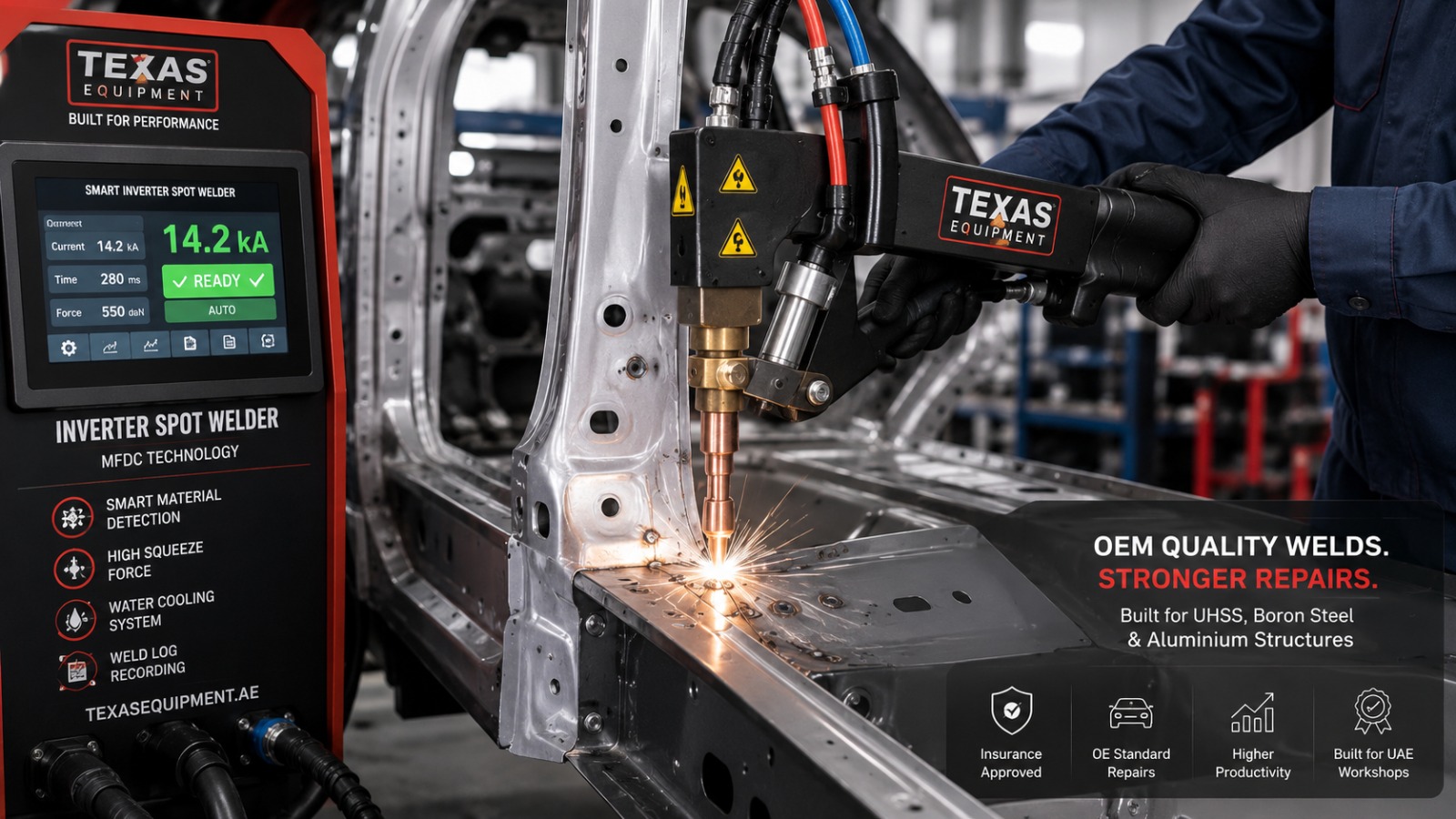
Inverter Spot Welders: Meeting UAE Insurance Standards on UHSS Frames

Written by Rajesh Sharma, Workshop Systems Lead | Reviewed by Technical Services Division, Texas Equipment UAE

Choosing the right spot welding machine is now a make-or-break decision for automotive body shops across the UAE. If your garage still attempts structural chassis repairs using standard MIG torches or outdated transformer equipment, your business faces rejected insurance claims and serious liability. Modern collision repair across Dubai, Sharjah, and Abu Dhabi demands verified factory-level resistance joining.

Modern vehicles no longer use soft, forgiving sheet metal for their internal frames. Today’s passenger sedans, commercial delivery vans, and full-size SUVs rely heavily on Ultra-High-Strength Steel (UHSS) and hot-stamped Boron steel rated up to 1,500 Megapascals (MPa). Repairing these crash-safety cells requires a dedicated inverter spot welding machine capable of delivering high clamping force, stabilized direct current, and printable quality logs.

While local machine sellers in industrial areas often hand you a basic catalog sheet listing prices between 14,000 and 22,000 AED, they rarely explain the real challenge: buying a welder that merely melts metal will not protect your shop if the insurance engineer rejects the finished repair.

Why Modern Car Steels Cause Insurance Claim Rejections

The high-strength alloys used in modern vehicle chassis protect passengers by redirecting crash energy around the cabin. However, their unique metallurgy makes workshop repairs unforgiving:

  • The Heat Affected Zone (HAZ) Problem: Traditional mild steel absorbs prolonged heat without catastrophic failure. Boron steel and UHSS, by contrast, gain their strength from specialized factory heating and rapid quenching. Applying a continuous MIG torch or an uncalibrated welder introduces excessive heat into the surrounding area. This anneals the steel, leaving the metal brittle or dangerously soft. In a subsequent collision, that repaired pillar will tear open rather than protect the cabin.
  • Structural Adhesives in Factory Seams: Modern car manufacturers bond frame panels with high-strength structural epoxies alongside spot welds. If a welding gun cannot generate enough clamping pressure to squeeze the adhesive out of the direct weld zone before the current fires, the glue burns. This creates internal porosity, severe arcing, and weak joints that fail non-destructive chisel tests.
  • Insurance Liability and Roadworthiness Audits: Under roadworthiness safety standards enforced in the UAE, collision repair facilities must match factory structural integrity. If an insurance surveyor identifies scorched panels, uneven puddle welds, or heat-warped pillars, the claim will be rejected immediately, leaving your workshop to cover the repair costs.

Transformer vs Inverter: Choosing the Right Spot Welding Machine

Most local distributor listings focus entirely on machine amperage while ignoring the technology behind power delivery and clamp mechanics.

1. Electrical Current: 50 Hz AC vs 1,000 Hz to 2,000 Hz MFDC

Traditional transformer spot welders run on standard 50 Hz alternating current. Because AC current constantly shifts polarity, power drops to zero 100 times every second. These electrical ripples cause metal spatter, inconsistent nugget fusion, and surface burning on sensitive high-strength steels.

Commercial inverter spot welders utilize Medium Frequency Direct Current (MFDC) operating between 1,000 Hz and 2,000 Hz. The inverter converts 3-phase workshop power into smooth, continuous direct current. This delivers uniform electrical energy through high-tensile panels, creating a clean weld nugget in milliseconds without burning through delicate outer panels.

2. Clamping Force: The Difference Between a Solid Nugget and a Burn-Through

Clamping force is just as critical as electrical amperage. Manual spot guns squeeze with only 150 to 250 decanewtons (daN) of pressure. When high current hits a loosely clamped panel, the electrical resistance causes an explosive spark that blows a hole straight through the sheet.

High-strength steel requires pneumatic or liquid-cooled C-tongs that deliver 450 to 600+ daN of clamping force. This mechanical squeeze forces the panel layers flat, drives out structural adhesives, and creates the tight metal-to-metal contact required for a uniform weld nugget.

Inverter Spot Welder Comparison: Commercial Workshop Guide

Equipment Specification Basic AC Transformer Welder Mid-Tier Inverter Welder (10,000A) Texas Equipment Smart MFDC Inverter (13,000A to 14,500A)
Welding Current Type 50 Hz Alternating Current (AC) Inverter DC (Basic control) Medium Frequency Direct Current (MFDC)
Max Output Current 6,000 to 8,000 Amps 9,000 to 10,500 Amps 13,000 to 14,500 Amps genuine output
Pneumatic Clamping Force 180 to 250 daN (Manual/Weak) 350 to 450 daN 500 to 600+ daN (Liquid-cooled pneumatic C-tong)
Material Capability Mild steel only High-Strength Steel (HSS) Boron Steel, UHSS, USIBOR, Galvanized, and Aluminium
Cooling Mechanism Fan/Air cooled (Overheats quickly) Basic internal water tank High-capacity radiator with liquid-cooled arms and tips
Material Sensing Manual dial adjustments Basic preset menus Smart automatic thickness and resistance detection
Digital Audit Logging None Basic screen display USB data export (Time, date, force, current, pass/fail)
UAE Insurance Compliance High rejection rate on structural jobs Acceptable for cosmetic repairs 100% compliant for structural chassis certification

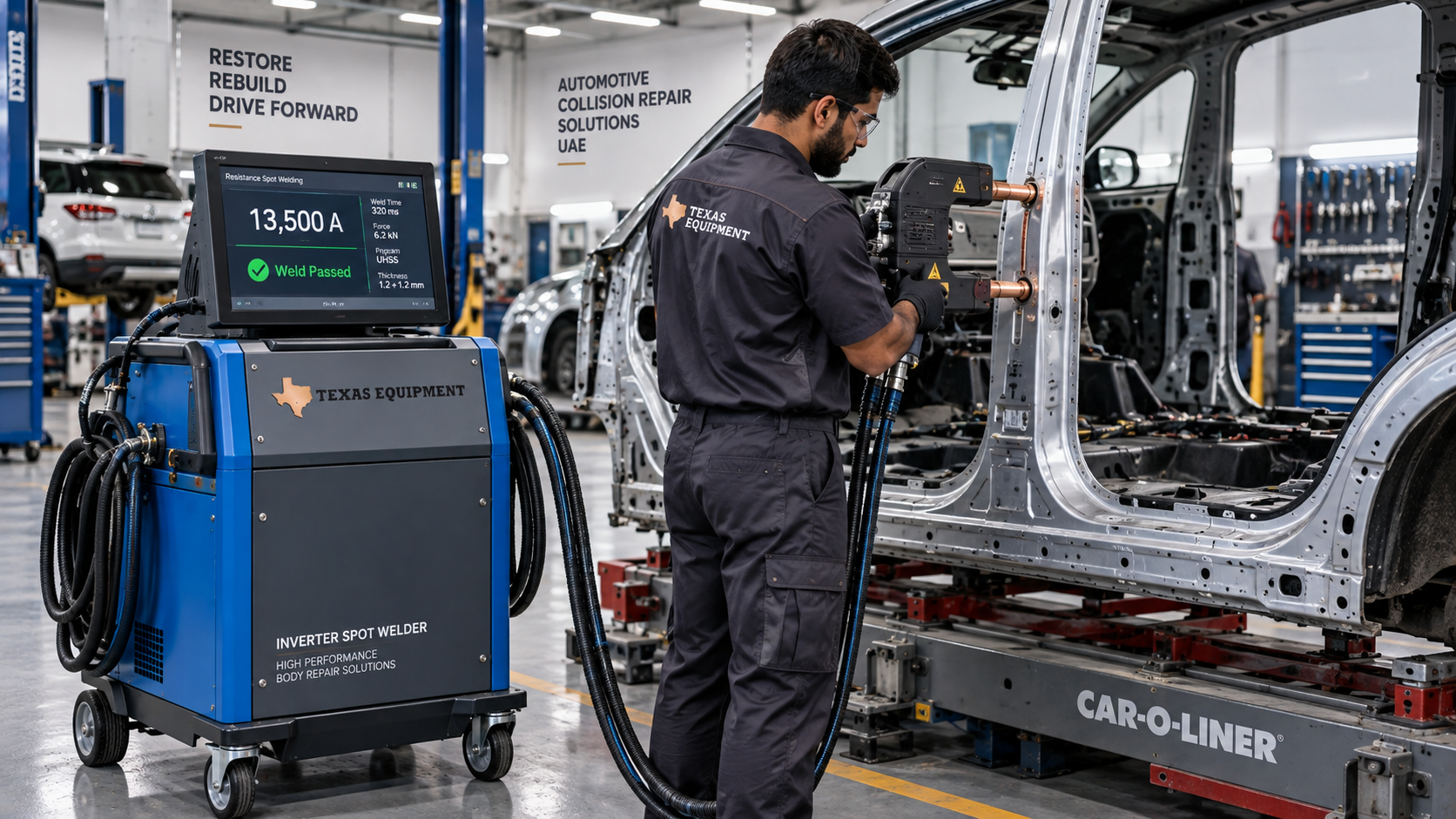
Commercial inverter spot welding machine repairing ultra-high-strength steel vehicle frame in a UAE automotive body shop.

The Audit Factor: USB Quality Logging That Protects Your Invoices

In previous years, an insurance estimator checked body repairs with a visual inspection or a quick tap of a hammer. Today, certified fleet operators and major insurance underwriters expect verifiable technical proof that repairs match factory crash standards.

Smart inverter spot welders remove human guesswork by integrating automated quality control sensors:

  • Real-Time Parameter Monitoring: As the trigger is pulled, onboard sensors measure actual secondary current, clamp pressure, and electrical resistance thousands of times per second.
  • Automated Pass/Fail Warnings: If a technician attempts to weld through thick e-coat primer, releases the trigger too early, or works with worn electrode tips, the unit sounds an audible alert and logs a failed weld.
  • Exportable USB Job Files: Every completed weld is stored in memory. Technicians can export a complete digital log to a USB flash drive, listing the exact date, time, amperage, and clamping force for every spot weld on that job card. Attaching this report to your insurance invoice provides undeniable proof of structural compliance, speeding up payment releases.

4 Practical Bay Steps to Pass Structural Inspections Every Time

1. Remove Coatings from Direct Contact Points

Even high-end smart welders cannot overcome heavy paint or rust on outer electrode contact points. Grind the metal down to clean, bare steel where the copper tips make contact, ensuring zero electrical resistance before clamping.

2. Dress Copper Electrode Tips Daily

Mushroomed or pitted electrode tips spread electrical current over an excessively large surface area. This drops current density and creates undersized, weak weld nuggets. Use a calibrated pneumatic or manual tip dresser every morning to maintain the factory 5 mm to 6 mm tip profile.

3. Conduct a Morning Destructive Peel Test

Before welding a customer vehicle, take two scrap off-cuts of matching panel thickness. Run a test spot weld, clamp one piece in a bench vise, and peel the other strip back using locking pliers. The weld nugget must tear a solid round plug out of the parent sheet metal rather than unzipping cleanly at the seam.

4. Provide Dedicated 3-Phase Industrial Power

A commercial spot welder delivering 14,000 Amps at the electrode tips demands clean, stable electricity. Running the machine through long, undersized extension cords causes voltage drops that trip workshop breakers mid-weld. Connect your unit directly to a dedicated 32A or 63A 3-phase industrial supply.

Frequently Asked Questions

Why do UAE insurance adjusters reject MIG plug welds on structural pillars?

MIG plug welding generates intense, continuous heat that ruins the delicate heat treatment of high-strength boron steel, leaving structural joints brittle. Insurance engineers require factory-style resistance spot welding to preserve original crash-test ratings.

How much welding current is actually needed for modern high-strength steels?

To overcome internal adhesive layers and properly fuse multi-layer UHSS structural posts, a body shop spot welder must deliver a genuine minimum of 12,000 to 13,000 Amps of inverter direct current (MFDC).

Can a smart inverter spot welder weld automotive aluminium?

Yes. When equipped with specialized aluminium welding programs and dedicated electrode arms, advanced inverter welders deliver the rapid, high-energy current bursts needed to weld aluminium chassis panels found on modern Land Rover, Audi, and Ford vehicles.

Why is liquid cooling mandatory for spot welders in the UAE?

High workshop ambient temperatures during summer cause air-cooled welding arms to overheat after just a few welds. Liquid-cooling systems circulate chilled fluid directly through the transformer, C-tong arms, and copper caps, allowing non-stop production without thermal shutdowns.

Equip Your Body Shop with Texas Equipment UAE

Upgrade your collision repair capability with certified inverter spot welding systems, computerized chassis alignment benches, digital dent pullers, and downdraft spray booths. Texas Equipment provides on-site machine commissioning, operator training, and local spare parts support across the UAE.

Visit our regional showrooms to test live demonstration welding stations:

  • Sharjah Showroom & Technical Centre: Shop #15, BMW Road, Industrial Area 2, Sharjah.
    Landline: +971 6 552 9860 | WhatsApp: +971 54 320 1243
  • Abu Dhabi Musaffah Branch: M9, 6th Street, Musaffah Industrial Area, Abu Dhabi.
    Mobile: +971 50 409 4965

Contact our workshop engineering team today to review your body shop machinery requirements or request an on-site equipment demonstration.
 

Scissor Lift vs 2-Post Lift: Bay Dimensions and Concrete Guide for UAE Workshops

Written by Rajesh Sharma, Workshop Systems Lead | Reviewed by Technical Services Division, Texas Equipment UAE

Renting an industrial warehouse in Dubai Al Quoz, Sharjah Industrial Areas, or Abu Dhabi Musaffah represents one of the largest fixed costs for any automotive business. When commercial space costs significant money per square foot, your bay layout directly controls your monthly revenue. If an equipment purchase blocks vehicle movement, prevents technicians from opening car doors, or fails structural building inspections, your investment becomes an expensive obstacle.

Most equipment distributors in the UAE treat vehicle lifts like simple commodity hardware. Their catalogs list maximum lifting tonnage (such as 3.5-ton or 4-ton ratings), show a generic factory photo, and quote a standard delivery price.

What those listings fail to tell you is how the lift interacts with your actual building. They ignore warehouse ceiling heights, clearance under overhead fire sprinkler pipes, concrete slab thickness, and the very real risk of anchor bolt pull-out on older industrial floors.

Understanding these engineering factors before ordering machinery determines whether you should install a clear-floor 2-post lift or a flush-mounted, low-profile scissor lift.

Ceiling Clearance and Vertical Restrictions in UAE Industrial Units

A major operational headache in UAE industrial parks is vertical space. Many commercial warehouses built across Sharjah and Al Quoz feature internal mezzanine storage floors, structural steel roof trusses, or low-hanging fire safety pipes running between 3.2 and 3.6 meters from the ground.

  • The 2-Post Clear-Floor Reality: A commercial clear-floor 2-post lift requires a vertical ceiling clearance of 3.8 to 4.2 meters. The rigid overhead crossbeam connects the top of the columns to route hydraulic equalizing cables. If you attempt to install a clear-floor 2-post unit in a bay with a 3.4-meter ceiling, the top beam will collide with roof beams or ductwork. Opting for a floor-plate 2-post lift instead avoids the high beam, but places a raised metal threshold across the floor that trips mechanics and snags rolling oil drainers.
  • The Low-Profile Scissor Lift Advantage: A full-rise scissor lift does not use overhead posts or crossbeams. The vertical space required is strictly determined by the height of the vehicle plus the platform’s lifting stroke (typically 1.8 to 1.9 meters). In a warehouse with a ceiling height of just 3.0 to 3.3 meters, a technician can safely raise passenger cars, crossovers, and low-roof vans to a comfortable working level without risking structural roof contact.

Concrete Slab Engineering: Preventing Anchor Bolt Pull-Out

Lift failure almost never occurs because the steel arms snap. It occurs when mechanical floor anchors rip out of the concrete under dynamic load.

A 2-post lift operates on a cantilever principle. When holding a 3-ton SUV like a Nissan Patrol, Toyota Land Cruiser, or Cadillac Escalade, the vehicle weight is concentrated entirely on two narrow vertical columns. This exerts massive upward tensile pulling force on the rear floor anchor bolts.

Before installing a 2-post lift, verify these floor specifications:

  • Minimum Slab Thickness: You need at least 150 mm to 200 mm of solid, un-cracked concrete.
  • Compressive Strength: The concrete must carry a verified rating of at least 3,000 PSI (C25/C30 industrial mix).
  • Expansion Joint Clearances: Anchor bolts must sit at least 150 mm away from any floor cut, joint, or crack.

In many rented Sharjah and Musaffah industrial sheds, warehouse floors consist of thin 100 mm slabs or weak screed poured over loose sand. Drilling heavy mechanical expansion bolts into poor concrete creates micro-fractures. Under the weight of a heavy 4×4, those bolts can shift, tilt, or pull out completely.

In contrast, a low-profile scissor lift distributes vehicle weight downward across two wide, flat steel base channels that run the full length of the platforms (typically 1.5 to 2.0 meters long). Because the downward force spreads over a broad surface area, upward leverage tension on the concrete is practically zero. You only need light locating anchors to prevent platform shift, making scissor lifts far safer for facilities where slab depth cannot be structurally certified.

Bay Width, Door Clearance, and Floor Obstructions

When planning your workshop floor, bay width dictates how smoothly technicians move between tasks:

1. The Column Barrier of 2-Post Lifts

A standard 4-ton 2-post lift has an overall outside column width of 3.4 to 3.6 meters. When placed in a narrow warehouse bay, the heavy steel columns form fixed physical barriers. Technicians must park the car with millimeter precision to ensure the swing arms reach factory lift points. Even then, opening the vehicle doors wide enough to step out without denting the paint against the steel post is difficult in tight spaces.

2. The Open Floor Plan of Flush-Mount Scissor Lifts

In-ground scissor lifts require cutting shallow floor recesses (approximately 110 mm to 120 mm deep) so the steel platforms fold completely flat with the surrounding concrete.

When the lift is down, the bay becomes an entirely flat, barrier-free floor. Technicians can drive vehicles straight through at any angle, roll heavy diagnostic trolleys freely across the bay, or turn the space into an express inspection area without dodging side posts.

3. Surface-Mounted Scissor Lifts and Low-Car Clearances

If digging pits into your warehouse floor is prohibited by your tenancy agreement, surface-mounted scissor lifts bolt directly on top of the concrete.

However, you must check the collapsed drive-over profile. Standard commercial surface lifts stand 105 mm to 115 mm tall when fully lowered and use hinged drive-on approach ramps. If your workshop services sports cars or low-profile luxury sedans, vehicles can scrape their rocker panels or front splitters on tall platforms. Always confirm your lift features low-profile drive-over ramps with an entry angle of 10 degrees or less.

Technical Comparison: 2-Post Lift vs Low-Profile Scissor Lift

Engineering & Bay Factor Clear-Floor 2-Post Lift (4 Ton) In-Ground / Low-Profile Scissor Lift (3.5 to 4 Ton)
Minimum Ceiling Height Required 3.8 to 4.2 meters 3.0 to 3.3 meters
Minimum Bay Width Needed 3.6 to 4.0 meters 3.0 to 3.4 meters
Floor Anchoring Stress Extreme upward tension (Cantilever leverage) Pure downward compression (Distributed weight)
Minimum Concrete Thickness 150 mm to 200 mm (3,000+ PSI required) 120 mm to 150 mm (Low structural anchor demand)
Underbody Accessibility 100% open from bumper to bumper Center open; sides obstructed by scissor mechanism
Primary Underbody Jobs Engine drops, gearboxes, long exhaust lines Brakes, suspension, oil service, tyre changing
Vehicle Loading Time 60 to 90 seconds (Adjust 4 swing arms) 15 to 20 seconds (Drive straight onto platforms)
Floor Space Efficiency Fixed posts restrict side bay movement Flush-mount models leave 100% flat floor space

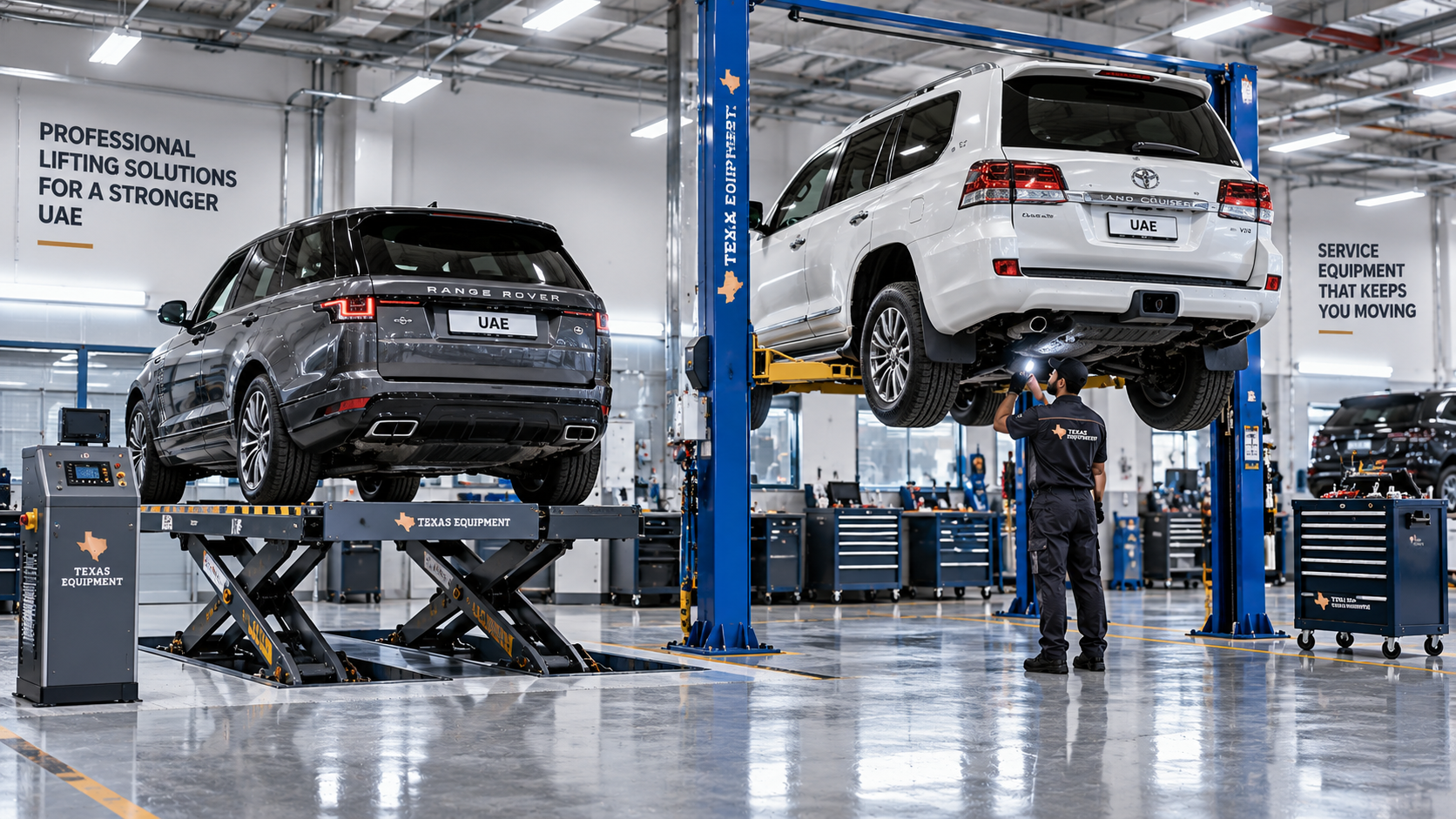
Low-profile scissor lift and 2-post car lift installed side-by-side in a modern UAE automotive workshop bay.

Matching the Lift to Your Workshop Workflow

Neither lift is universally superior. The correct choice depends entirely on your repair specialism:

Choose a 2-Post Clear-Floor Lift if:

  • Your workshop focuses on heavy mechanical repairs, including engine overhauls, automatic transmission removals, and differential replacements.
  • You need completely open, unobstructed access along both sides of the vehicle underbody.
  • Your warehouse ceiling clears 4.0 meters and your concrete slab has been core-drilled and certified for 3,000 PSI strength.
  • You regularly service heavy, extended-chassis commercial pickup trucks and long-wheelbase cargo vans.

Choose a Low-Profile Scissor Lift if:

  • Your garage specializes in quick-service maintenance: oil changes, brake disc skimming, suspension bushes, tyre rotations, and wheel alignments.
  • Your building has low mezzanine clearance or hanging overhead utilities below 3.6 meters.
  • You operate a high-volume express service lane where fast loading and rapid vehicle turnover increase billable hours.
  • You rent an older industrial unit where concrete thickness is questionable, or where tenancy contracts prohibit heavy foundation excavation.

Frequently Asked Questions

Can a low-profile scissor lift safely raise large Gulf 4x4s?

Yes. Commercial workshop scissor lifts supplied by Texas Equipment carry verified ratings between 3.5 and 4.5 tons. Platform extensions pull out to support long-wheelbase vehicles like the Nissan Patrol and Toyota Land Cruiser at their designated chassis lifting points.

What is the excavation depth needed for an in-ground flush-mount scissor lift?

Most commercial flush-mounted scissor lifts require a shallow concrete pit between 110 mm and 130 mm deep, along with dedicated perimeter drainage channels and a small conduit pipe to route hydraulic and electrical lines to the wall-mounted control cabinet.

Can I install a 2-post car lift on an existing tiled garage floor?

No. Floor tiles, decorative screeds, and unreinforced topping layers crush easily under load and cause anchor bolts to loosen. Before bolting down a 2-post lift, the floor tiles and loose bedding must be saw-cut away down to the solid, reinforced concrete foundation slab.

What happens if a hydraulic line breaks on a scissor lift?

Commercial scissor lifts utilize pneumatic mechanical safety locks that automatically engage at each step of elevation. In the event of a sudden hydraulic pressure drop, dual mechanical safety ratchets lock the platform in place immediately, preventing any vehicle descent.

Plan Your Workshop Bay Layout with Texas Equipment UAE

Do not risk installation delays, building damage, or unsafe lifting equipment. Texas Equipment provides comprehensive workshop planning across Dubai, Sharjah, and Abu Dhabi. Our technical team conducts on-site bay measurements, ceiling clearance audits, and concrete slab strength assessments before recommending the ideal machinery for your business.

Visit our regional technical facilities to inspect live working demonstration lifts:

  • Sharjah Showroom & Technical Centre: Shop #15, BMW Road, Industrial Area 2, Sharjah.
    Landline: +971 6 552 9860 | WhatsApp: +971 54 320 1243
  • Abu Dhabi Musaffah Branch: M9, 6th Street, Musaffah Industrial Area, Abu Dhabi.
    Mobile: +971 50 409 4965

Contact our engineering team today to schedule an on-site workshop layout consultation or request equipment specifications for your upcoming fit-out.

Rotary Screw vs Piston Air Compressors: Why Gulf Workshops Outgrow Piston Units

Written by Rajesh Sharma, Technical Service Lead | Reviewed by Technical Services Division, Texas Equipment UAE

Operating a busy vehicle service workshop in the UAE puts massive stress on your air system. When two or three mechanics run air impact guns, tyre changers, and sanders at the same time, pressure drops can stop work completely. If your shop still runs an older piston compressor, you probably deal with machines shutting down on hot summer afternoons, wet air ruining paint jobs, and a loud clatter that gives everyone a headache.

Choosing between a standard piston unit and an industrial rotary screw air compressor comes down to work volume, heat handling, noise, and air cleanliness. A piston compressor works fine for a tiny garage with one bay and occasional use. But for a commercial workshop handling multiple cars daily, pushing a piston pump beyond its limits leads to burnt valves and constant downtime once summer temperatures cross 45°C.

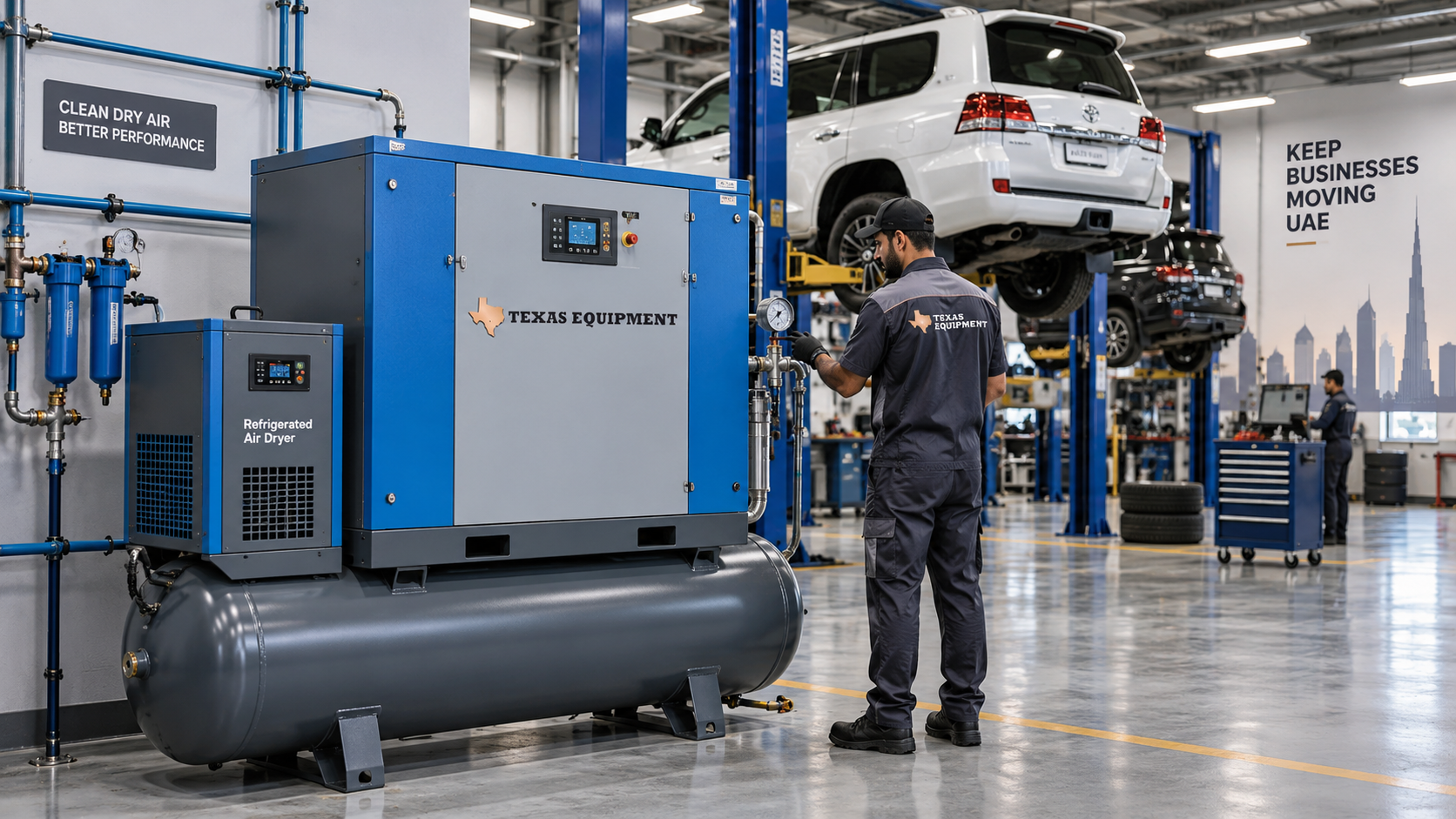
Industrial rotary screw air compressor and integrated refrigerated air dryer installed in a UAE automotive repair workshop.

The Core Mechanical Difference: Continuous Work vs Rest Breaks

The main difference between these two machines is how they compress air and handle friction:

  • Piston Compressors (Intermittent Duty): These work like a small car engine, using pistons moving up and down inside cylinders. Because metal parts create heavy friction and heat, standard piston compressors have a 50% to 60% duty cycle. That means for every 10 minutes of pumping, the machine needs 4 to 5 minutes of rest to cool down. If you force a piston unit to run non-stop all day, the valves burn out and the pump head can seize.
  • Rotary Screw Air Compressors (100% Continuous Duty): These use two spiral screws that spin smoothly together to push air through. Oil continuously cools and seals the screws, so metal parts do not grind against each other. Because of this design, a rotary screw compressor can run 100% non-stop through an entire 8 to 12 hour shift without overheating.

The 50°C Summer Heat Challenge in the Gulf

In industrial zones across Sharjah, Al Quoz in Dubai, and Musaffah in Abu Dhabi, workshop indoor heat easily tops 48°C during July and August. Hot air makes it much harder for any compressor to cool itself down.

Standard piston pumps lose about 8% of their pumping power for every 5°C jump above 40°C. Under non-stop demand, the cylinder head of a piston compressor gets hot enough to burn the oil inside into sticky carbon, causing valve leaks. A commercial rotary screw air compressor, on the other hand, comes with large oil radiators and cooling fans that keep internal temperatures stable between 75°C and 90°C, even during peak summer afternoons.

Noise Levels: Workshop Comfort and Safety

Sound level is a major factor that garage owners often forget until the machine is installed:

  • Piston Compressors (82 to 92 dBA): The rhythmic banging of pistons and slapping reed valves makes a huge racket. Working near an open piston compressor makes normal conversation impossible and causes ear strain. To work comfortably, you usually have to build a separate room outside the shop to hide the noise.
  • Rotary Screw Compressors (62 to 72 dBA): The smooth spinning of screws creates no banging or hammering sounds. Encased in a sound-dampened steel cabinet, a rotary screw unit is about as quiet as a household appliance. You can install it right next to your service bays and talk comfortably beside it.

Local Noise Regulations in Dubai and Sharjah

Local municipality safety rules in Dubai and across the UAE set daytime commercial noise limits between 60 and 70 dBA. Setting up an unshielded, 90-decibel piston compressor along an open wall can bring customer complaints or safety warnings. A cabinet screw compressor stays well within safe occupational limits without needing extra masonry walls.

Sizing Your Air System: Total Tool Demand (CFM)

Never buy a compressor based only on tank size in liters or basic horsepower (HP). What matters most is Cubic Feet per Minute (CFM), which measures how much air volume the machine delivers under pressure.

Workshop Tool Average CFM Needed (at 90 PSI / 6 Bar) Work Pattern Recommended Compressor
1/2″ Air Impact Wrench 4.5 to 6.0 CFM Short bursts (Tyre changes) Piston (1 bay) or Screw
3/4″ Heavy Duty Impact Gun 8.0 to 12.0 CFM Moderate (Trucks & SUV suspension) Rotary Screw Recommended
Automatic Tyre Changer 5.0 to 8.0 CFM Short bursts (Bead breaking) Piston or Rotary Screw
Orbital Body Sander 11.0 to 15.0 CFM Continuous non-stop sanding Rotary Screw Mandatory
Paint Spray Gun (HVLP) 12.0 to 18.0 CFM Continuous spraying Rotary Screw + Air Dryer
Pneumatic Lift / Jack 6.0 to 9.0 CFM Intermittent lifting Piston or Rotary Screw

To find the right size, add up the CFM of the tools your mechanics use at the same time and add 25% extra for line resistance. If your shop runs a 3/4″ gun (10 CFM), a tyre machine (6 CFM), and a sander (12 CFM) together, you need roughly 35 CFM. A 10 HP to 15 HP rotary screw compressor provides 38 to 55 CFM all day long without breaking a sweat, whereas a piston unit of the same size would overheat trying to keep up.

The Humidity Problem: Why an Air Dryer is Mandatory in the UAE

Compressing air squeezes out humidity like water from a sponge. In coastal cities like Dubai and Sharjah, summer air humidity often hits 75% to 85%.

A 10 HP compressor running for 8 hours in UAE summer weather pulls about 15 to 20 liters of water straight out of the atmosphere. If you do not dry this air, all that water goes right into your pipes and tools:

  • Rusted Air Tools: Water washes away tool oil, rusting inside bearings and ruining impact guns.
  • Paint Blisters: Water spraying out of a paint gun causes bubbles, peeling, and spots that ruin expensive paint jobs.
  • Corroded Rims: Wet air pumped into customer tyres oxidizes aluminum wheel rims from the inside.

This is why an inline refrigerated air dryer is essential. It cools incoming compressed air to 3°C, drops out the liquid moisture through automatic drain valves, and delivers dry, clean air to your work bays.

3-Year Cost Reality: Purchase Price vs Power Bills

A piston unit looks cheap on day one, but looking at a 3-year timeline shows why growing garages switch to screw units:

Feature Piston Compressor (10 HP) Rotary Screw Compressor (10 HP Complete Skid)
Upfront Machine Cost Lower (6,500 to 11,000 AED) Moderate (16,000 to 24,000 AED)
Daily Work Capacity 50% to 60% (Needs rest breaks) 100% continuous full output
Noise Level Loud (85+ dBA, needs separate room) Quiet (65 dBA, fits inside the bay)
Air Cleanliness High oil mist passing into lines Very clean air with built-in separators
Power Efficiency Loses efficiency as it gets hot High CFM output per kilowatt of electricity
Typical Lifespan in Gulf Heat 3 to 5 years under heavy garage work 8 to 12+ years with simple servicing

Because a screw compressor gives you more air for every unit of electricity and avoids heat breakdowns, it generally makes up the price difference within 14 to 20 months of busy workshop use.

Common Questions Workshop Owners Ask

Is a rotary screw compressor better for a car workshop than a piston compressor?

Yes, especially if you have more than two bays or use tools that run continuously like sanders and paint sprayers. A rotary screw compressor runs non-stop without overheating, keeps noise low, and delivers smooth, clean air.

How much quieter is a screw compressor compared to a piston model?

Rotary screw compressors operate around 62 to 72 dBA, meaning you can stand right next to the cabinet and speak in a normal voice. Piston compressors produce 82 to 92 dBA, creating a heavy hammering sound that usually requires a separate walled-off room.

Can a piston compressor run all day without stopping in UAE weather?

No. Piston compressors need regular rest periods. Running one non-stop in 45°C ambient heat will overheat the pump heads, burn the gaskets, and eventually seize the pistons.

Why do I need a refrigerated air dryer with my compressor?

Summer humidity in the UAE is very high. Compressing humid air produces up to 20 liters of water each day inside your air lines. A refrigerated air dryer removes this moisture before it can rust your air tools or ruin spray paint finishes.

Equip Your Workshop with Texas Equipment UAE

Avoid pressure drops, wet air lines, and summer shutdowns with an air system built specifically for high-temperature Gulf conditions. Texas Equipment supplies compact, tank-mounted rotary screw compressors, integrated refrigerated air dryers, line filters, and workshop piping across the UAE.

Visit our showrooms to see live working demonstration units:

  • Sharjah Showroom: Shop #15, BMW Road, Industrial Area 2, Sharjah.
    Landline: +971 6 552 9860 | WhatsApp: +971 54 320 1243
  • Abu Dhabi Branch: M9, 6th Street, Musaffah Industrial Area, Abu Dhabi.
    Mobile: +971 50 409 4965

Contact our technical team today to calculate your workshop air requirements or request an on-site consultation.


EV Diagnostic Scanners and High-Voltage Battery Analyzers: Complete UAE Workshop Guide

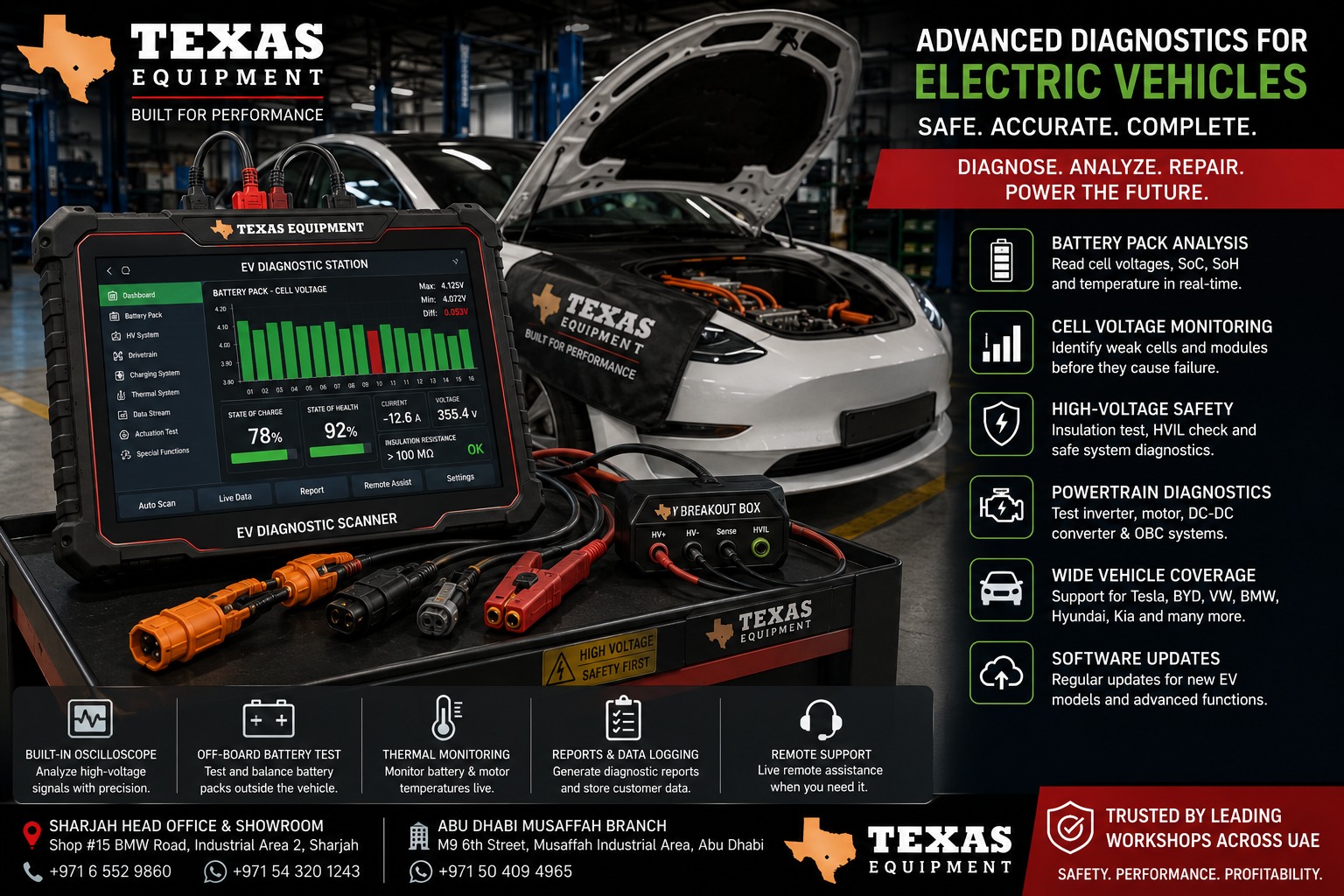
Investing in a specialized EV diagnostic scanner allows UAE workshops to analyze high-voltage battery pack health, pinpoint weak individual cells, and diagnose electric powertrain faults safely. Standard OBD2 scan tools only read basic 12-volt auxiliary codes and cannot communicate with isolated traction battery management systems (BMS), high-voltage junction boxes, or inverter drive circuits.

Written by: Rajesh Sharma, Technical Service Lead (Automotive Diagnostics)

Over 14 years supporting commercial diagnostic scanners, ECU coding interfaces, and workshop electrical systems across Sharjah Industrial Areas, Al Quoz, and Musaffah

EV Diagnostic Scanner

Why High-Voltage EV Diagnostics Demand Dedicated Equipment

Electric vehicles from Tesla, BYD, Volkswagen, BMW, and commercial electric delivery fleets operate on high-voltage DC systems ranging from 400V to 800V. Under severe UAE summer conditions where road temperatures frequently cross 60°C, high-voltage battery packs experience thermal stress that accelerates cell degradation and cooling system faults.

Diagnosing an electric vehicle requires much more than clearing a simple check engine light. Technicians must be able to:

  • Measure individual battery cell voltage variations down to the millivolt.
  • Perform off-board battery pack health testing when a pack is removed from the chassis.
  • Test High-Voltage Interlock Loops (HVIL) to ensure safety disconnects function properly.
  • Measure insulation resistance between the high-voltage bus and vehicle ground.

Safety standards established by the International Electrotechnical Commission (IEC) mandate that diagnostic tools interfacing with live high-voltage traction circuits must feature certified insulation protection and dedicated high-voltage break-out leads to prevent technician shock and arc-flash hazards.

Comparing Generic OBD2 Scanners with Dedicated EV Diagnostic Scanners

Selecting the right EV diagnostic hardware determines whether your technicians can perform in-depth battery pack repairs or only read superficial trouble codes. Explore our active range of diagnostic equipment on the Texas Equipment machinery store.

Diagnostic Capability Standard Multi-Brand Scanner Generic Code Reader Texas Equipment Dedicated EV Diagnostic Station Workshop Advantage
High-Voltage Battery BMS Access Read-only general codes Not supported Full deep BMS parameter & cell access Reads state-of-charge (SoC) and state-of-health (SoH)
Off-Board Battery Pack Testing Not supported Not supported Direct off-board jumper cables & protocols Tests battery packs on lift tables outside the car
Cell Voltage Deviation Analysis Basic live data list None Dynamic graphical cell bar chart display Identifies weak modules causing rapid range drops
High-Voltage Component Testing Limited None Inverter, DC-DC converter, and OBC testing Diagnoses onboard charger and motor phase faults
Safety Measurement Hardware Standard probes None Integrated digital oscilloscope & multimeter Measures isolation resistance and high-voltage signals
Average Investment 9,500 to 16,000 AED 1,200 to 3,000 AED 19,000 to 34,000 AED Opens high-ticket commercial EV fleet maintenance revenue

5 Practical Steps to Run Safe EV Diagnostics in Your Bay

Step 1: Check Insulation Resistance Before Disassembly

Before opening any high-voltage control enclosure or unplugging orange cables, use the high-voltage insulation tester on your diagnostic station. Testing between the positive bus, negative bus, and the vehicle chassis confirms that no live current is leaking into the bodywork.

Step 2: Analyze Cell Voltage Uniformity and State of Health

Connect to the Battery Management System (BMS) and view the cell balancing graph. In a healthy traction pack, voltage differences across all cell blocks should remain within 10 to 20 millivolts. A cell showing a 50+ millivolt drop under load indicates internal resistance breakdown, requiring module replacement.

Step 3: Verify High-Voltage Interlock Loop (HVIL) Continuity

The HVIL is a low-voltage safety circuit running through every high-voltage connector. If a connector is loose or a manual service plug is removed, the HVIL opens and the vehicle disables main battery contactors. Use your scanner to monitor real-time HVIL circuit continuity when troubleshooting no-start conditions.

Step 4: Perform Off-Board Battery Diagnostic Routines

When rebuilding or replacing modules in a dropped battery pack, utilize off-board diagnostic connection cables. These specialized wiring adapters connect directly from your diagnostic station to the battery pack connector, allowing you to test module health on the bench before reinstalling the heavy pack into the car.

Step 5: Keep Vehicle Model Software Updated for Local GCC Imports

The UAE market contains a wide mix of GCC-spec electric cars, Chinese-market EVs (BYD, Zeekr), and North American imports. Maintain an active software update plan to access factory diagnostic algorithms, high-voltage wiring schematics, and service reset procedures for new electric vehicle models.

Frequently Asked Questions

Can I diagnose an electric vehicle using my existing petrol car scanner?

Standard OBD2 scanners only access low-voltage 12V modules such as body control and infotainment. They cannot access high-voltage battery management systems, test individual cell voltages, or perform high-voltage safety discharge procedures.

What is the difference between State of Charge (SoC) and State of Health (SoH)?

State of Charge (SoC) represents the current battery percentage remaining, similar to a fuel gauge. State of Health (SoH) measures the maximum usable capacity of the battery compared to when it was brand new.

How does an EV diagnostic scanner assist during battery replacement?

When replacing a high-voltage module or complete pack, an EV diagnostic scanner performs battery registration, cell balancing routines, and cooling circuit bleed cycles so the car’s BMS recognizes the replacement hardware.

Where can I get training and accessories for EV diagnostic scanners in Sharjah?

Texas Equipment provides full setup assistance, high-voltage safety training, and replacement breakout leads at our main showroom in Sharjah Industrial Area 2 and our Musaffah branch in Abu Dhabi.

Equip Your Workshop with Texas Equipment UAE

Position your repair shop as a leader in electric vehicle maintenance with certified EV diagnostic stations, high-voltage safety toolkits, battery lift tables, and insulation meters backed by local technical support across the UAE.

  • Sharjah Head Office & Showroom: Shop #15 BMW Road, Industrial Area 2, Sharjah.
    Landline: +971 6 552 9860 | WhatsApp / Mobile: +971 54 320 1243
  • Abu Dhabi Musaffah Branch: M9 6th Street, Musaffah Industrial Area, Abu Dhabi.
    WhatsApp / Mobile: +971 50 409 4965

Visit the Texas Equipment Contact Page to speak directly with an EV diagnostic specialist and book an on-site equipment demonstration.
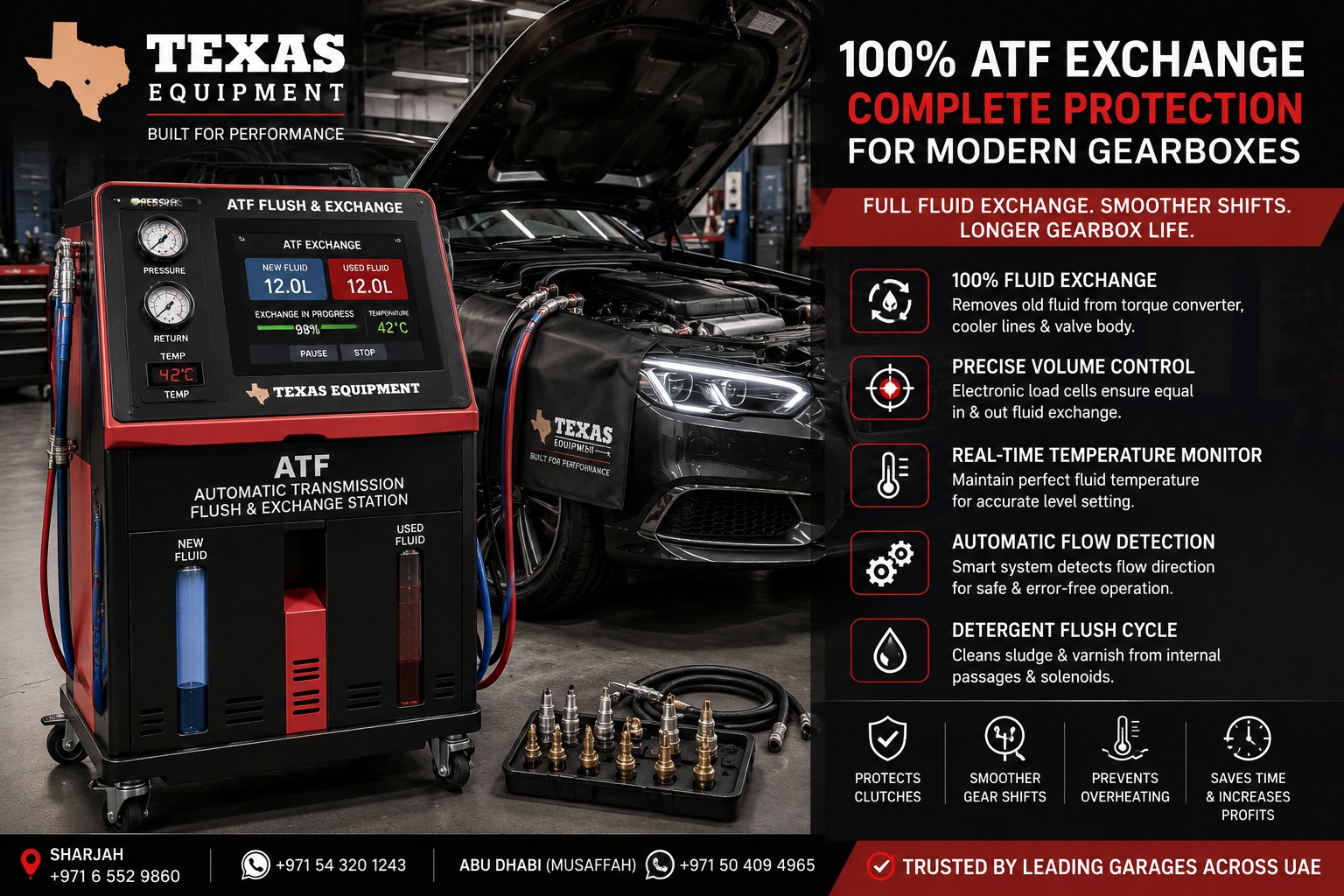
Automatic ATF Flush and Fluid Exchange Machines: Complete UAE Workshop Guide

Investing in an automatic ATF flush machine allows UAE workshops to perform a 100% transmission fluid exchange, removing burned oil and clutch debris that cause harsh gear shifting and transmission overheating during peak summer months. Traditional gravity drain-and-fill methods replace only 35% to 40% of old automatic transmission fluid, leaving degraded fluid trapped inside the torque converter, valve body passages, and external cooler lines.

Written by: Rajesh Sharma, Technical Service Lead (Automotive Diagnostics)

Over 14 years supporting commercial diagnostic scanners, fluid exchange stations, and workshop equipment across Sharjah Industrial Areas, Al Quoz, and Musaffah.

ATF Flush Machine

Why Gulf Heat Causes Premature Automatic Transmission Failure

Automatic transmissions, dual-clutch gearboxes (DCT), and continuously variable transmissions (CVT) generate tremendous internal heat. In the UAE, where ambient summer temperatures consistently exceed 45°C, gearbox fluid temperatures can climb above 110°C in heavy stop-and-go highway traffic.

Under extreme thermal stress, automatic transmission fluid oxidizes rapidly, losing its hydraulic viscosity and anti-foaming protection. This degradation leads to:

  • Sluggish gear engagement and delayed upshifts when accelerating.
  • Slipping clutch packs and torque converter shudder.
  • Microscopic varnish buildup clogging delicate valve body solenoids.
  • Complete transmission breakdown requiring expensive mechanical rebuilds.

Automotive lubricant standards recognized by the GCC Standardization Organization (GSO) emphasize the importance of maintaining proper fluid viscosity and thermal stability. Performing an automated complete fluid exchange preserves shift quality and prevents catastrophic gearbox failure for your customers.

Comparing Manual Drain-and-Fill with Automatic ATF Exchange Stations

Upgrading to a smart transmission flush machine transforms an untidy manual fluid change into a fast, highly profitable maintenance service. Explore our full range of fluid maintenance machines on the Texas Equipment machinery store.

Service Feature Manual Gravity Drain Semi-Automatic Drain Cart Texas Equipment Smart ATF Exchange Station Workshop Advantage
Fluid Exchange Rate 35% to 40% (Pan fluid only) 50% to 60% 98% to 100% (Complete exchange) Replaces all old oil from converter and cooler
Service Time Per Vehicle 45 to 60 minutes 30 to 45 minutes 15 to 20 minutes Doubles daily transmission service throughput
Volume Accuracy Visual guess via dipstick Manual meter checking Twin electronic load cells (0.01L accuracy) Matches outgoing and incoming fluid down to the gram
Flow Direction Sensing Manual pipe checking Manual valve flipping Automated flow direction detection Prevents cross-flow damage and workshop spills
Transmission Flushing Not supported Basic static drain Dynamic detergent cycle under engine idle Cleans valve body passages before refilling
Average Investment 500 to 1,200 AED 4,500 to 8,000 AED 14,000 to 24,000 AED Recovers cost rapidly through premium fluid service packages

5 Practical Steps to Run an Automated ATF Flush Service

Step 1: Run an In-Line Detergent Cleaning Cycle

Before exchanging the fluid, connect the machine to the transmission cooler lines and add an approved cleaning additive. Run the vehicle engine at idle for 10 minutes, cycling through all gear positions (P-R-N-D). This allows the circulating detergent to break loose sludge and varnish from solenoids and valve channels.

Step 2: Use Automatic Flow Recognition

Older flush machines require mechanics to manually figure out which transmission line is the feed and which is the return. Modern smart ATF machines automatically detect flow direction upon startup, eliminating line-connection errors and preventing reverse-flow oil spills.

Step 3: Ensure Equal-Volume Fluid Replacement

Operating automatic gearboxes with too much or too little fluid causes foaming, erratic shifting, and burned clutches. High-precision load cells inside the machine monitor the exact weight of drained oil and inject the exact same volume of fresh fluid simultaneously while the engine is running.

Step 4: Verify Transmission Fluid Temperature

Modern 6-speed, 8-speed, and 10-speed transmissions (ZF, Aisin, GM, Ford) require fluid level inspection at specific operating temperatures (usually between 35°C and 45°C). Integrated digital temperature sensors on the machine display real-time fluid heat so technicians can set the final overflow level accurately.

Step 5: Equip Your Bay with a Universal Adaptor Kit

The UAE vehicle market features a diverse mix of American trucks, German luxury sedans, and Japanese SUVs. Ensure your flush station includes dedicated vehicle-specific quick-connect fittings for ZF 6HP/8HP, Mercedes 722.9/9G-Tronic, Aisin, DSG, and CVT cooler lines.

Frequently Asked Questions

Can an automatic ATF flush machine damage high-mileage gearboxes?

No. Smart ATF stations use the vehicle’s own internal transmission pump to circulate the fluid rather than using aggressive external pressure. This gentle, synchronous exchange safely removes old oil without dislodging heavy sludge into internal channels.

Why is a gravity drain-and-fill insufficient for modern automatic cars?

When you remove the transmission drain plug, more than half of the old fluid remains trapped inside the torque converter, valve body channels, and external oil cooler. An automated machine connects in-line to swap out 100% of the old fluid while the vehicle runs.

How often should automatic transmission fluid be flushed in the UAE?

Due to high ambient temperatures and dusty driving conditions across the Gulf, automatic transmission fluid should be fully flushed and replaced every 40,000 to 60,000 kilometers, or every 2 years.

Where can I get replacement adaptors and filters for ATF machines in Sharjah?

Texas Equipment maintains fully stocked warehouses in Sharjah Industrial Area 2 and Abu Dhabi Musaffah, carrying universal quick-connect adaptor kits, internal fluid filters, sight glasses, and service pumps for same-day delivery.

Equip Your Workshop with Texas Equipment UAE

Expand your maintenance services with certified automatic transmission flush machines, brake bleeders, oil extractors, and fluid handling systems backed by on-site technician training across Dubai, Sharjah, and Abu Dhabi.

  • Sharjah Head Office & Showroom: Shop #15 BMW Road, Industrial Area 2, Sharjah.
    Landline: +971 6 552 9860 | WhatsApp / Mobile: +971 54 320 1243
  • Abu Dhabi Musaffah Branch: M9 6th Street, Musaffah Industrial Area, Abu Dhabi.
    WhatsApp / Mobile: +971 50 409 4965

Visit the Texas Equipment Contact Page to speak with an equipment specialist and schedule a live machine demonstration.

GDI Injector Cleaners and High-Pressure Testers: UAE Garage Fuel Service Guide

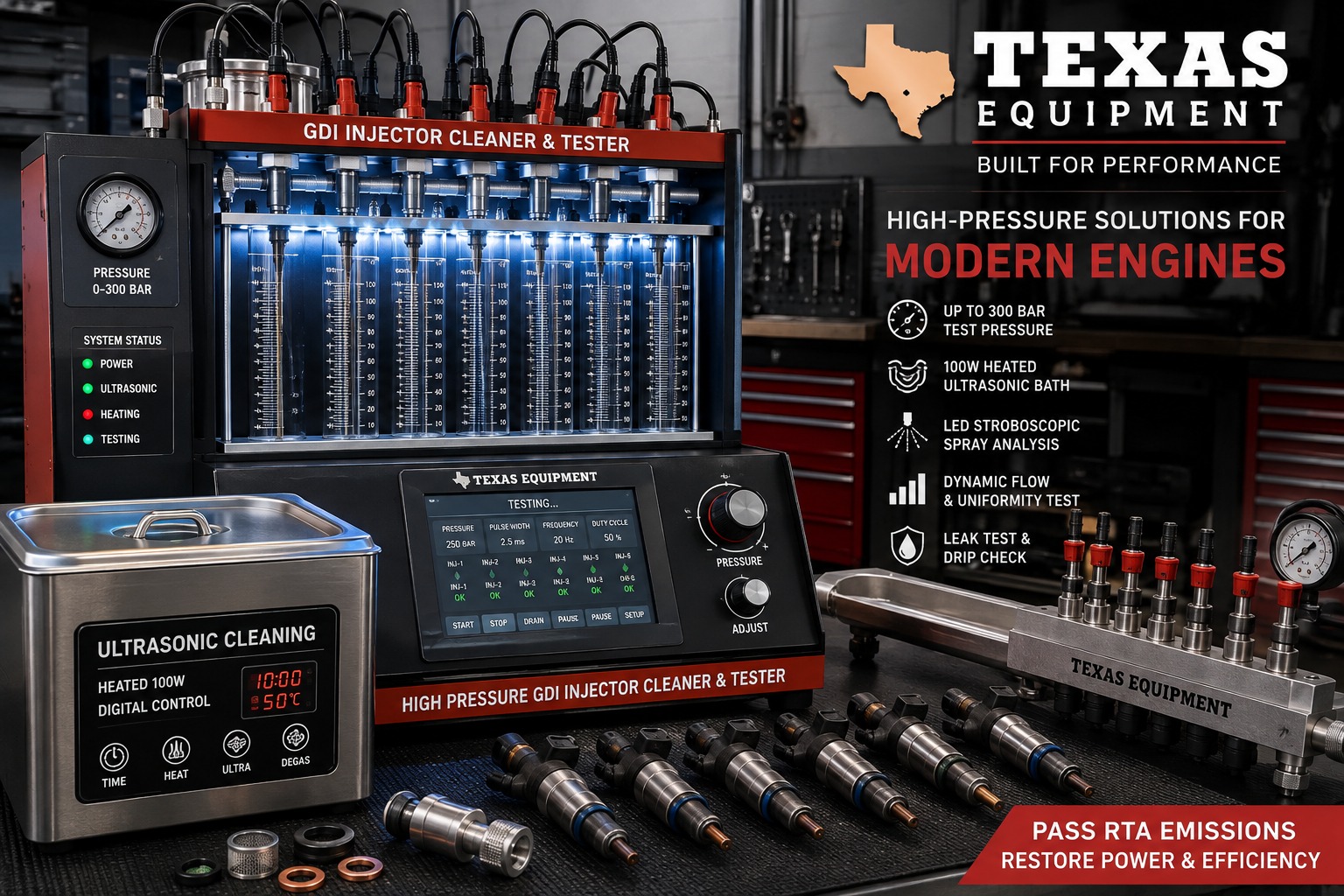
Investing in a dedicated ultrasonic GDI injector cleaner and high-pressure tester allows UAE workshops to diagnose, clean, and flow-test modern direct-injection petrol and diesel injectors at true operating pressures up to 300 bar. Outdated low-pressure test benches designed for older port-injection engines cannot generate the pressure needed to test modern Gasoline Direct Injection (GDI) and Piezo injectors, leading to misdiagnosed misfires, poor fuel economy, and failed vehicle inspections.

Written by: Rajesh Sharma, Technical Service Lead (Automotive Diagnostics)

Over 14 years supporting commercial diagnostic scanners, ECU coding interfaces, and workshop fuel test systems across Sharjah Industrial Areas, Al Quoz, and Musaffah.

GDI Injector Cleaner

Why Direct-Injection Fuel Systems Suffer Heavy Carbon Buildup in the UAE

Modern engines from Ford (EcoBoost), Volkswagen/Audi (TSI/TFSI), BMW, Mercedes-Benz, Hyundai, and Toyota rely on direct fuel injection straight into the combustion chamber. Because fuel is no longer sprayed over the intake valves, fuel detergents cannot wash away oily crankcase vapors.

Combined with severe UAE summer ambient heat, heavy airborne dust, and stop-and-go traffic across Dubai and Sharjah, direct injectors develop severe baked-on carbon deposits on their micro-nozzle tips. Clogged nozzles disrupt the fuel spray cone, resulting in:

  • Rough engine idling and hesitation under heavy air conditioning load.
  • Poor fuel atomization leading to unburned hydrocarbons (HC) and carbon monoxide (CO).
  • Immediate technical inspection rejection at passing centers regulated by the Roads and Transport Authority (RTA).
  • Black exhaust soot and premature catalytic converter degradation.

A specialized high-pressure cleaner and tester allows your technicians to clean stubborn carbon in an ultrasonic bath and verify exact flow balance before reinstalling injectors into the engine.

Comparing Port Fuel Injector Cleaners with High-Pressure GDI Workstations

Choosing the right cleaning bench determines which modern vehicle brands your garage can service. Explore our full range of fuel system equipment on the Texas Equipment machinery store.

Cleaning & Testing Feature Traditional PFI Injector Cleaner Generic Multi-Injector Bench Texas Equipment High-Pressure GDI Workstation Workshop Advantage
Max Testing Pressure 6 to 8 bar (Low pressure) Up to 10 bar Variable 10 to 300+ bar (High pressure) Replicates real in-cylinder combustion pressures
Injector Type Support Standard 12V MPI / PFI only Basic standard injectors GDI, FSI, TFSI, Piezo, & standard 12V Services 95% of modern GCC and import vehicles
Ultrasonic Cleaning Power 50W unheated bath 70W basic tank 100W heated digital ultrasonic chamber Softens and strips hardened carbon in 10 minutes
Spray Pattern Simulation Continuous spray only Basic pulsed spray Multi-angle LED stroboscopic analysis Identifies distorted spray cones and uneven misting
Dynamic Flow Measurement Manual graduated cylinders Basic digital tubes High-precision electronic burette measurement Spots micro-flow imbalances under 2% variance
Average Investment 2,800 to 4,500 AED 6,000 to 9,500 AED 14,000 to 24,000 AED Creates a high-margin daily carbon clean service

5 Practical Steps to Set Up a High-Volume Fuel Service Bay

Step 1: Strip Carbon Using a Heated Ultrasonic Bath

Place clogged injectors into a 100W heated ultrasonic bath filled with specialized carbon-dissolving fluid. Running an ultrasonic pulse cycle for 10 to 15 minutes breaks down baked-on carbon deposits from the nozzle tips and internal needle seats without scratching delicate micro-machined orifices.

Step 2: Test Spray Patterns Under Variable High Pressure

Direct injectors operate at high fuel rail pressures. Test the injectors across varying pressure stages (from 20 bar up to 300 bar) inside an illuminated testing chamber. Use high-speed stroboscopic LED lighting to visually confirm that the multi-hole spray cone is clean, symmetrical, and fully atomized.

Step 3: Run Dynamic Delivery and Uniformity Tests

Mount all four, six, or eight injectors onto the fuel rail manifold. Run a simulated 3,000 RPM dynamic pulse test to measure the exact milliliter delivery across all cylinders. A fuel volume variance greater than 3% between injectors will trigger engine misfire codes and rough idling.

Step 4: Inspect for Micro-Dripping Under Static Hold

Pressurize the rail to maximum operating pressure with the injectors electronically closed. Hold the pressure for 60 seconds and watch the nozzle tips. A dripping injector leaks unburned fuel into cylinders after engine shutoff, causing hard warm starts, crankcase oil dilution, and high tailpipe emissions.

Step 5: Always Replace Teflon Sealing Rings and Micro-Baskets

GDI injectors operate under extreme combustion pressures and require Teflon compression seals at the cylinder head interface. Always replace the internal micro-filter basket and use a dedicated Teflon seal resizing tool before pushing the injectors back into the engine block.

Frequently Asked Questions

Can a standard low-pressure injector cleaner test GDI injectors safely?

No. Standard bench testers only produce 6 to 8 bar of pressure and drive injectors with continuous 12V power. GDI injectors require high-pressure fuel circuits and precise pulse-width modulation (PWM) peak-and-hold driver signals. Testing GDI units on standard 12V benches can burn the internal electromagnetic coils.

How does cleaning GDI injectors help vehicles pass RTA emissions testing?

Clogged or dripping injector nozzles cause incomplete fuel combustion, releasing raw unburned fuel into the exhaust. Cleaning the injectors restores optimal air-fuel atomization, dropping hydrocarbon (HC) and carbon monoxide (CO) levels well below RTA passing limits.

Why is an ultrasonic heated bath required instead of in-tank chemical additives?

In-tank chemical additives cannot clean the severe carbon baked onto direct injector tips because the deposits are exposed to direct combustion flame heat. Heated ultrasonic agitation physically vibrates the carbon loose without damaging internal micro-valves.

Where can I get replacement Teflon seals, filter baskets, and adaptors in Sharjah?

Texas Equipment stocks genuine injector rebuild kits, universal GDI rail adaptors, replacement ultrasonic transducers, and calibration fluids at our main warehouse in Sharjah Industrial Area 2 for immediate collection or same-day dispatch.

Equip Your Workshop with Texas Equipment UAE

Expand your diagnostic and engine service capabilities with certified high-pressure GDI injector cleaning benches, ultrasonic tanks, smoke leak testers, and fuel pressure gauges backed by on-site technician training across Dubai, Sharjah, and Abu Dhabi.

  • Sharjah Head Office & Showroom: Shop #15 BMW Road, Industrial Area 2, Sharjah.
    Landline: +971 6 552 9860 | WhatsApp / Mobile: +971 54 320 1243
  • Abu Dhabi Musaffah Branch: M9 6th Street, Musaffah Industrial Area, Abu Dhabi.
    WhatsApp / Mobile: +971 50 409 4965

Visit the Texas Equipment Contact Page to speak directly with an equipment specialist and book a live injector testing demonstration.

3D Wheel Alignment Machine for Modern UAE Garages: Setup and Alignment Guide

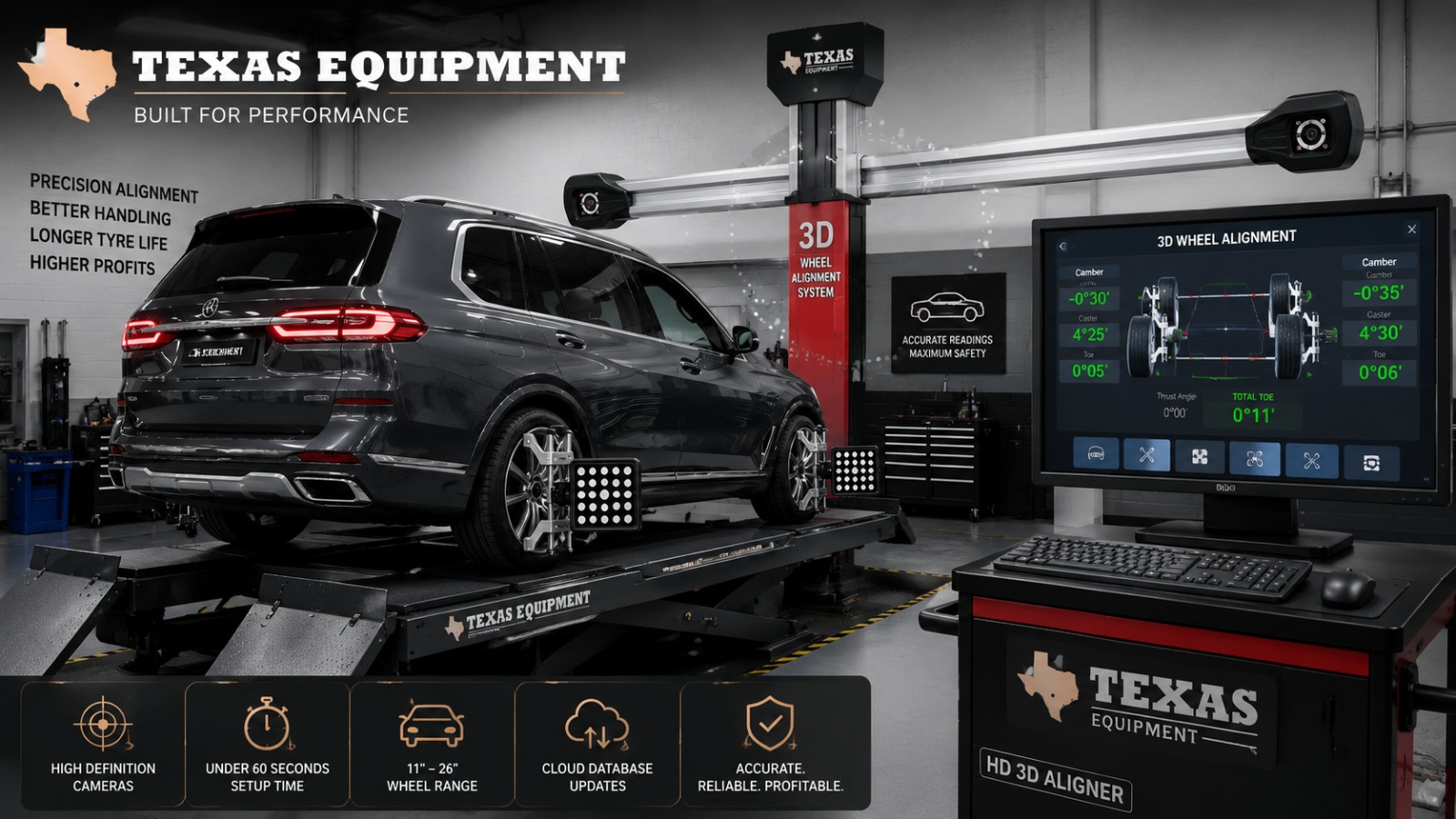
Investing in a high-precision 3D wheel alignment machine allows UAE workshops to eliminate high-speed highway vibrations, prevent uneven tyre wear, and pass strict annual RTA vehicle inspections. Traditional laser string gauges and outdated CCD sensors take too long to calibrate, suffer signal loss from workshop lighting, and fail to measure modern long-wheelbase SUVs accurately.

Written by: Tariq Mansoor, Senior Workshop Installation Specialist

Over 12 years outfitting commercial automotive workshops across Sharjah Industrial Area 2, Al Quoz, and Musaffah.3D Wheel Alignment Machine


Why High-Speed UAE Driving Demands Precision 3D Wheel Alignment

Vehicles in Dubai, Sharjah, and Abu Dhabi regularly cruise at highway speeds between 120 km/h and 140 km/h on routes like Sheikh Zayed Road (E11) and Mohamed Bin Zayed Road (E311). At these speeds, a steering misalignment of just 0.5 degrees creates noticeable vehicle pull, steering wheel off-center errors, and dangerous high-speed lane drift.

Combined with extreme summer road temperatures that exceed 60°C, improper camber or toe settings will scrub off the inner shoulder of a tyre in less than 5,000 kilometers. When vehicle owners take their cars for registration renewal, inspection centers regulated by the Roads and Transport Authority (RTA) reject cars showing uneven tyre wear, tracking misalignment, or loose steering geometry.

Adding a dedicated 3D wheel alignment bay allows your garage to turn a standard oil service into a high-margin steering geometry alignment package in under 10 minutes.

Comparing Outdated CCD Systems with High-Definition 3D Wheel Alignment Machines

Selecting the right alignment technology determines your daily vehicle throughput and measurement reliability. Explore our complete alignment lineup on the Texas Equipment machinery store.

Alignment Feature Traditional CCD Sensor System Standard 2-Camera 3D Aligner Texas Equipment High-Definition 3D Aligner Workshop Advantage
Measuring Technology Battery sensor heads on wheels Dual CMOS cameras Multi-camera high-resolution optical arrays No electronics on wheels; drop-proof targets
Setup & Runout Time 10 to 15 minutes (Jack & turn) 3 to 5 minutes Under 60 seconds (Short rolling runout) Aligns 4 times more vehicles per shift
Wheel Clamp Range 13 to 20 inches 13 to 22 inches 11 to 26 inches (Rim-claw & tyre clamps) Fits low-profile sports rims & heavy 4x4s
Lighting Interference Sunlight & lamps cause errors Low sensitivity Immune to ambient workshop light & glare Works reliably in open-door Gulf workshops
Vehicle Database Limited / Manual entry Annual manual update Cloud-synced GCC, USA, and Euro database Identifies exact specs for imported cars
Average Investment 12,000 to 18,000 AED 22,000 to 32,000 AED 32,000 to 52,000 AED Generates immediate, high-margin daily profits

5 Practical Steps to Set Up a 3D Wheel Alignment Bay

Step 1: Laser-Level the Lift or Alignment Pit

A 3D wheel alignment system measures micro-angles relative to the vehicle plane. Your 4-post alignment lift or scissor lift runways must be level within 1 mm from front to back and side to side. Texas Equipment installation engineers use precision optical levels to calibrate runway slip plates and turn tables during setup.

Step 2: Mount High-Definition Optical Target Clamps

Old-school electronic sensor heads have delicate internal circuit boards and batteries that break if dropped by a technician. Modern 3D alignment systems use lightweight, passive target boards containing zero electronic parts. Technicians mount them securely using non-marking claw clamps that grip the tyre rubber instead of scratching painted alloy rims.

Step 3: Run a Short Push-Pull Rolling Runout

Eliminate the need to jack up each wheel independently to calculate runout. With a 3D alignment system, the technician rolls the vehicle backward and forward by just 20 centimeters. The high-speed digital cameras calculate runout compensation and live caster angles in seconds.

Step 4: Perform Steering Angle Sensor (SAS) Calibration

Modern cars equipped with Electronic Stability Control (ESC) and Lane Keep Assist require the steering angle sensor to match mechanical wheel center. If you adjust front toe without resetting the SAS module through a diagnostic scanner, the traction control warning light will illuminate on the dashboard.

Step 5: Keep Vehicle Alignment Databases Cloud-Updated

The UAE has a wide variety of imported vehicles, including American salvage imports, Japanese domestic models, and long-wheelbase Gulf-spec Nissan Patrols and Land Cruisers. Maintain an active cloud database subscription to access exact factory camber, caster, and toe angle tolerances.

Frequently Asked Questions

Can a 3D wheel alignment machine work with an in-ground service pit?

Yes. Texas Equipment provides custom column stands and wall-mounted camera beam options engineered specifically for service pits, 4-post alignment lifts, and heavy-duty in-ground scissor lifts.

What causes steering wheel off-center complaints after wheel alignment?

Steering wheel crookedness happens when technicians adjust toe angles without locking the steering wheel at true level, or when the rear axle thrust angle is misaligned before adjusting the front axle.

How often should a 3D wheel alignment camera beam be calibrated?

Because the target plates are passive, the camera beam requires calibration only during initial installation or if the camera support structure is physically moved or struck.

Where can I get replacement turntables and clamp claws in Sharjah?

Texas Equipment maintains a fully stocked parts inventory in Sharjah Industrial Area 2, carrying replacement mechanical turntables, rear slip plates, target boards, and nylon rim protectors for same-day delivery.

Equip Your Workshop with Texas Equipment UAE

Transform your workshop efficiency with certified high-definition 3D wheel alignment systems, alignment scissor lifts, and four-post lifts backed by factory-trained installation engineers.

  • Sharjah Head Office & Showroom: Shop #15, BMW Road, Industrial Area 2, Sharjah.
    Landline: +971 6 552 9860 | WhatsApp / Mobile: +971 54 320 1243
  • Abu Dhabi Musaffah Branch: M9 6th Street, Musaffah Industrial Area, Abu Dhabi.
    WhatsApp / Mobile: +971 50 409 4965

Visit the Texas Equipment Contact Page to speak directly with an alignment specialist and request a tailored bay layout for your garage.

Inverter Spot Welders for Modern Car Collision Repair: UAE Body Shop Guide

Investing in a certified inverter spot welder allows UAE body shops to replicate OEM factory welds on Ultra-High-Strength Steel (UHSS) and pass mandatory insurance repair audits without burning structural chassis panels. Traditional MIG welders and manual gas torches overheat modern vehicle pillars, weakening the metal and causing insurance adjusters to reject the entire structural repair.

Written by: Tariq Mansoor, Senior Workshop Installation Specialist

Over 12 years outfitting commercial automotive workshops across Sharjah Industrial Area 2, Al Quoz, and Musaffah.Inverter Spot Welder


The Hidden Danger of Welding Modern Car Steel with Traditional Tools

Modern passenger cars and luxury SUVs no longer use simple mild steel. To increase passenger safety and reduce curb weight, global automakers build B-pillars, rocker panels, and roof structures out of Ultra-High-Strength Steel (UHSS) and Boron Steel.

These advanced alloys are engineered with a delicate heat treatment. When a collision repair technician uses an old-school MIG welder or oxyacetylene torch, the prolonged heat destroys the steel’s molecular structure. This creates a wide “Heat-Affected Zone” (HAZ) where the metal becomes brittle and loses up to 50% of its structural tensile strength. The next time that vehicle is involved in an accident, the pillar can fracture rather than absorb impact energy.

Under structural roadworthiness codes enforced by the Ministry of Industry and Advanced Technology (MoIAT), collision repair facilities must adhere to OEM structural integrity mandates. Insurance adjusters across Dubai, Sharjah, and Abu Dhabi routinely inspect chassis repair joints. If they find uneven heat damage or sloppy puddle welds instead of clean factory-style resistance spot welds, they will reject the claim and hold the workshop liable.

Comparing Traditional Welders with Smart Inverter Resistance Spot Welders

Upgrading to an automated inverter resistance spot welder ensures your body shop can handle high-strength steel and structural panel bonding safely. Review our complete range of collision repair tools on the Texas Equipment Body Shop Equipment store.

Welding Feature Traditional MIG / MAG Welder Generic Manual Spot Welder Texas Equipment Smart Inverter Spot Welder Body Shop Advantage
Welding Current Type AC Continuous Arc Low-Frequency AC Medium-Frequency Direct Current (MFDC) Delivers precise energy without heat warping
Current Output 180A to 250A continuous Up to 8,000A AC Up to 14,000A to 15,000A DC Welds through three thick structural sheets easily
Pneumatic Squeeze Force None (Manual clamps) 150 to 250 daN High-pressure 500 to 600+ daN C-Arm Pushes structural adhesives aside before current fires
Material Compatibility Mild steel only Standard thin sheet Boron, UHSS, HSS, and Automotive Aluminium Meets strict repair guidelines for European & GCC cars
Smart Material Detection None (Manual guess) Manual timer setting Fully automated sheet thickness & resistance sensing Eliminates operator guesswork and burn-through
Average Equipment Cost 3,500 to 6,000 AED 12,000 to 18,000 AED 28,000 to 48,000 AED Recovers cost quickly through premium insurance approvals

5 Practical Steps to Set Up a Compliant Collision Repair Bay

Step 1: Ensure High Squeeze Force to Displace Structural Glues

Modern vehicle panels are joined using structural epoxy adhesives combined with spot welds. A high-grade inverter spot welder features heavy-duty pneumatic C-arms that apply up to 600 daN of clamping pressure. This force squeezes the uncured adhesive out of the contact zone so bare metal touches bare metal before the electrical current fires.

Step 2: Configure Dedicated 3-Phase Industrial Power

Industrial resistance spot welders pull short, massive bursts of electrical current (up to 15,000 Amps at the welding tips). Ensure your body shop has a dedicated 380V, 3-phase connection backed by a 63A or 80A industrial motor breaker to prevent nuisance tripping during high-load structural pulses.

Step 3: Install an Active Water-Cooling System

Summer temperatures in UAE workshops regularly exceed 45°C. High duty-cycle welding on multi-panel B-pillars overheats standard copper electrode arms quickly. Choose an inverter spot welder with built-in liquid cooling that circulates water directly to the electrode tips, preventing tip mushrooming and joint contamination.

Step 4: Keep Traceable Weld Logs for Insurance Adjusters

Modern smart welders monitor voltage, current, and metal resistance in real time. If a weld fails to meet required fusion depth (due to paint residue or improper clamping), the machine sounds an error tone and logs the failure. You can export these weld records via USB to give insurance surveyors irrefutable proof of factory-grade repair quality.

Step 5: Equip Technicians with Dedicated Aluminium Dents Pulling Stations

Never mix steel and aluminium repair tools in the same physical bay. Airborne steel dust settling on bare aluminium causes galvanic corrosion that bubbles under new paint within months. Set up a separate dent-pulling station equipped with dedicated capacitive discharge stud welders for aluminium panels.

Frequently Asked Questions

Why do UAE insurance adjusters reject MIG plug welds on structural pillars?

MIG plug welding generates excessive heat that destroys the temper of high-strength boron steel, creating brittle joints that crack in a collision. Insurance engineers require factory-style resistance spot welds to maintain original crash-test ratings.

Can a smart inverter spot welder weld automotive aluminium?

Yes. With specialized aluminium welding programs and high-current capacitor discharge bursts, premium inverter spot welders from Texas Equipment can weld structural aluminium sheets found in modern Land Rover, Audi, and Ford chassis.

How often should spot welder copper electrode tips be replaced or dressed?

Electrode tips should be dressed with a tip cutter after every 50 to 100 spot welds to maintain the correct tip contact diameter. Replace worn electrodes immediately to ensure consistent current density and prevent poor nugget fusion.

Where can I get replacement C-arms and electrode accessories in Sharjah?

Texas Equipment maintains fully stocked warehouses in Sharjah Industrial Area 2 and Abu Dhabi Musaffah, carrying genuine replacement C-arms, copper electrode tips, cooling fluid, and dent-pulling consumables for immediate delivery across the UAE.

Equip Your Body Shop with Texas Equipment UAE

Upgrade your collision repair facility with certified smart inverter spot welders, digital dent-pulling stations, frame alignment benches, and paint booths backed by on-site technician training across Dubai, Sharjah, and Abu Dhabi.

  • Sharjah Head Office & Showroom: Shop #15 BMW Road, Industrial Area 2, Sharjah.
    Landline: +971 6 552 9860 | WhatsApp / Mobile: +971 54 320 1243
  • Abu Dhabi Musaffah Branch: M9 6th Street, Musaffah Industrial Area, Abu Dhabi.
    WhatsApp / Mobile: +971 50 409 4965

Visit the Texas Equipment Contact Page to speak with a collision repair specialist and book a live welding demonstration.