
Written by Rajesh Sharma, Workshop Systems Lead | Reviewed by Technical Services Division, Texas Equipment UAE
Renting an industrial warehouse in Dubai Al Quoz, Sharjah Industrial Areas, or Abu Dhabi Musaffah represents one of the largest fixed costs for any automotive business. When commercial space costs significant money per square foot, your bay layout directly controls your monthly revenue. If an equipment purchase blocks vehicle movement, prevents technicians from opening car doors, or fails structural building inspections, your investment becomes an expensive obstacle.
Most equipment distributors in the UAE treat vehicle lifts like simple commodity hardware. Their catalogs list maximum lifting tonnage (such as 3.5-ton or 4-ton ratings), show a generic factory photo, and quote a standard delivery price.
What those listings fail to tell you is how the lift interacts with your actual building. They ignore warehouse ceiling heights, clearance under overhead fire sprinkler pipes, concrete slab thickness, and the very real risk of anchor bolt pull-out on older industrial floors.
Understanding these engineering factors before ordering machinery determines whether you should install a clear-floor 2-post lift or a flush-mounted, low-profile scissor lift.
Ceiling Clearance and Vertical Restrictions in UAE Industrial Units
A major operational headache in UAE industrial parks is vertical space. Many commercial warehouses built across Sharjah and Al Quoz feature internal mezzanine storage floors, structural steel roof trusses, or low-hanging fire safety pipes running between 3.2 and 3.6 meters from the ground.
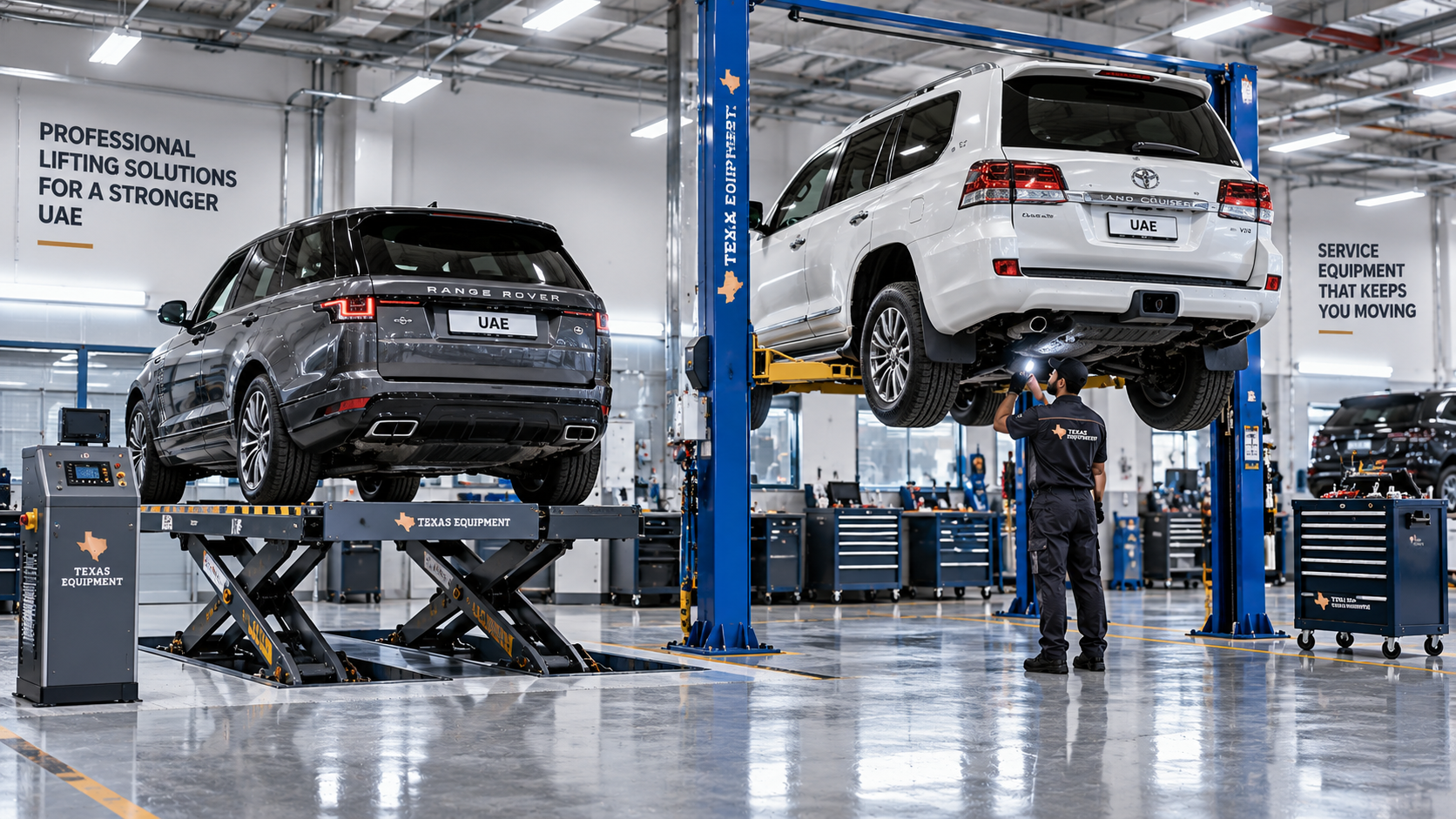
- The 2-Post Clear-Floor Reality: A commercial clear-floor 2-post lift requires a vertical ceiling clearance of 3.8 to 4.2 meters. The rigid overhead crossbeam connects the top of the columns to route hydraulic equalizing cables. If you attempt to install a clear-floor 2-post unit in a bay with a 3.4-meter ceiling, the top beam will collide with roof beams or ductwork. Opting for a floor-plate 2-post lift instead avoids the high beam, but places a raised metal threshold across the floor that trips mechanics and snags rolling oil drainers.
- The Low-Profile Scissor Lift Advantage: A full-rise scissor lift does not use overhead posts or crossbeams. The vertical space required is strictly determined by the height of the vehicle plus the platform’s lifting stroke (typically 1.8 to 1.9 meters). In a warehouse with a ceiling height of just 3.0 to 3.3 meters, a technician can safely raise passenger cars, crossovers, and low-roof vans to a comfortable working level without risking structural roof contact.
Concrete Slab Engineering: Preventing Anchor Bolt Pull-Out
Lift failure almost never occurs because the steel arms snap. It occurs when mechanical floor anchors rip out of the concrete under dynamic load.
A 2-post lift operates on a cantilever principle. When holding a 3-ton SUV like a Nissan Patrol, Toyota Land Cruiser, or Cadillac Escalade, the vehicle weight is concentrated entirely on two narrow vertical columns. This exerts massive upward tensile pulling force on the rear floor anchor bolts.
Before installing a 2-post lift, verify these floor specifications:
- Minimum Slab Thickness: You need at least 150 mm to 200 mm of solid, un-cracked concrete.
- Compressive Strength: The concrete must carry a verified rating of at least 3,000 PSI (C25/C30 industrial mix).
- Expansion Joint Clearances: Anchor bolts must sit at least 150 mm away from any floor cut, joint, or crack.
In many rented Sharjah and Musaffah industrial sheds, warehouse floors consist of thin 100 mm slabs or weak screed poured over loose sand. Drilling heavy mechanical expansion bolts into poor concrete creates micro-fractures. Under the weight of a heavy 4×4, those bolts can shift, tilt, or pull out completely.
In contrast, a low-profile scissor lift distributes vehicle weight downward across two wide, flat steel base channels that run the full length of the platforms (typically 1.5 to 2.0 meters long). Because the downward force spreads over a broad surface area, upward leverage tension on the concrete is practically zero. You only need light locating anchors to prevent platform shift, making scissor lifts far safer for facilities where slab depth cannot be structurally certified.
Bay Width, Door Clearance, and Floor Obstructions
When planning your workshop floor, bay width dictates how smoothly technicians move between tasks:
1. The Column Barrier of 2-Post Lifts
A standard 4-ton 2-post lift has an overall outside column width of 3.4 to 3.6 meters. When placed in a narrow warehouse bay, the heavy steel columns form fixed physical barriers. Technicians must park the car with millimeter precision to ensure the swing arms reach factory lift points. Even then, opening the vehicle doors wide enough to step out without denting the paint against the steel post is difficult in tight spaces.
2. The Open Floor Plan of Flush-Mount Scissor Lifts
In-ground scissor lifts require cutting shallow floor recesses (approximately 110 mm to 120 mm deep) so the steel platforms fold completely flat with the surrounding concrete.
When the lift is down, the bay becomes an entirely flat, barrier-free floor. Technicians can drive vehicles straight through at any angle, roll heavy diagnostic trolleys freely across the bay, or turn the space into an express inspection area without dodging side posts.
3. Surface-Mounted Scissor Lifts and Low-Car Clearances
If digging pits into your warehouse floor is prohibited by your tenancy agreement, surface-mounted scissor lifts bolt directly on top of the concrete.
However, you must check the collapsed drive-over profile. Standard commercial surface lifts stand 105 mm to 115 mm tall when fully lowered and use hinged drive-on approach ramps. If your workshop services sports cars or low-profile luxury sedans, vehicles can scrape their rocker panels or front splitters on tall platforms. Always confirm your lift features low-profile drive-over ramps with an entry angle of 10 degrees or less.
Technical Comparison: 2-Post Lift vs Low-Profile Scissor Lift
| Engineering & Bay Factor | Clear-Floor 2-Post Lift (4 Ton) | In-Ground / Low-Profile Scissor Lift (3.5 to 4 Ton) |
| Minimum Ceiling Height Required | 3.8 to 4.2 meters | 3.0 to 3.3 meters |
| Minimum Bay Width Needed | 3.6 to 4.0 meters | 3.0 to 3.4 meters |
| Floor Anchoring Stress | Extreme upward tension (Cantilever leverage) | Pure downward compression (Distributed weight) |
| Minimum Concrete Thickness | 150 mm to 200 mm (3,000+ PSI required) | 120 mm to 150 mm (Low structural anchor demand) |
| Underbody Accessibility | 100% open from bumper to bumper | Center open; sides obstructed by scissor mechanism |
| Primary Underbody Jobs | Engine drops, gearboxes, long exhaust lines | Brakes, suspension, oil service, tyre changing |
| Vehicle Loading Time | 60 to 90 seconds (Adjust 4 swing arms) | 15 to 20 seconds (Drive straight onto platforms) |
| Floor Space Efficiency | Fixed posts restrict side bay movement | Flush-mount models leave 100% flat floor space |
Matching the Lift to Your Workshop Workflow
Neither lift is universally superior. The correct choice depends entirely on your repair specialism:
Choose a 2-Post Clear-Floor Lift if:
- Your workshop focuses on heavy mechanical repairs, including engine overhauls, automatic transmission removals, and differential replacements.
- You need completely open, unobstructed access along both sides of the vehicle underbody.
- Your warehouse ceiling clears 4.0 meters and your concrete slab has been core-drilled and certified for 3,000 PSI strength.
- You regularly service heavy, extended-chassis commercial pickup trucks and long-wheelbase cargo vans.
Choose a Low-Profile Scissor Lift if:
- Your garage specializes in quick-service maintenance: oil changes, brake disc skimming, suspension bushes, tyre rotations, and wheel alignments.
- Your building has low mezzanine clearance or hanging overhead utilities below 3.6 meters.
- You operate a high-volume express service lane where fast loading and rapid vehicle turnover increase billable hours.
- You rent an older industrial unit where concrete thickness is questionable, or where tenancy contracts prohibit heavy foundation excavation.
Frequently Asked Questions
Can a low-profile scissor lift safely raise large Gulf 4x4s?
Yes. Commercial workshop scissor lifts supplied by Texas Equipment carry verified ratings between 3.5 and 4.5 tons. Platform extensions pull out to support long-wheelbase vehicles like the Nissan Patrol and Toyota Land Cruiser at their designated chassis lifting points.
What is the excavation depth needed for an in-ground flush-mount scissor lift?
Most commercial flush-mounted scissor lifts require a shallow concrete pit between 110 mm and 130 mm deep, along with dedicated perimeter drainage channels and a small conduit pipe to route hydraulic and electrical lines to the wall-mounted control cabinet.
Can I install a 2-post car lift on an existing tiled garage floor?
No. Floor tiles, decorative screeds, and unreinforced topping layers crush easily under load and cause anchor bolts to loosen. Before bolting down a 2-post lift, the floor tiles and loose bedding must be saw-cut away down to the solid, reinforced concrete foundation slab.
What happens if a hydraulic line breaks on a scissor lift?
Commercial scissor lifts utilize pneumatic mechanical safety locks that automatically engage at each step of elevation. In the event of a sudden hydraulic pressure drop, dual mechanical safety ratchets lock the platform in place immediately, preventing any vehicle descent.
Plan Your Workshop Bay Layout with Texas Equipment UAE
Do not risk installation delays, building damage, or unsafe lifting equipment. Texas Equipment provides comprehensive workshop planning across Dubai, Sharjah, and Abu Dhabi. Our technical team conducts on-site bay measurements, ceiling clearance audits, and concrete slab strength assessments before recommending the ideal machinery for your business.
Visit our regional technical facilities to inspect live working demonstration lifts:
- Sharjah Showroom & Technical Centre: Shop #15, BMW Road, Industrial Area 2, Sharjah.
Landline: +971 6 552 9860 | WhatsApp: +971 54 320 1243 - Abu Dhabi Musaffah Branch: M9, 6th Street, Musaffah Industrial Area, Abu Dhabi.
Mobile: +971 50 409 4965
Contact our engineering team today to schedule an on-site workshop layout consultation or request equipment specifications for your upcoming fit-out.